Photos of the Real Alcázar of Seville
Every room and garden of the Alcázar, in real photographs. Each picture says what it shows and links to the guide that explains it.
All 98 photographs are openly licensed works from Wikimedia Commons, with the author and licence under each one. No image on this page is generated or a stock reconstruction.
The palace of Pedro I
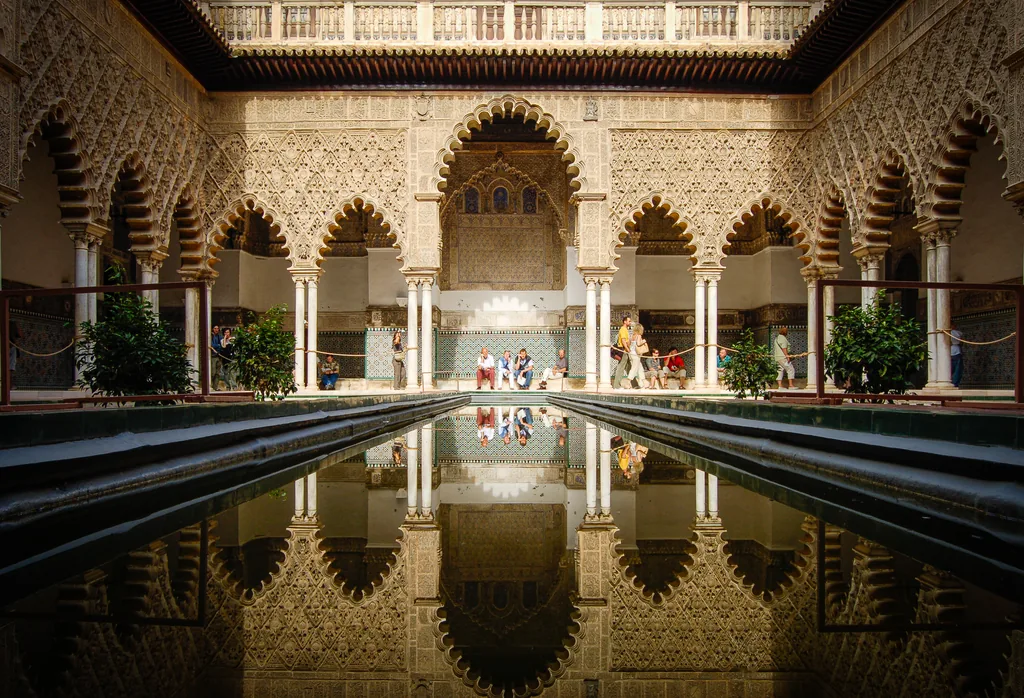
The long pool of the Patio de las Doncellas reflecting the carved arcade above it
A flat marble floor covered this garden for a long time. Stand at the short end of the pool for the reflection.
Read the guide →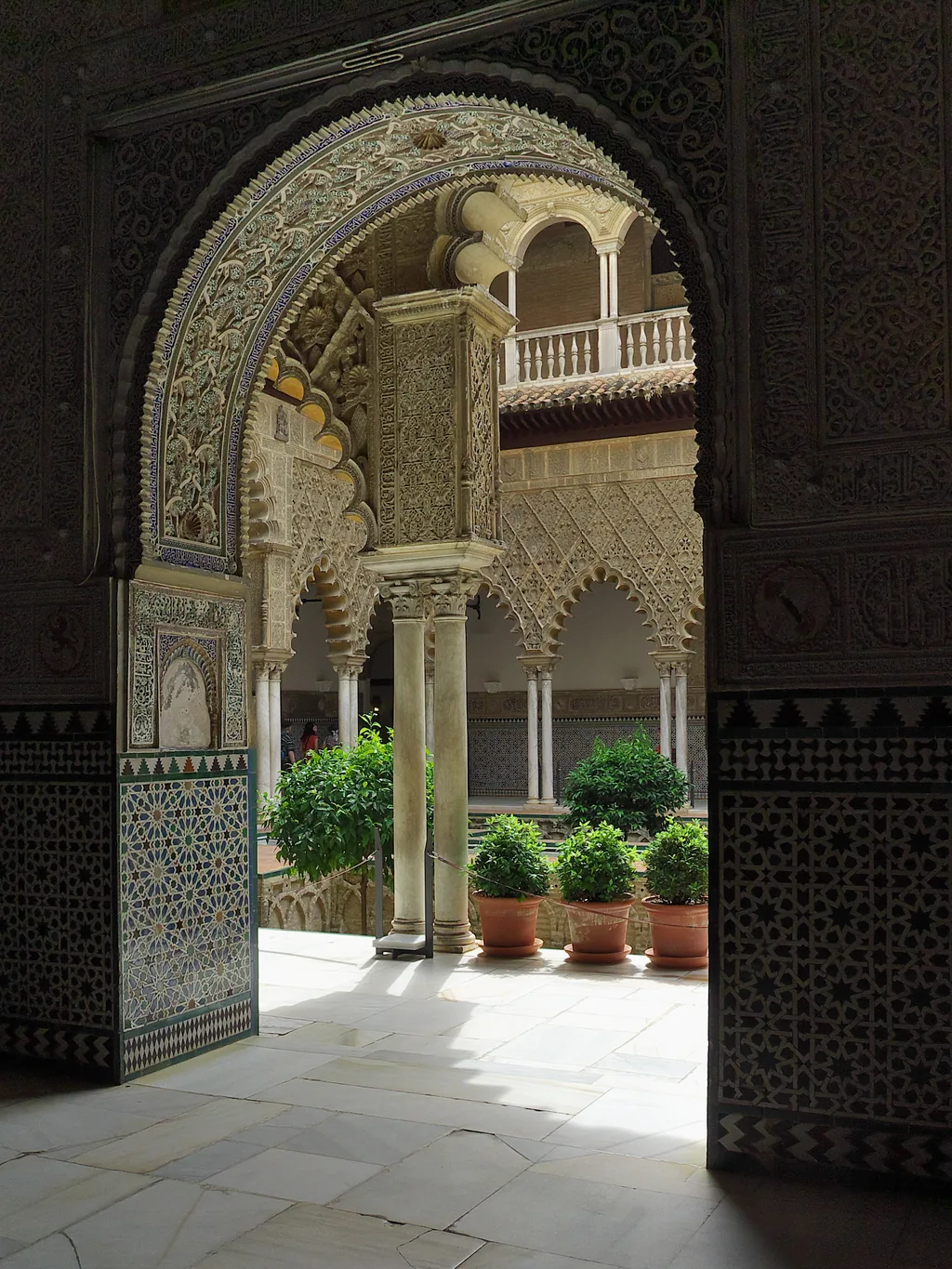
The Patio de las Doncellas seen through a horseshoe arch from a neighbouring room
The palace is laid out so that each room frames the next. It is worth pausing in the doorways.
Read the guide →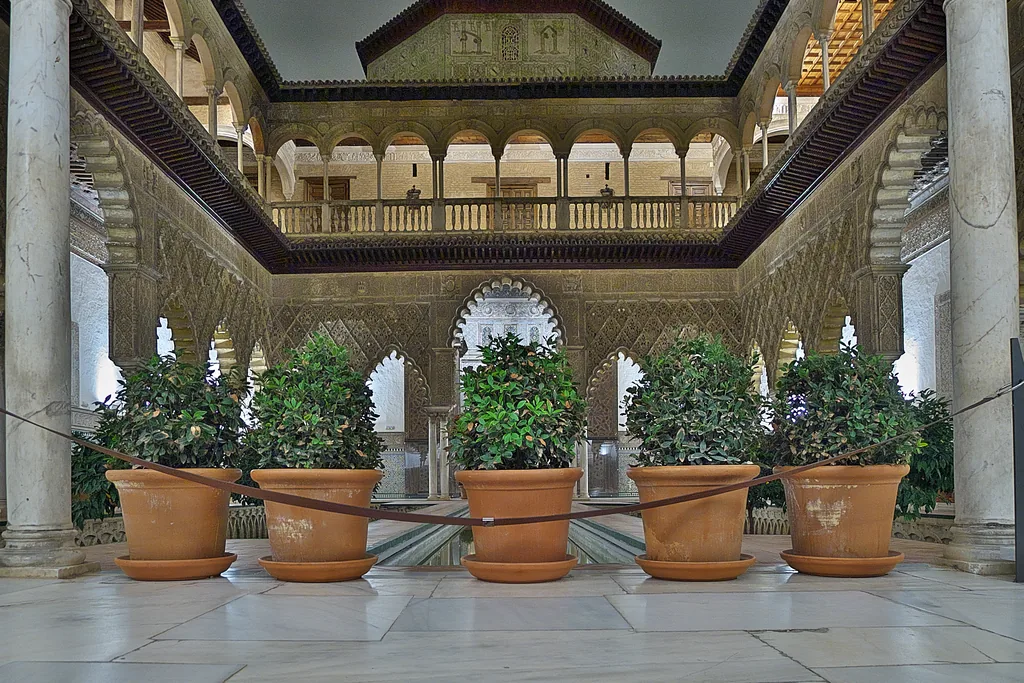
The upper gallery of the Patio de las Doncellas with terracotta pots along the arcade
The upper floor is the Cuarto Real Alto, visited in a timed group on a ticket bought separately.
Read the guide →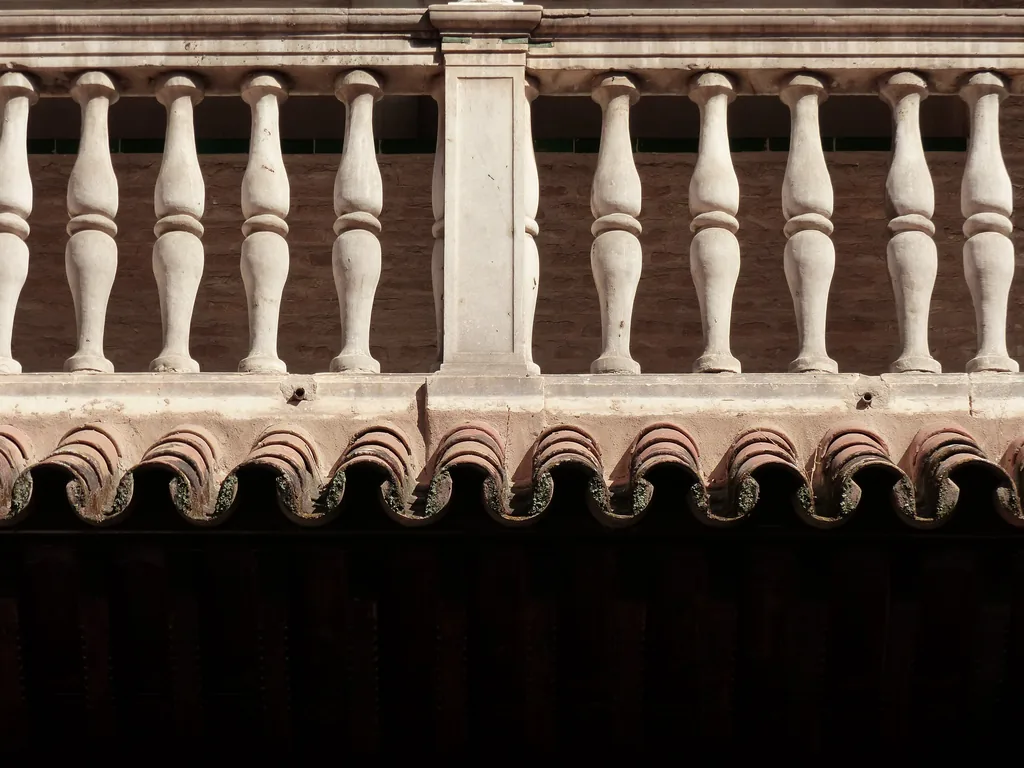
Close view of the marble balustrade and arches of the upper gallery of the Patio de las Doncellas
The upper floor is Renaissance work set on top of the Mudéjar courtyard, which is why the two storeys look so different.
Read the guide →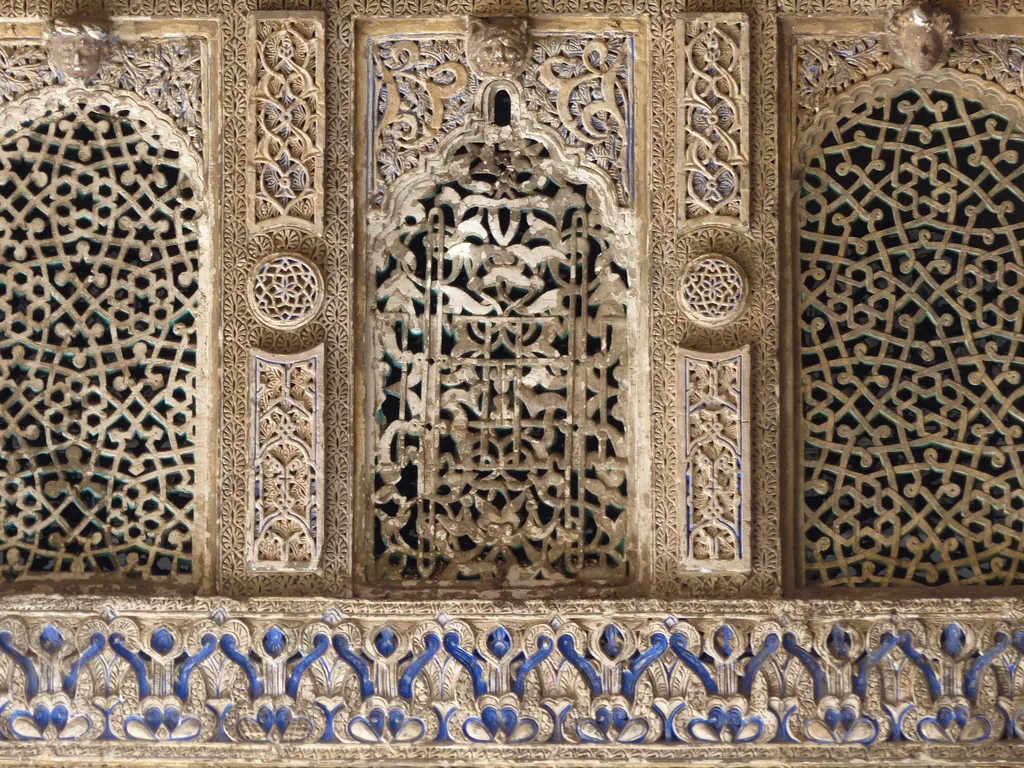
Carved plaster panel above a band of blue and white azulejo tiles in the Patio de las Doncellas
Tile below, carved plaster above: the same order repeats through the whole palace once you start looking for it.
Read the guide →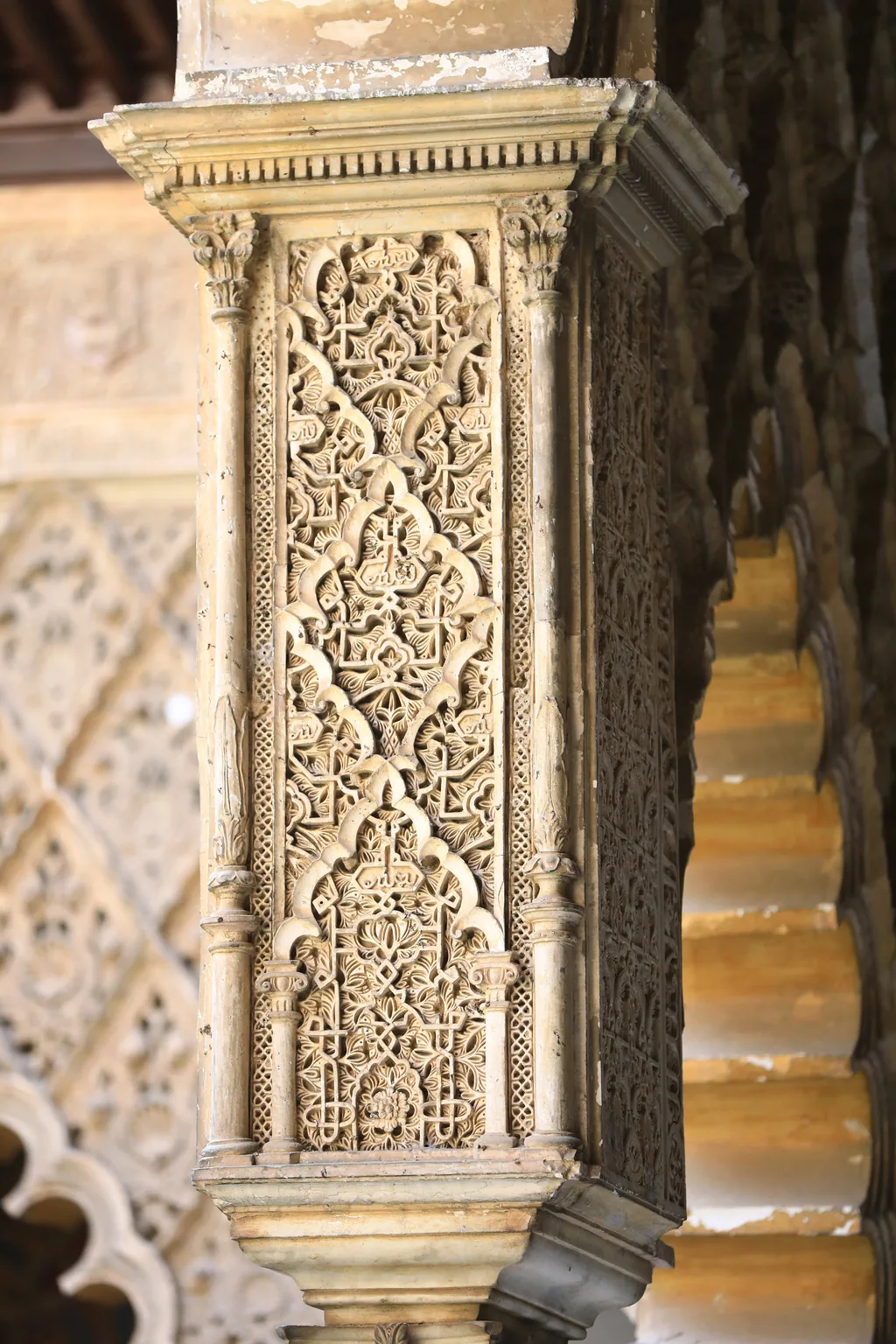
Detail of the deeply carved plaster on a pillar of the Patio de las Doncellas
Look closely and the plaster carries Arabic inscriptions, in a palace built for a Christian king by Muslim craftsmen.
Read the guide →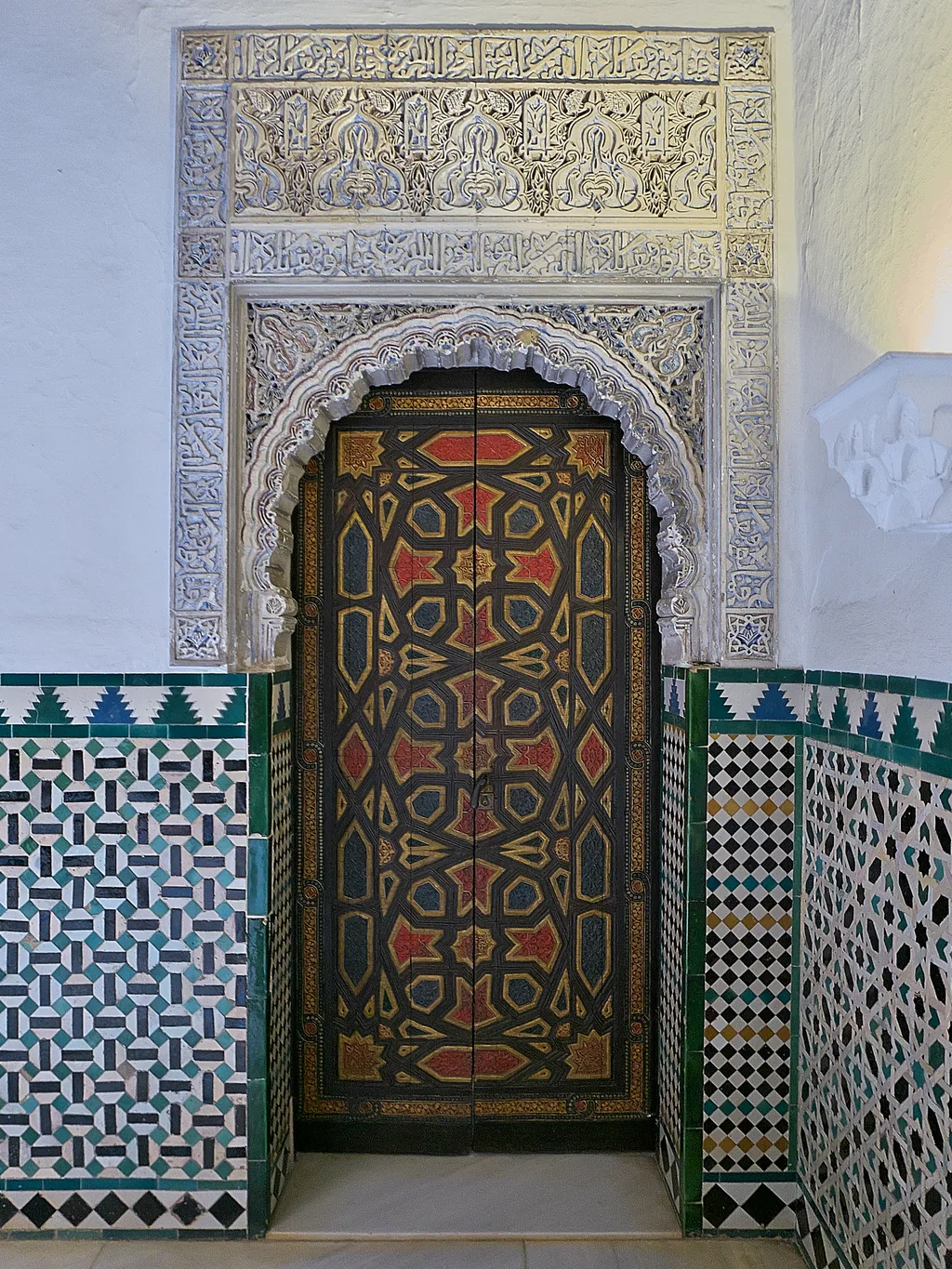
An ornate doorway of the Patio de las Doncellas framed in carved plaster and tilework
Doorways like this are where the crowds bunch up. Let a group pass and you get the frame to yourself.
Read the guide →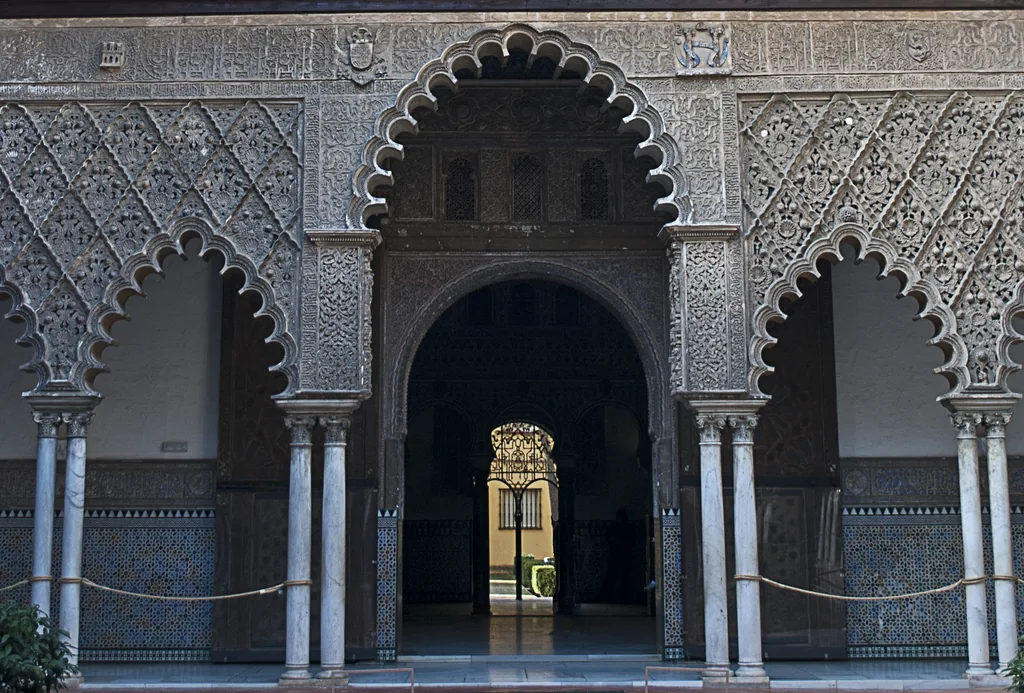
A gilded doorway glowing at the end of a dark arcade in the Palace of Pedro I
The palace is dark between the courtyards, so the bright rooms hit harder when you reach them.
Read the guide →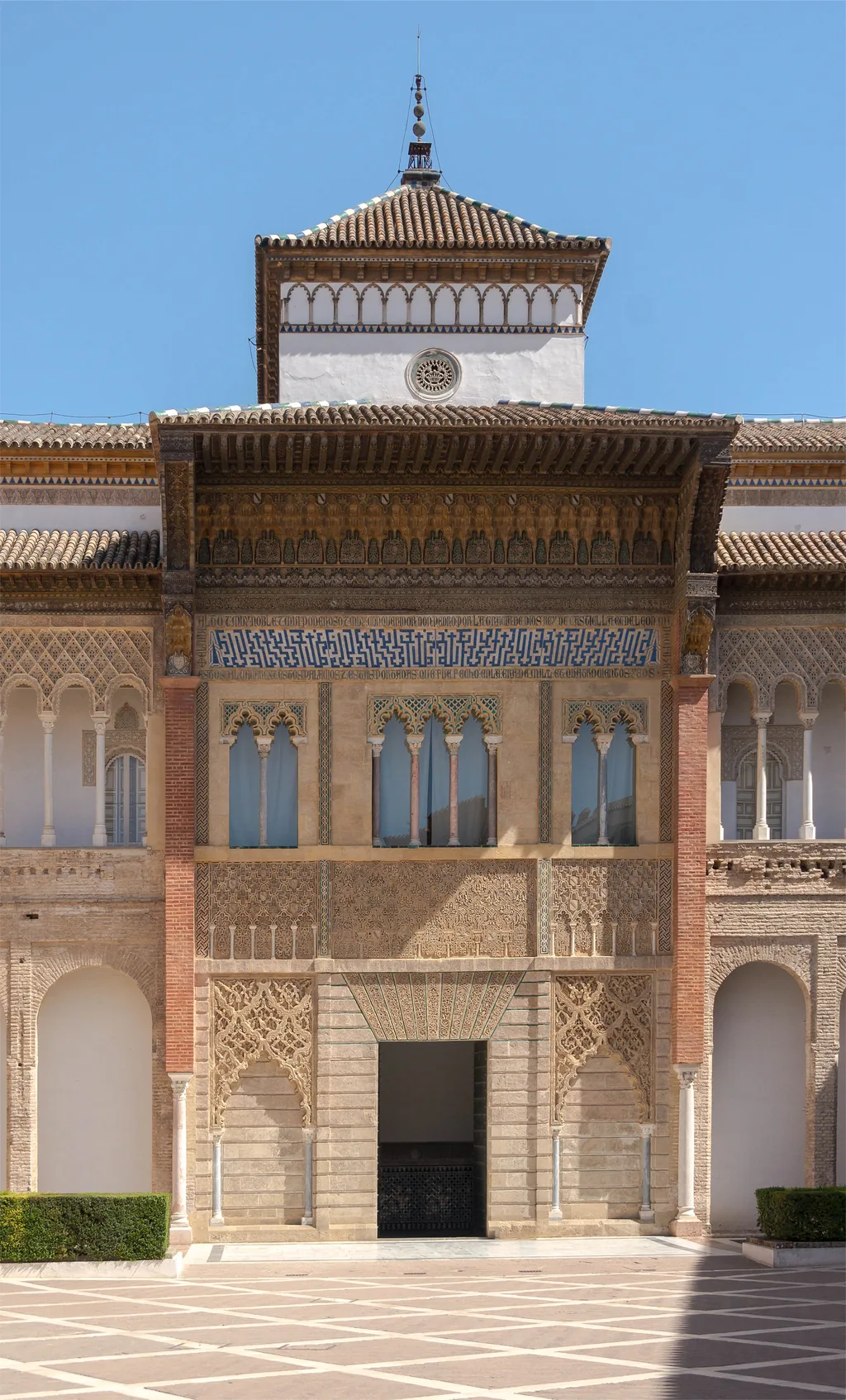
The facade of the Palace of Pedro I with its carved eaves and tiled inscription band
The first thing you see after the ticket check. Stand back across the courtyard before going in.
Read the guide →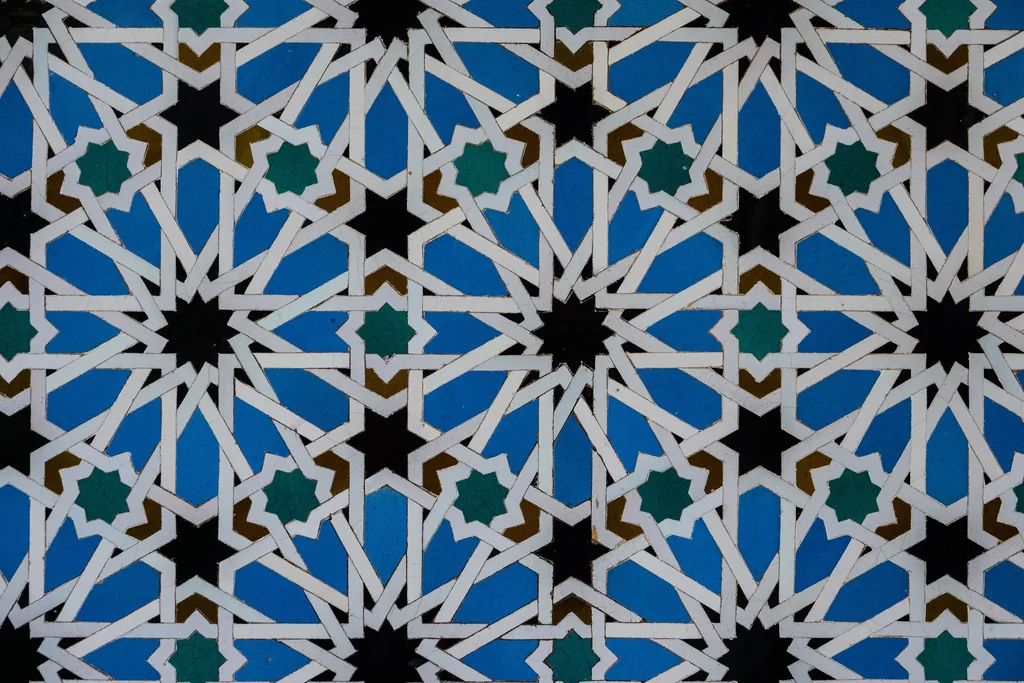
Blue, green and white azulejo tiles laid in an eight-point star pattern
The eight-point star repeats all over the palace. Once you have seen it you will find it in every room.
Read the guide →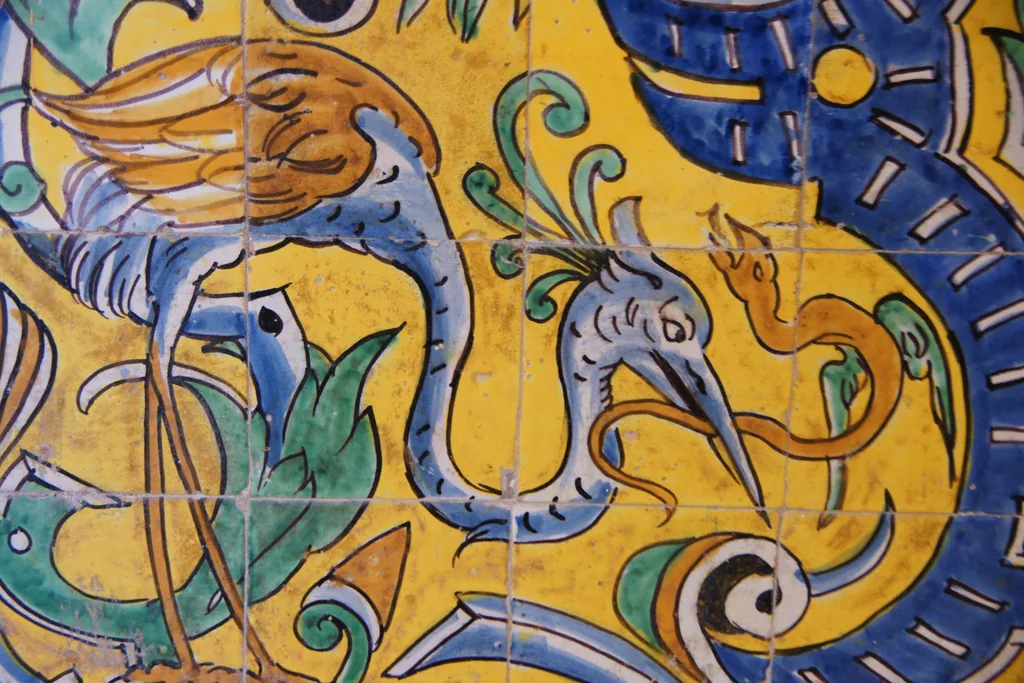
A painted azulejo panel showing a long-necked bird in yellow, blue and green
Later tilework brings in animals and figures, which the earlier geometric panels never do.
Read the guide →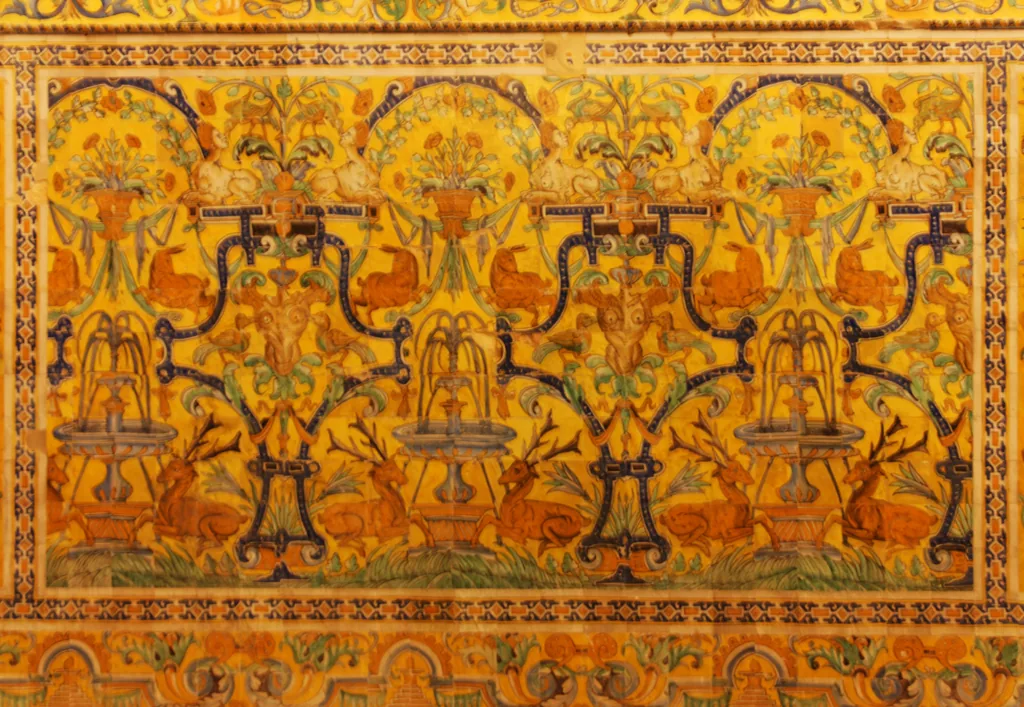
A wall of golden-yellow azulejos with a repeating pattern of urns and foliage
Whole walls are tiled floor to ceiling. The effect is closer to wallpaper than to decoration in panels.
Read the guide →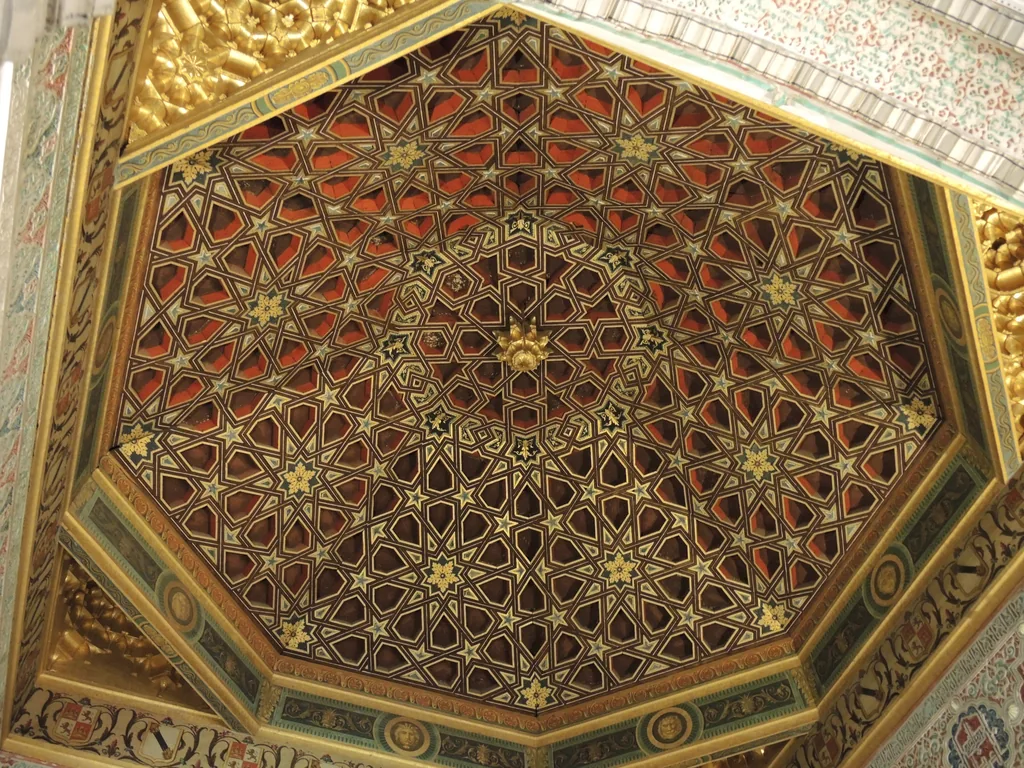
A gilded and painted wooden ceiling in an octagonal pattern of interlacing stars
Look up in every room. Several of the ceilings are better than the walls beneath them.
Read the guide →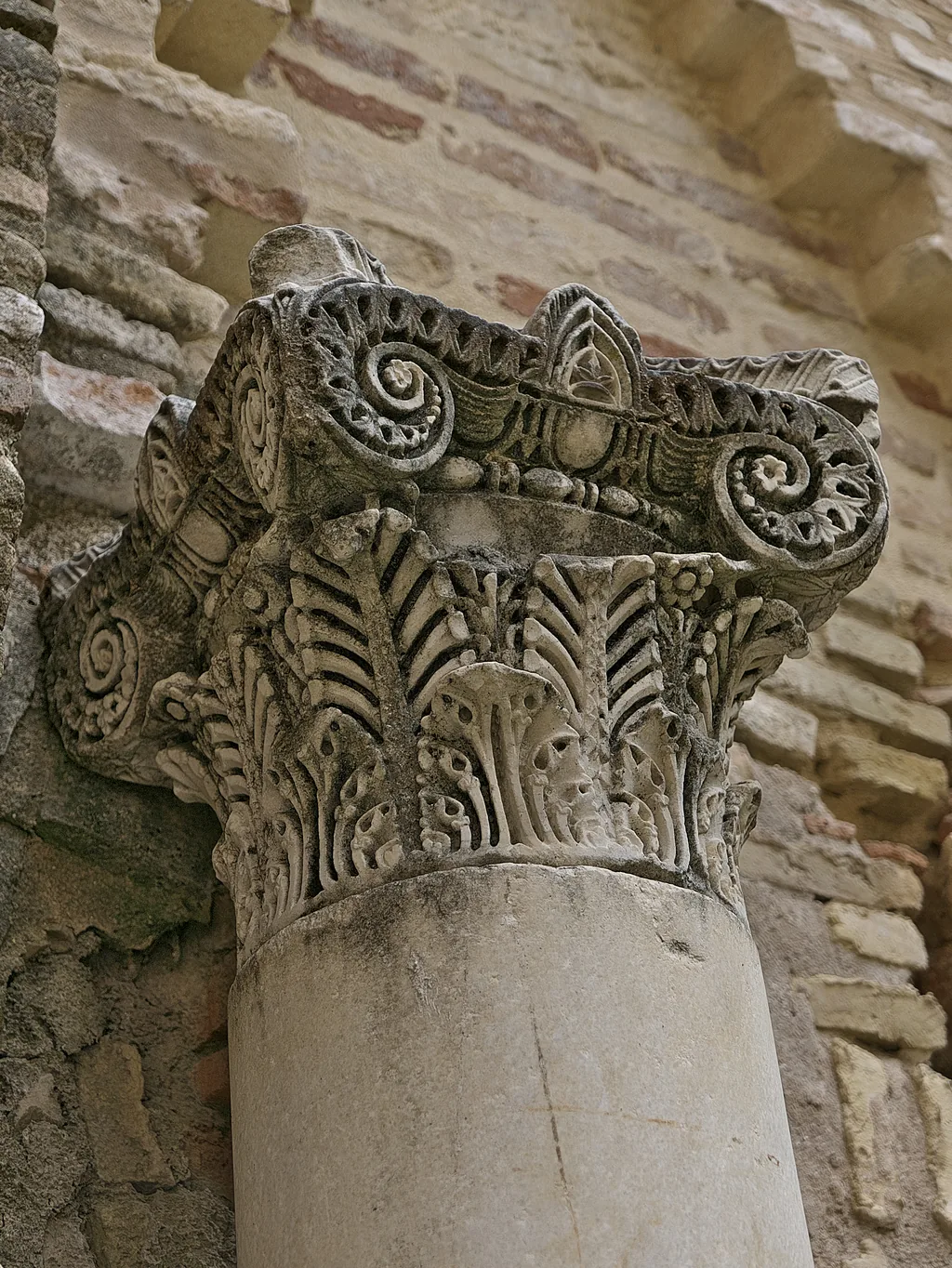
Close view of a deeply carved capital with curling stone foliage
Detail like this rewards a slow walk. Nothing about the route stops you standing still for a minute.
Read the guide →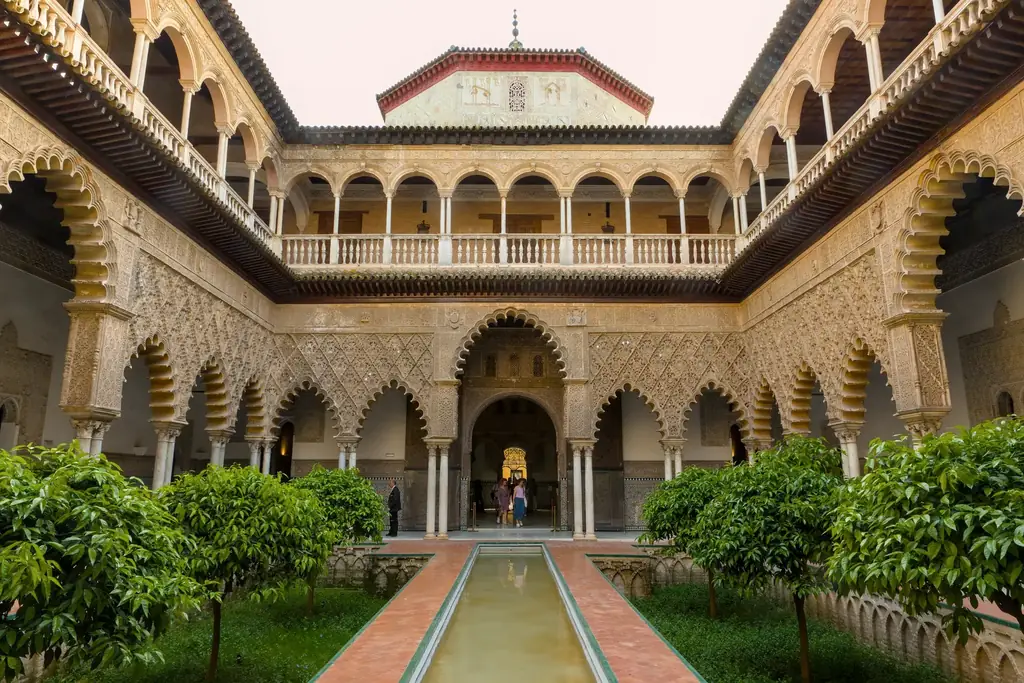
The Patio de las Doncellas seen along its central pool, with orange trees in the sunken beds and carved Mudéjar arches on both sides
The ceremonial courtyard of Pedro I's palace, built in the 1360s. Its sunken garden was paved over for four centuries and uncovered again by the excavations of 2002–2005.
Read the guide →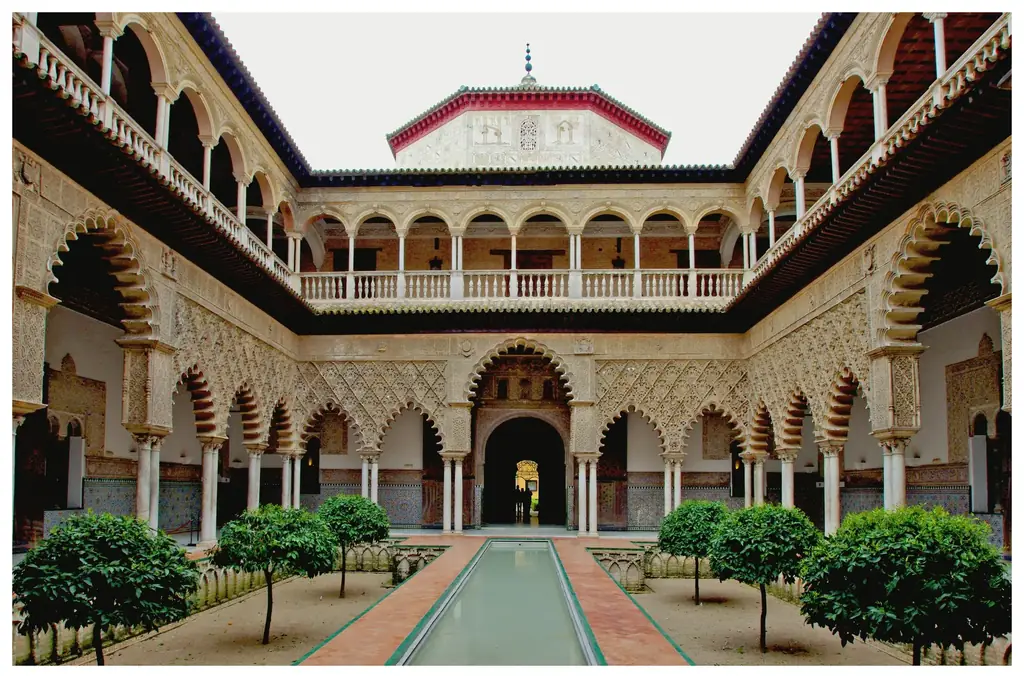
Wide view of the Patio de las Doncellas from the end of the pool, both storeys and the full arcade in frame
The view most visitors photograph. Take the first entry slot at 09:30 if you want the courtyard without a crowd along the water.
Read the guide →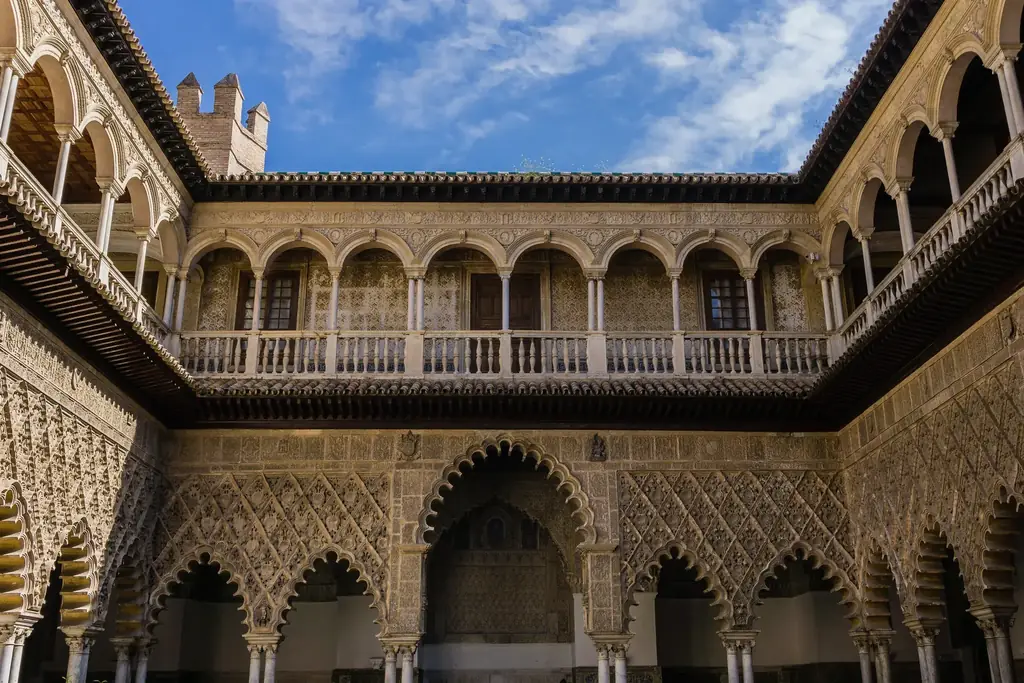
Carved plaster arcade of the Patio de las Doncellas, with the Renaissance upper gallery above the Mudéjar ground floor
Two eras in one courtyard: the polylobed arches below are from the 1360s, the round-arched gallery above was added between 1540 and 1572 by Luis de Vega.
Read the guide →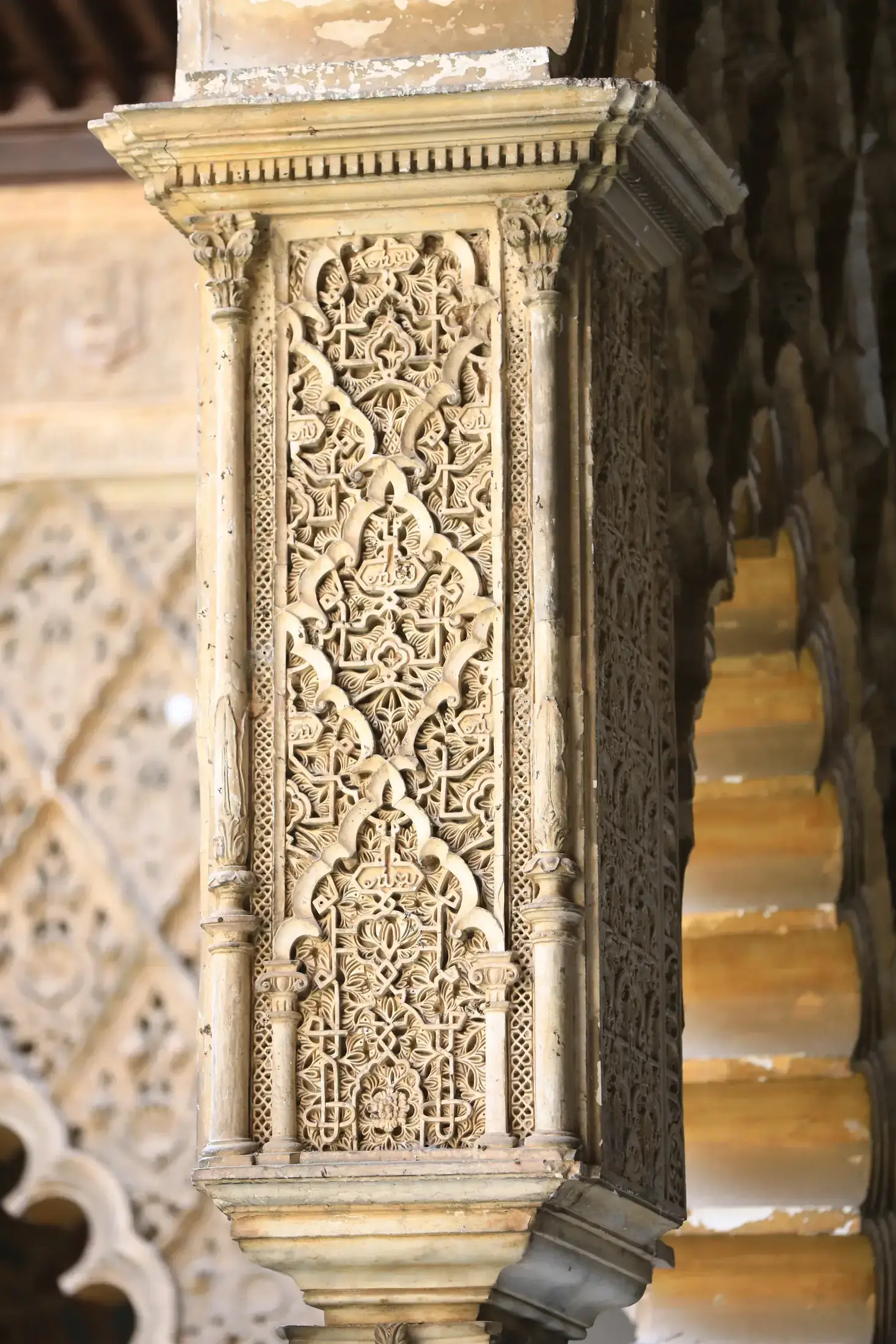
Close view of a carved capital and plaster panel in the Patio de las Doncellas, showing interlacing geometry and Arabic script
The plaster was carved while still soft, then painted. Bands of Arabic calligraphy run through the pattern, and some of them praise Pedro I, a Christian king, as sultan.
Read the guide →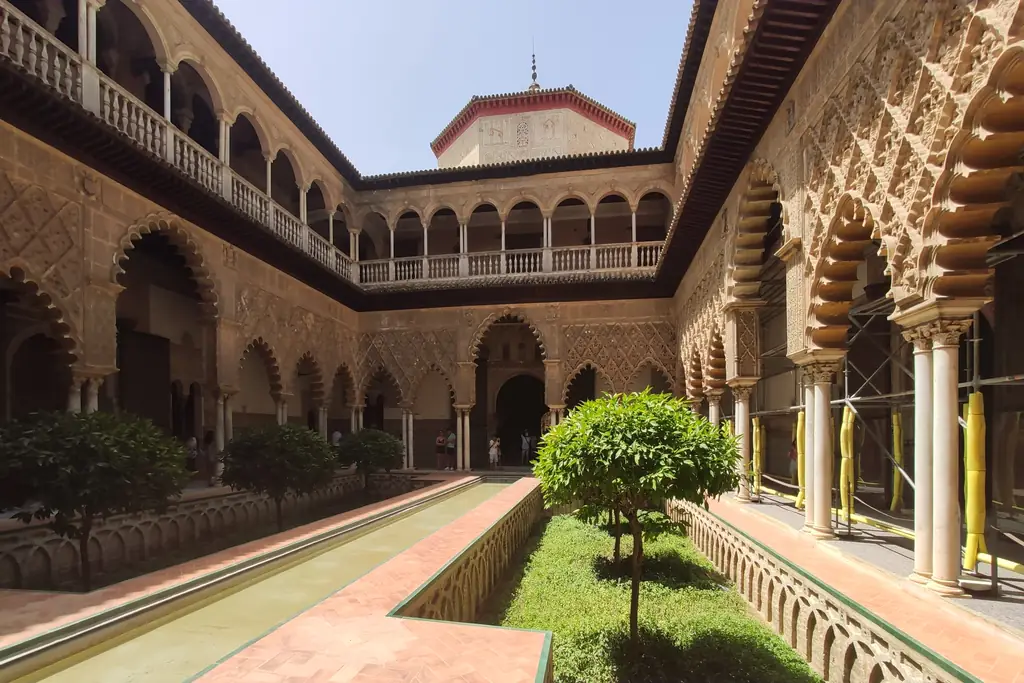
The Patio de las Doncellas: a long sunken pool between orange trees, framed by carved Mudéjar arches
The image most people have in mind when they think of the Alcázar, and the courtyard every route through the palace passes.
Read the guide →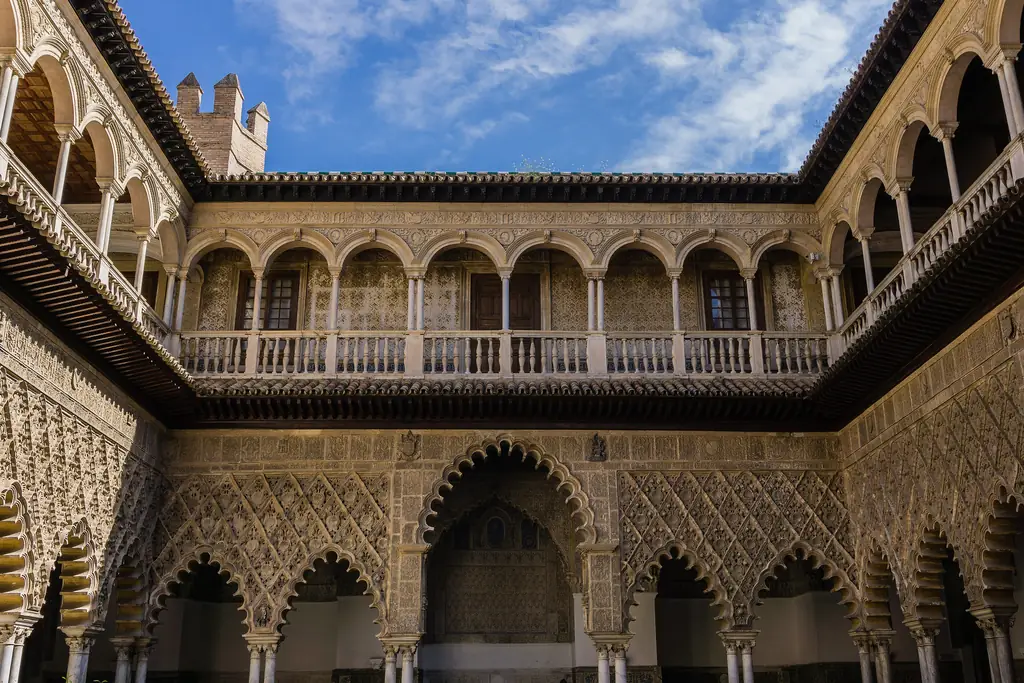
Carved plaster arches and the upper gallery around the Patio de las Doncellas
Look at the band above the arches: geometric lattices, plant scrolls and lines of Arabic script, carved in plaster and once painted.
Read the guide →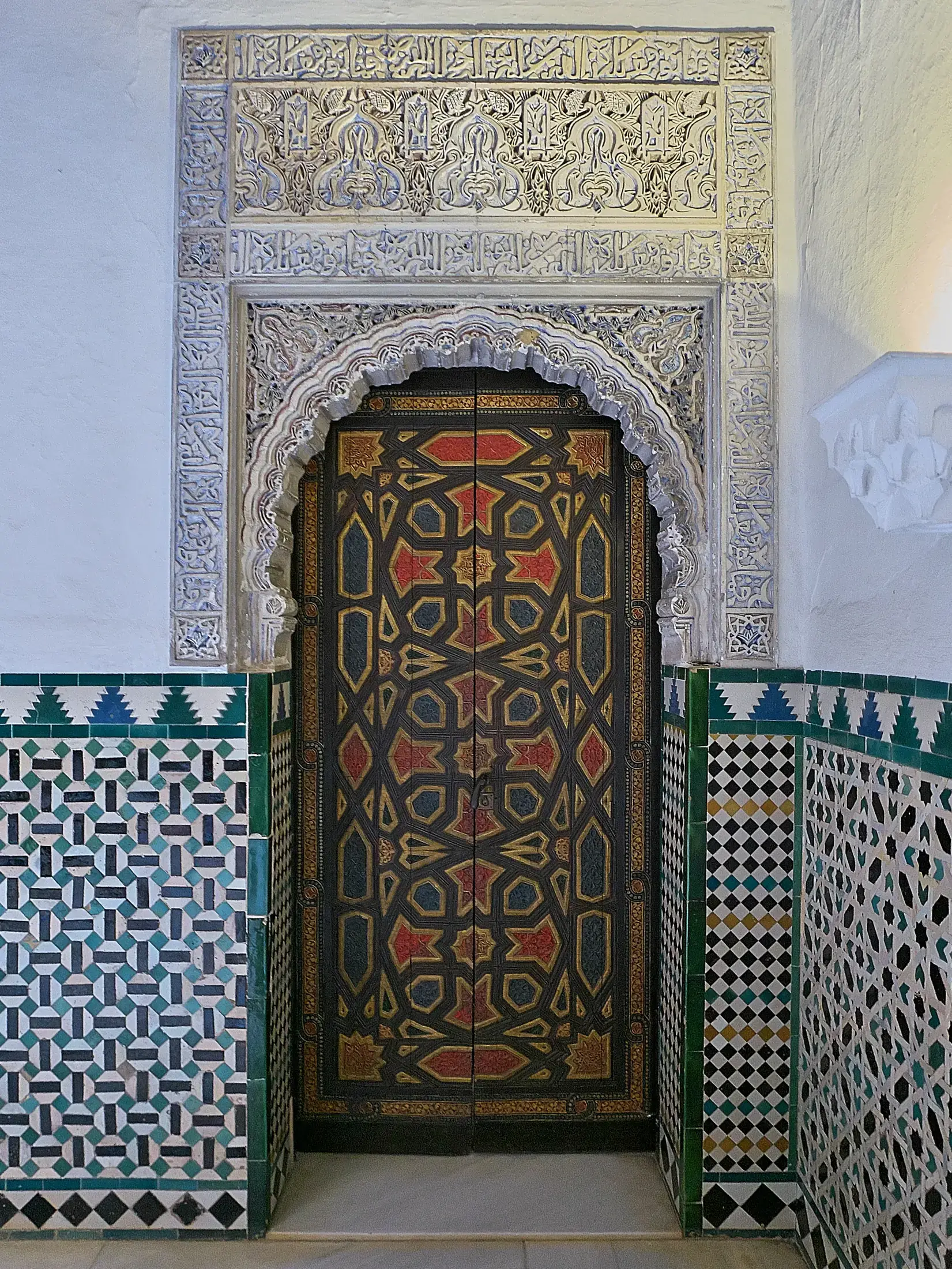
Painted and gilded door of the Patio de las Doncellas, framed by carved plaster above and cut-tile mosaic below
Three materials do all the work in this palace: cut tile at the bottom, carved plaster in the middle, worked wood at the top.
Read the guide →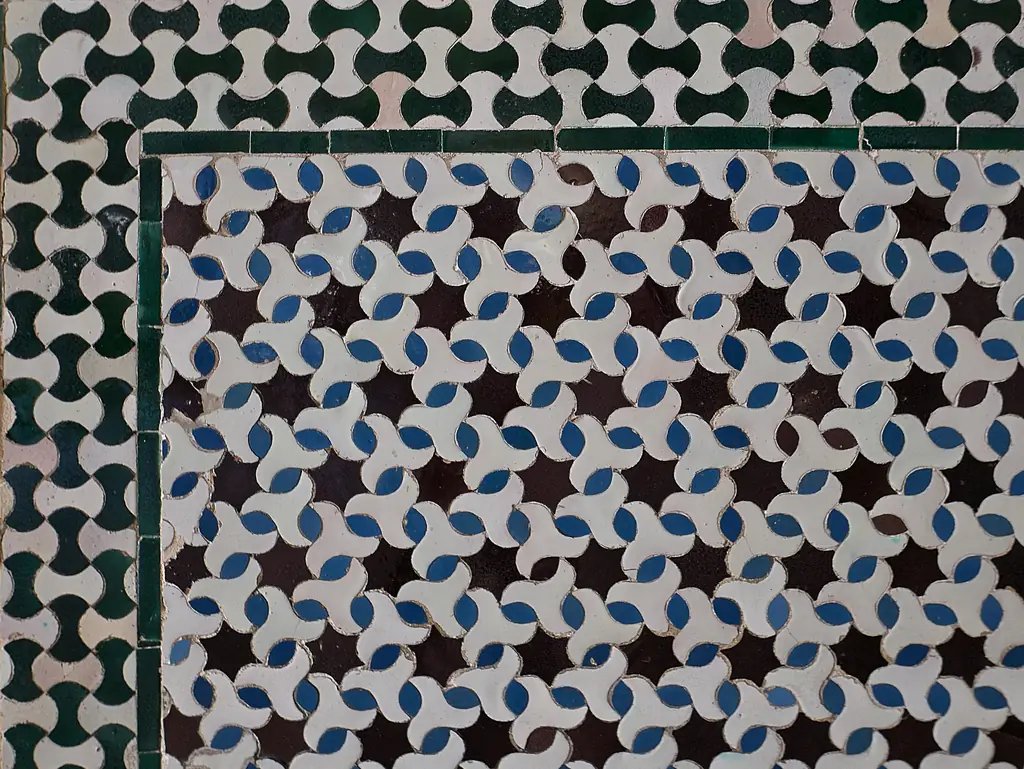
Star-pattern tilework in the Hall of the Ambassadors
Each colour is a separate piece of glazed tile, cut by hand and fitted like a jigsaw. The technique is called alicatado.
Read the guide →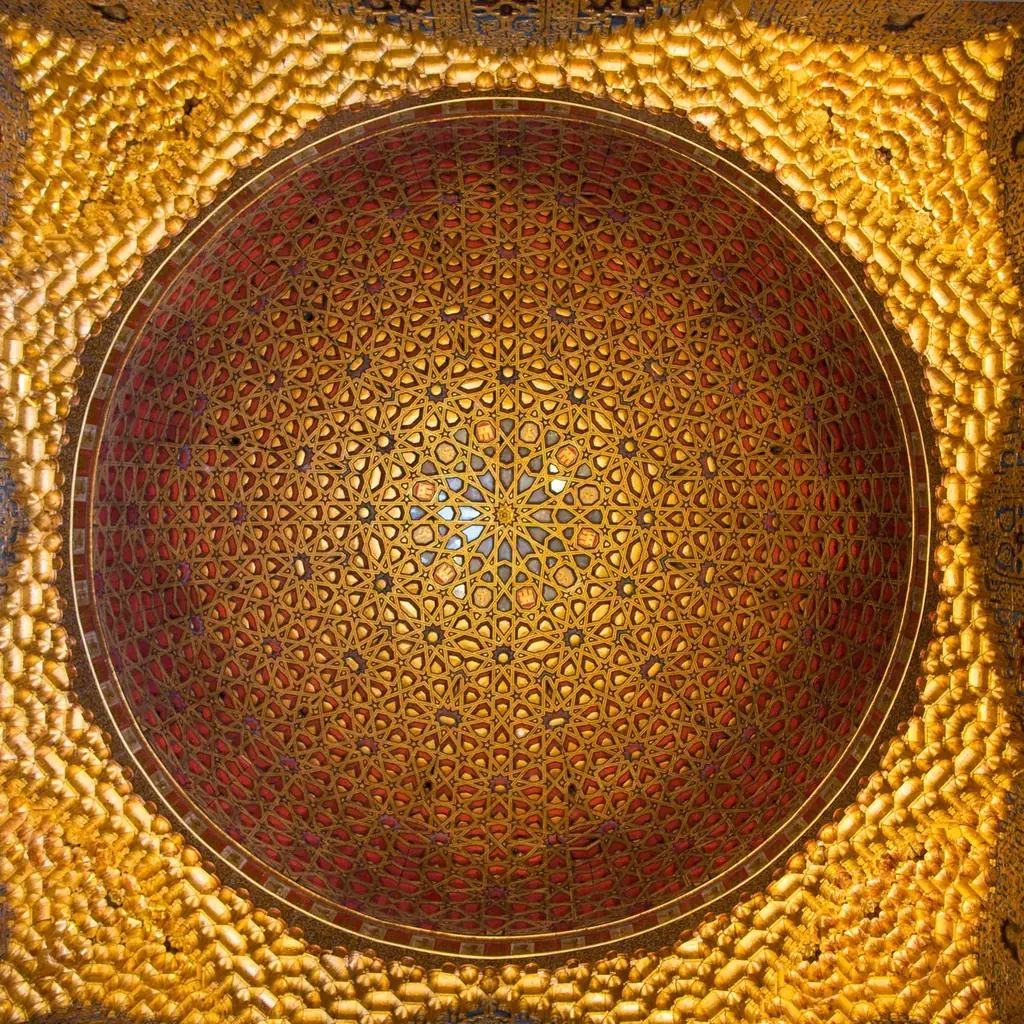
The gilded wooden dome of the Hall of the Ambassadors seen straight from below, its interlaced star pattern radiating from the centre
Rebuilt in 1427 by the carpenter Diego Ruiz, whose name and date run along its base. It is carved and gilded wood, not gold.
Read the guide →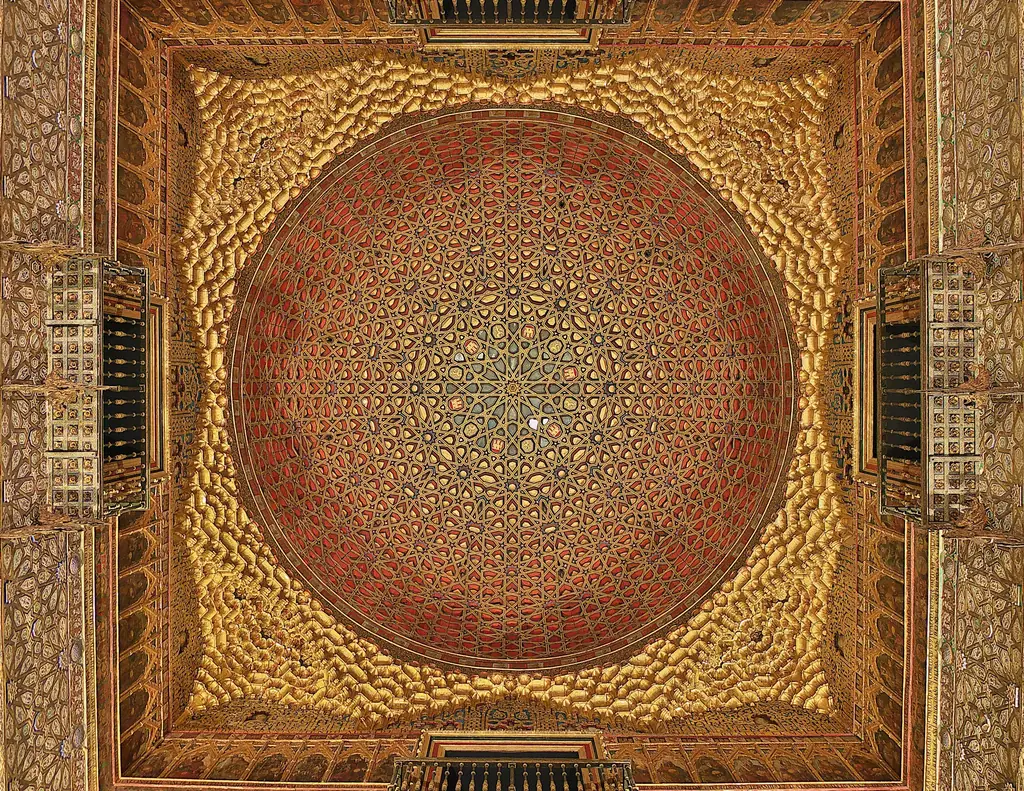
The dome of the Hall of the Ambassadors within its square ceiling, muqarnas filling the corners between square and circle
The room is a qubba, the domed throne hall of Islamic tradition. A Christian king of Castile chose the form for his own audience chamber.
Read the guide →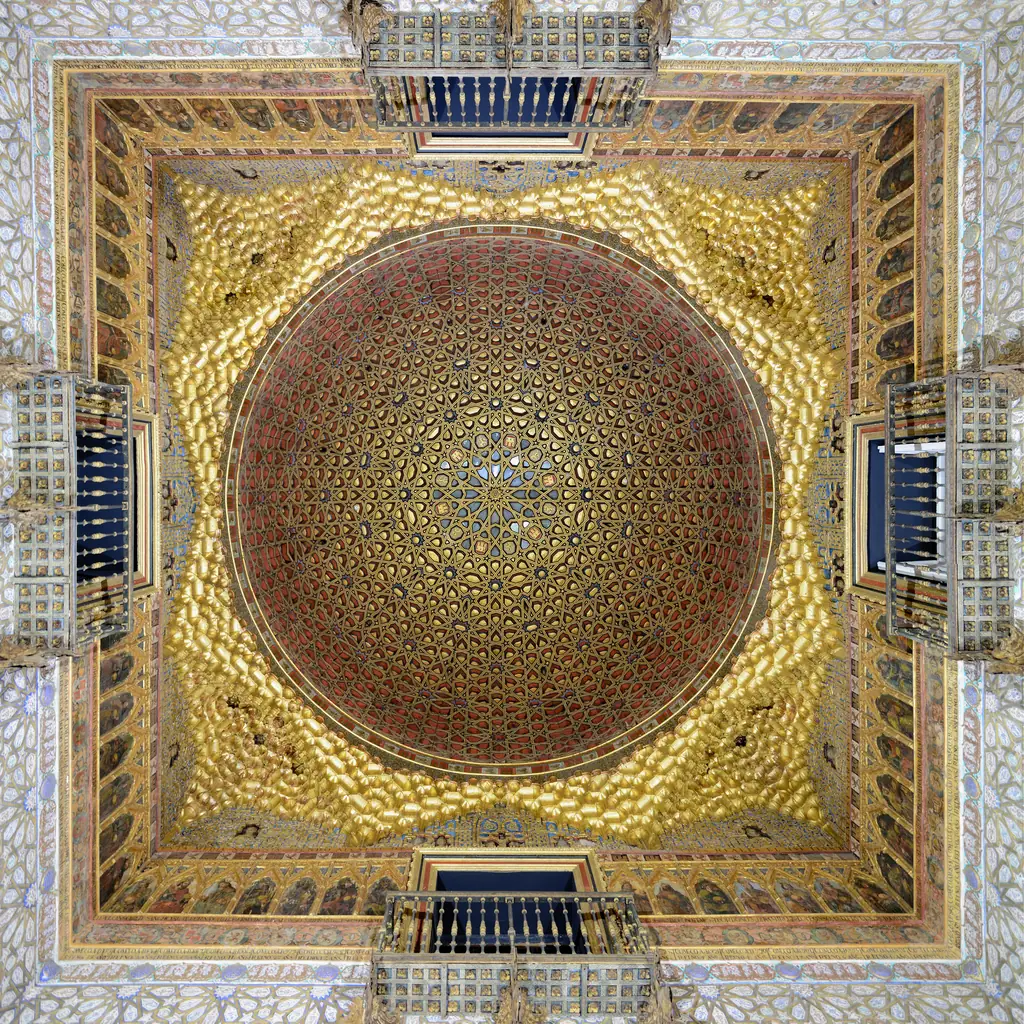
The gilded wooden dome of the Hall of the Ambassadors, seen from below
Spanish guides call this shape a media naranja, half an orange. Stand in the centre of the room and look straight up.
Read the guide →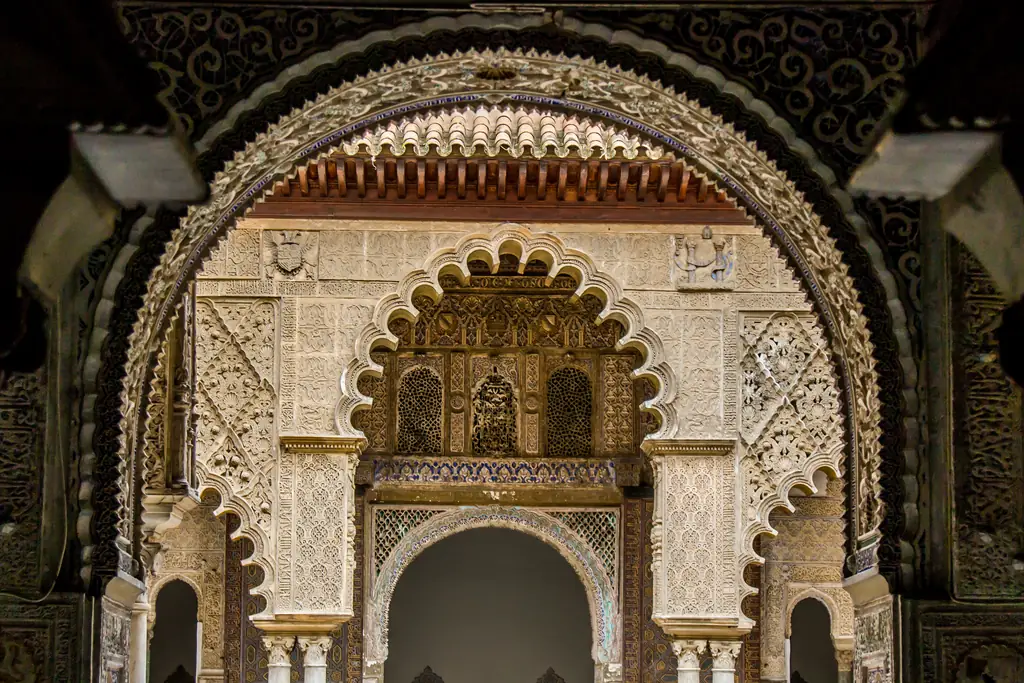
Horseshoe arches of the Hall of the Ambassadors, seen from the Patio de las Doncellas
Three arches on each of three sides open the throne room to the rooms around it, each group framed by a rectangular alfiz.
Read the guide →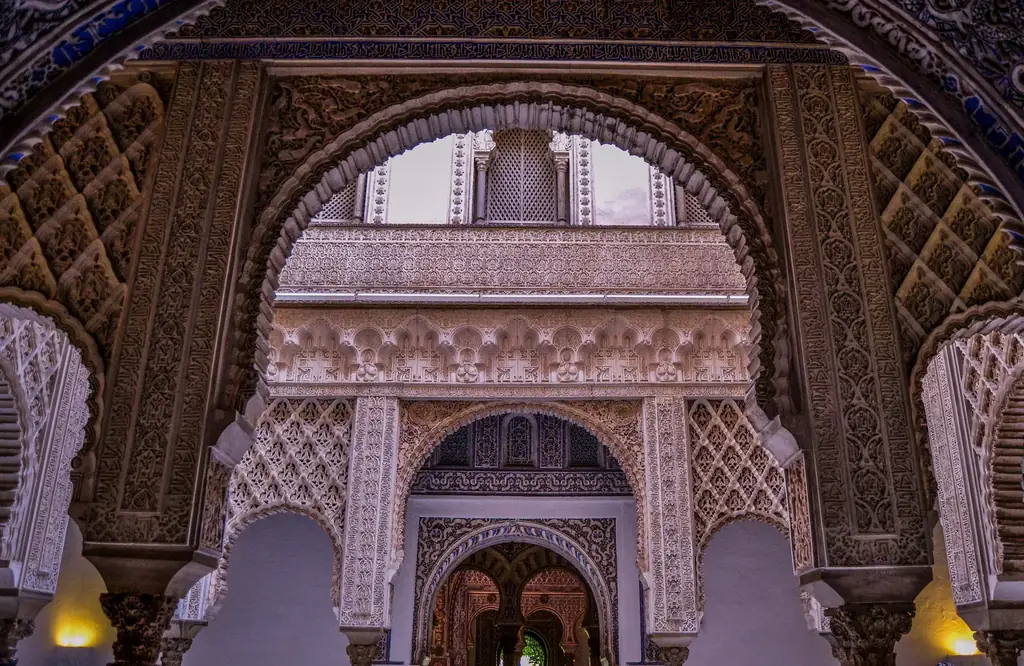
The Patio de las Muñecas seen through the arches of the Hall of the Ambassadors, columns and plasterwork receding into the private quarters
The Courtyard of the Dolls served the palace's private rooms. Tiny carved faces hide at the base of one of its arches, and finding them is a visitors' game.
Read the guide →The older palaces and the baths
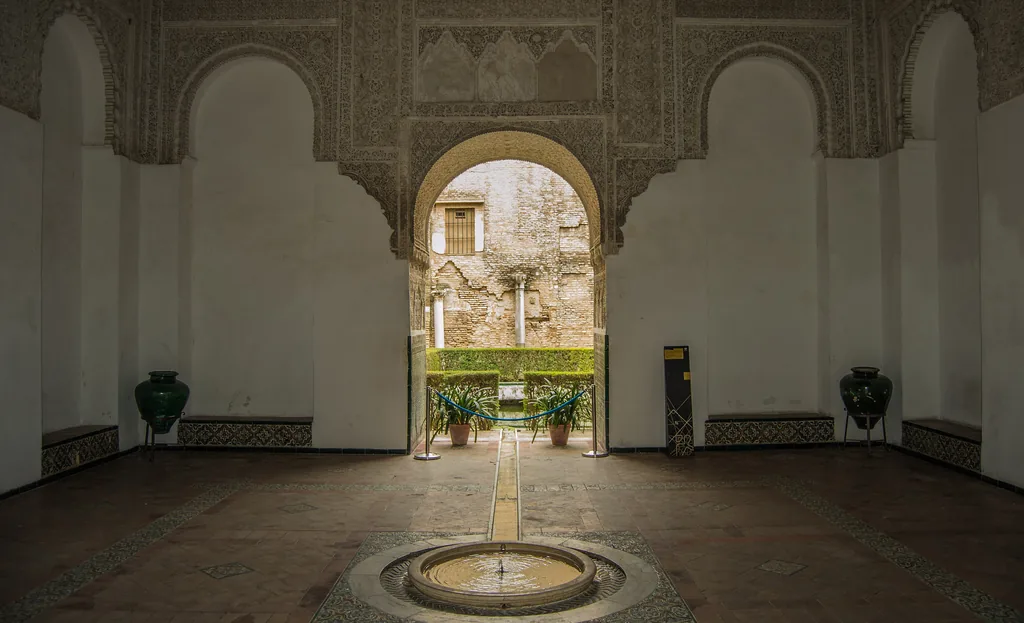
The Sala de la Justicia, a square Mudéjar hall with a small fountain set in the floor
One of the first rooms on the route, and one most visitors walk straight through on the way to the courtyards.
Read the guide →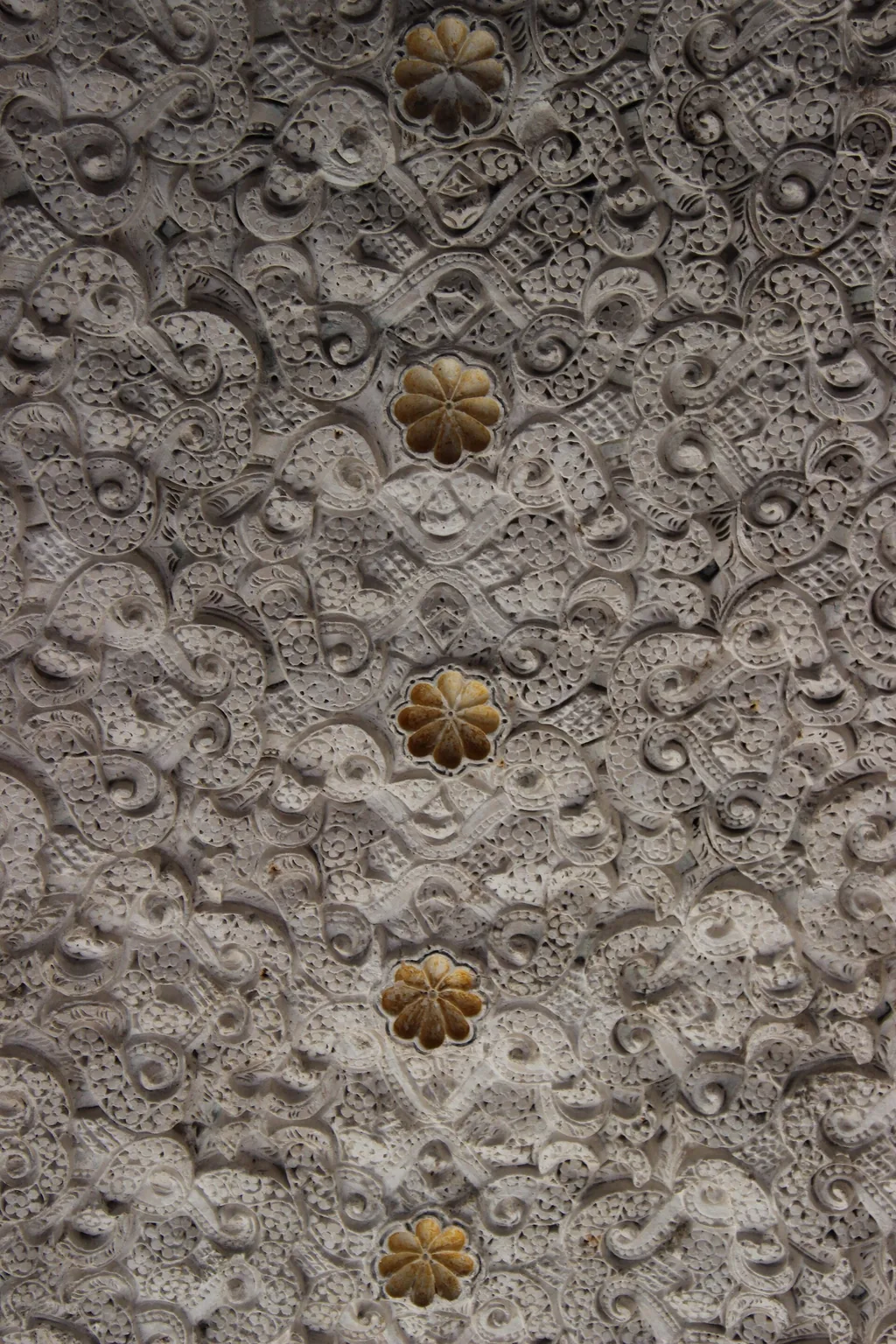
Detail of the carved plaster wall of the Sala de la Justicia
Worth two minutes at close range: the plasterwork here is as fine as anything deeper inside the palace.
Read the guide →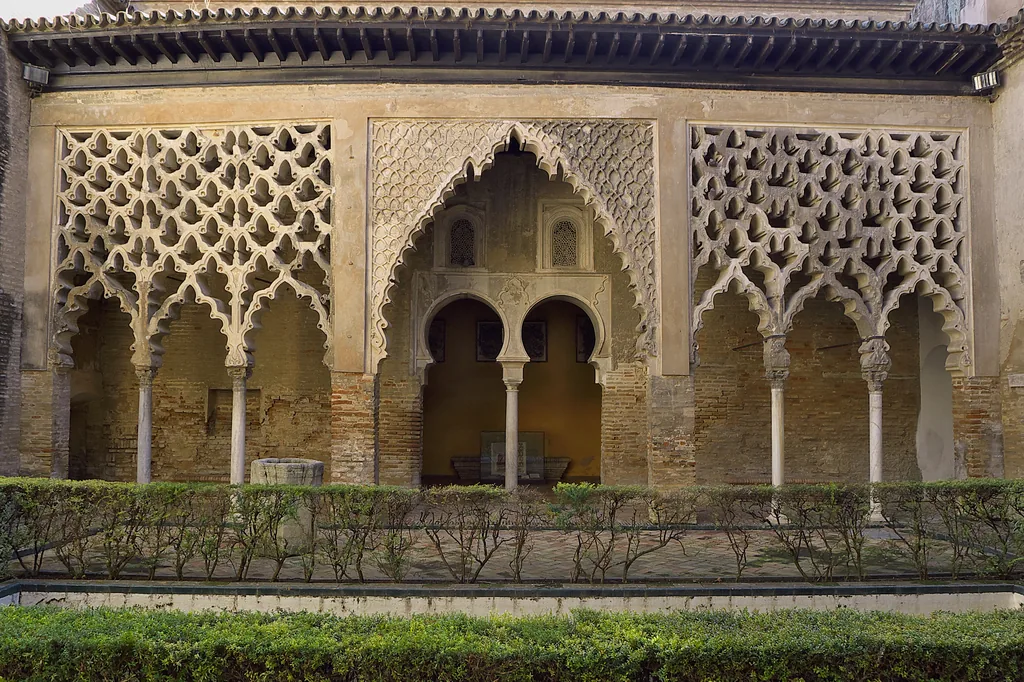
The lacework brick portico of the Patio del Yeso seen straight on
This is Almohad work, older than the Mudéjar palace and much plainer in its materials.
Read the guide →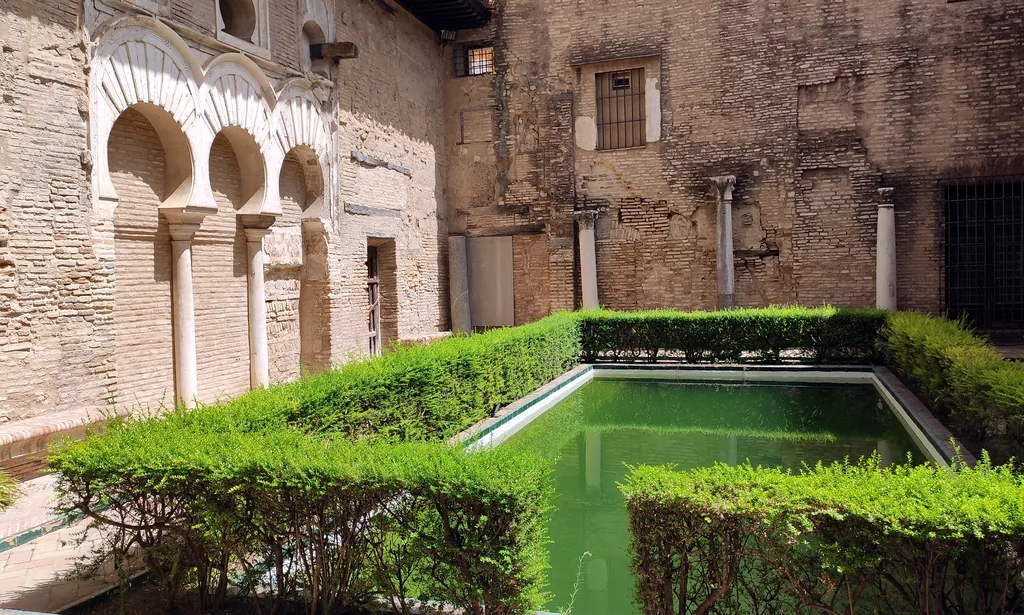
The narrow pool of the Patio del Yeso between clipped hedges and brick walls
Small, quiet and easy to miss. It is the closest thing on the route to the Alcázar before the Christian kings.
Read the guide →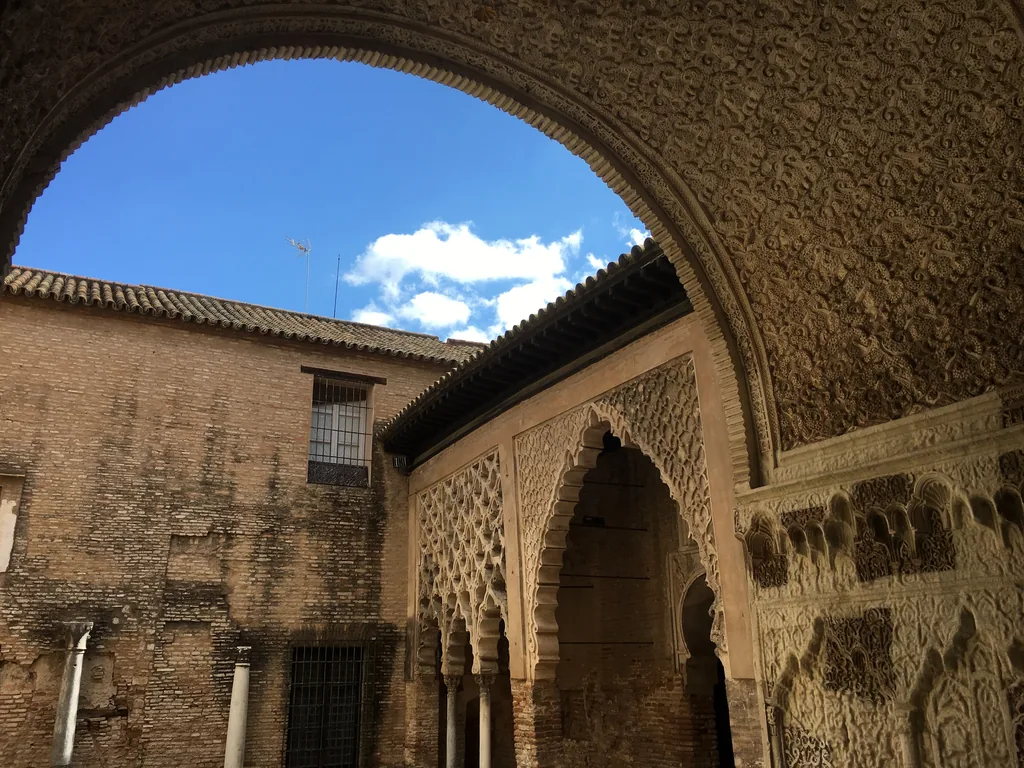
A brick arch of the Patio del Yeso framing open sky and clouds
Brick and plaster, no marble and no gold. The contrast with the Pedro I palace next door is the point.
Read the guide →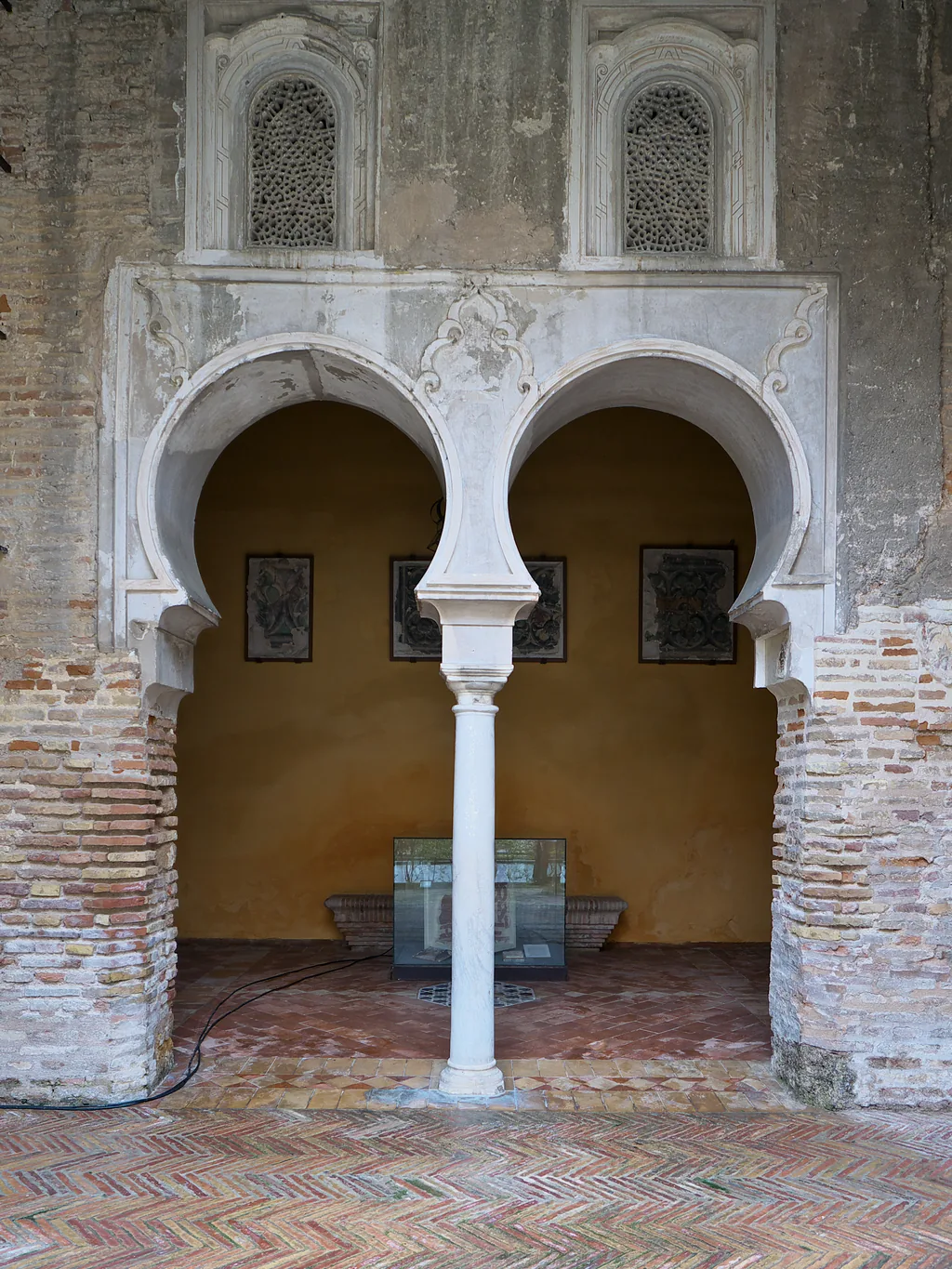
The vaulted hall beside the Patio del Yeso, with plain whitewashed walls
The oldest surviving parts of the Alcázar are the plainest. The decoration you came for is mostly later.
Read the guide →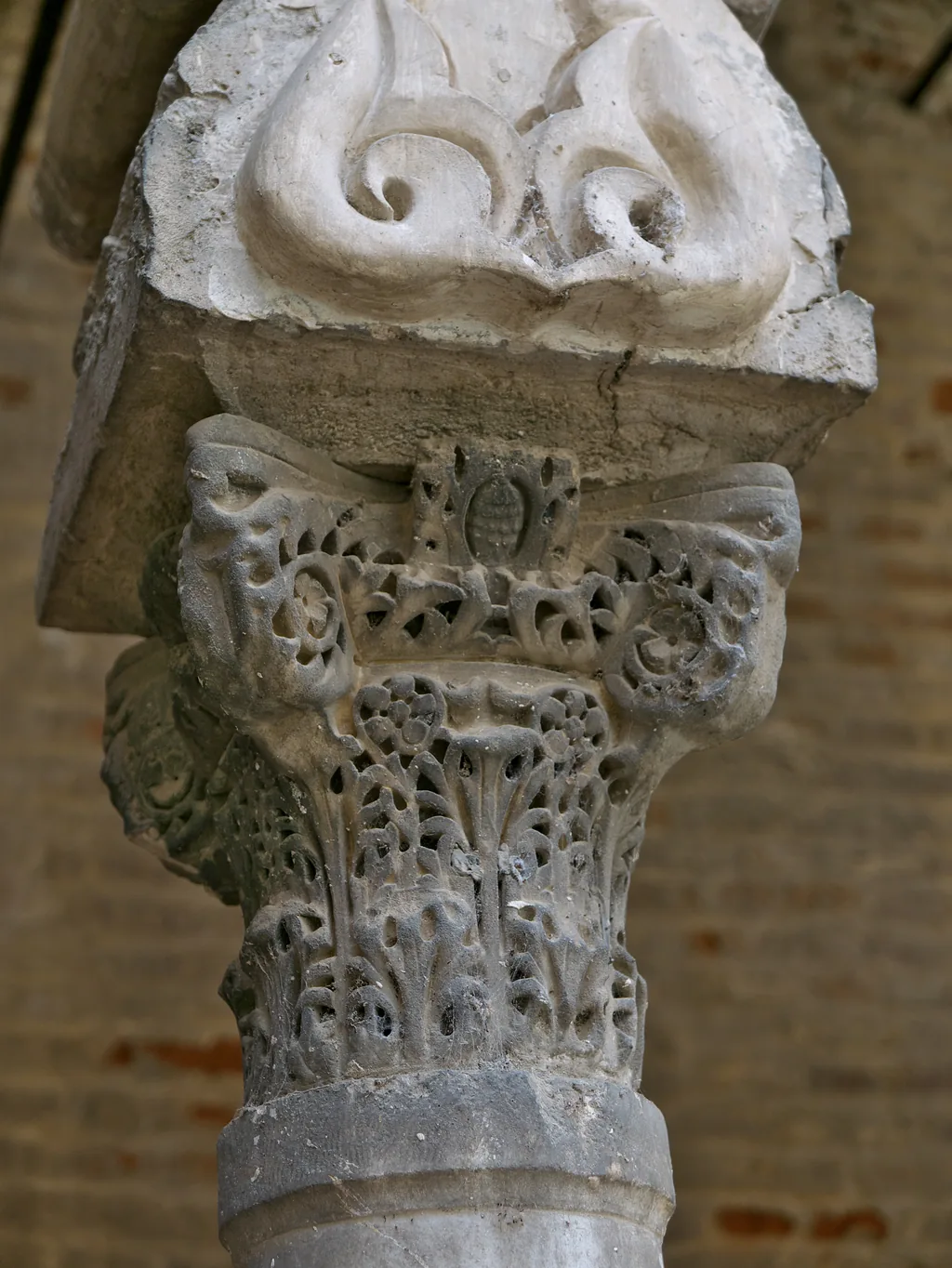
A carved stone capital on a slender column in the Patio del Yeso
Many capitals in the Alcázar are older than the walls that hold them, reused from earlier buildings.
Read the guide →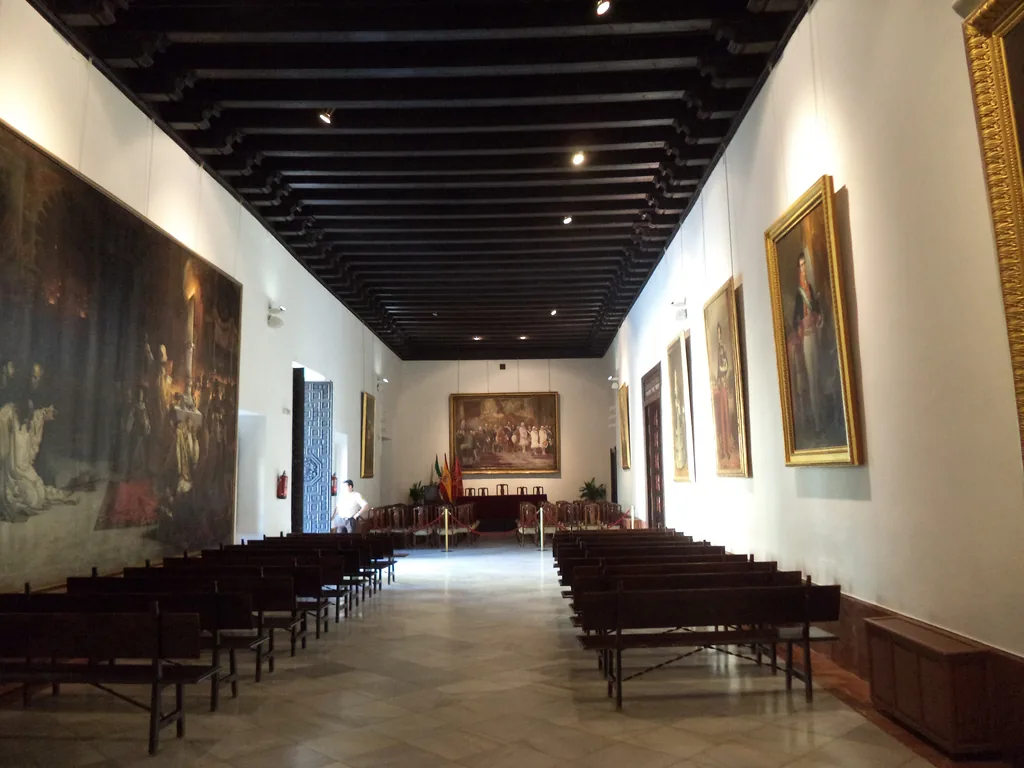
The Cuarto del Almirante, a long hall hung with paintings under a dark beamed ceiling
This wing was the Casa de Contratación, the office that ran Spain's trade with the Americas.
Read the guide →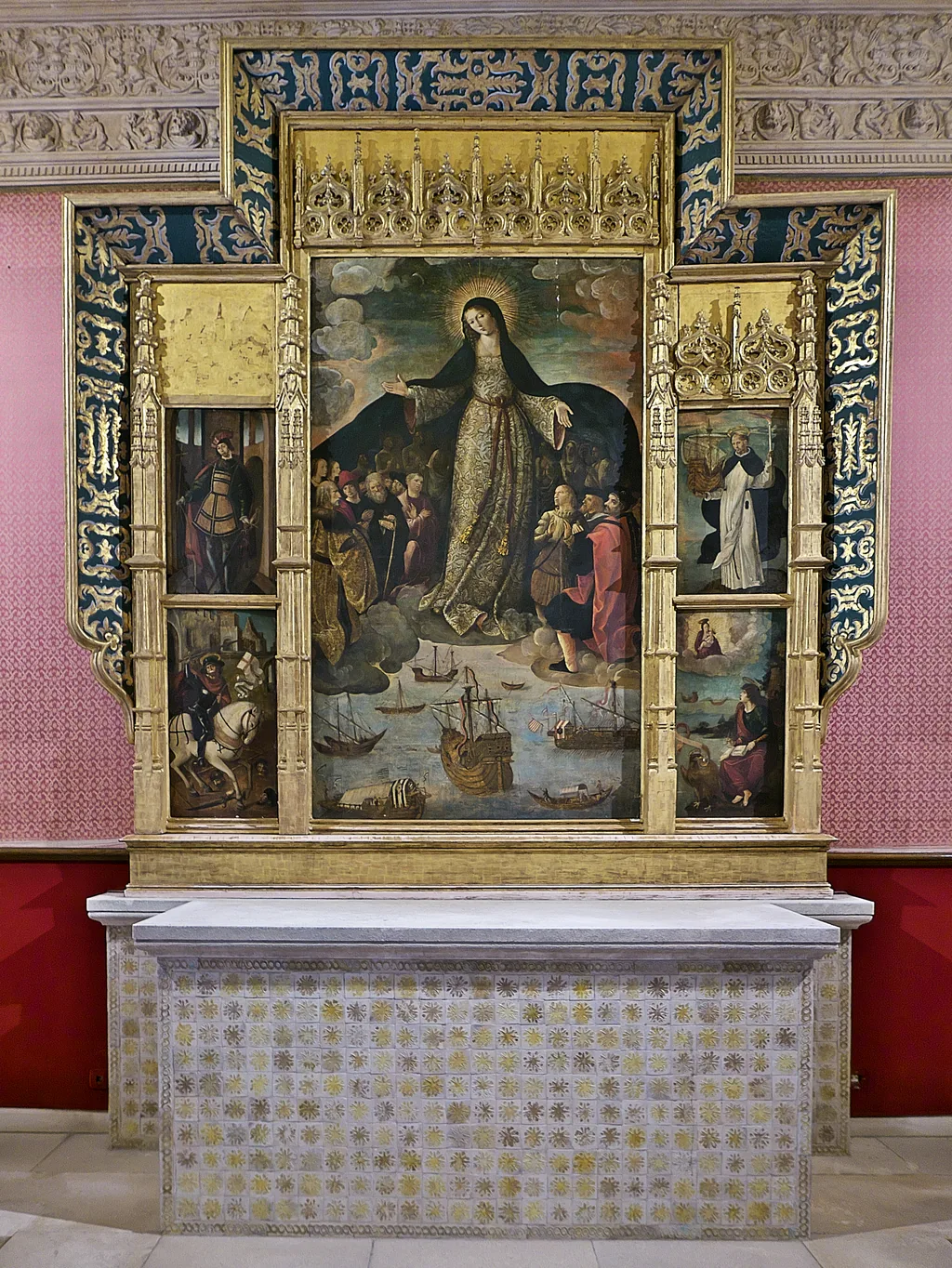
The gilded altarpiece of the Virgin of the Navigators in the Admiral's quarters
The altarpiece was painted for the office that licensed the voyages, and it shows the ships beneath the Virgin.
Read the guide →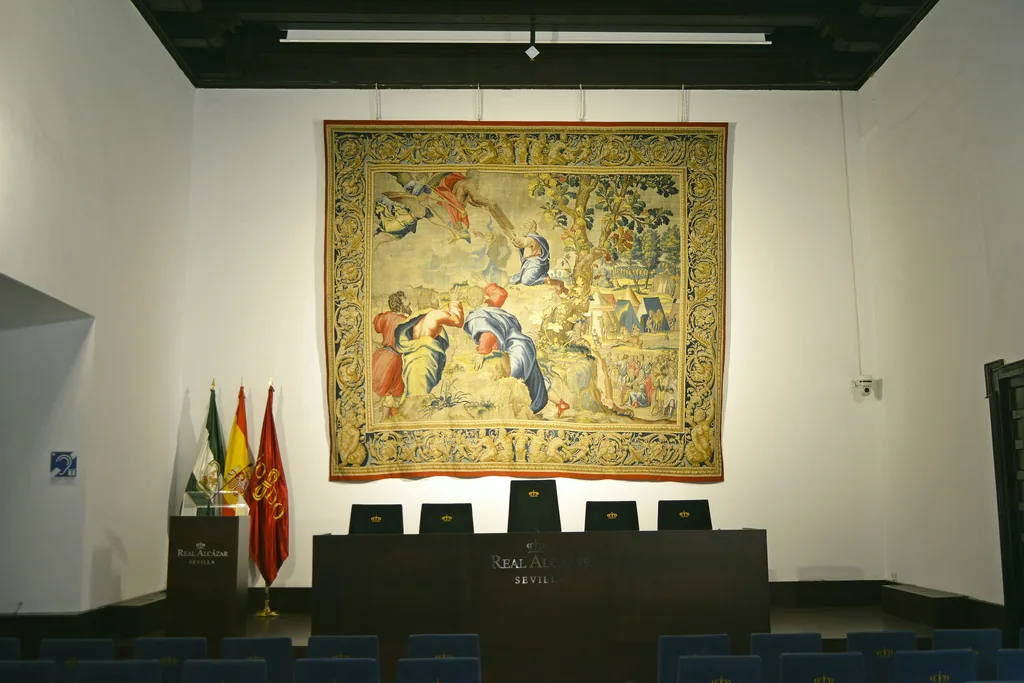
A large tapestry hung above rows of chairs in the Admiral's quarters
The Alcázar is a working building. Rooms like this are still used for ceremonies and can close without notice.
Read the guide →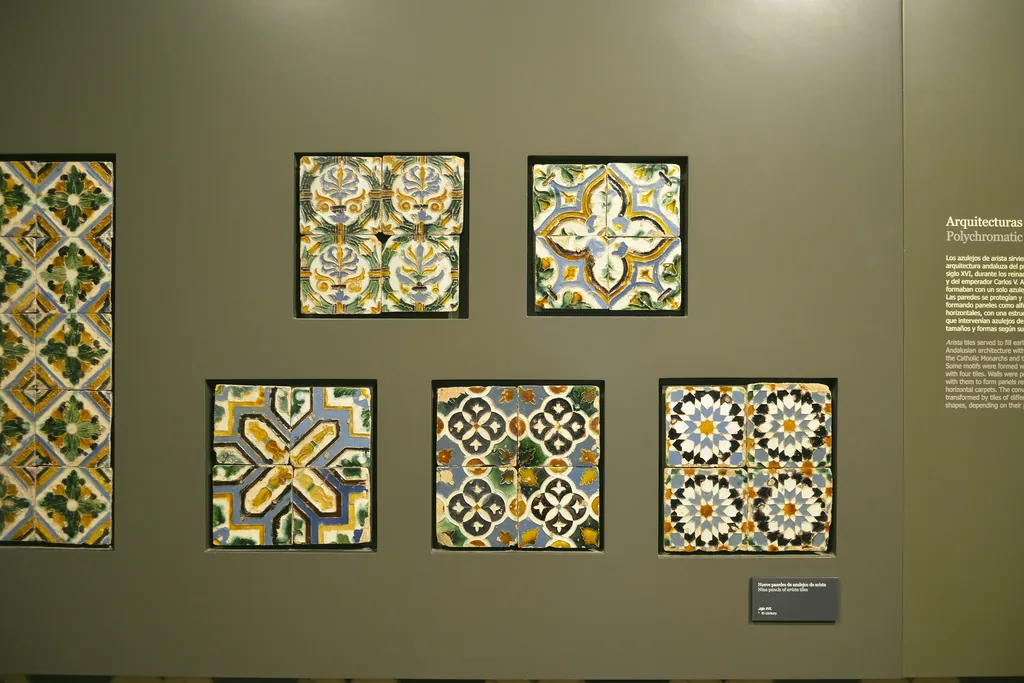
Framed sample tiles displayed on a wall, each with a different geometric pattern
A small display of tile patterns, useful if you want to know what you have been walking past all morning.
Read the guide →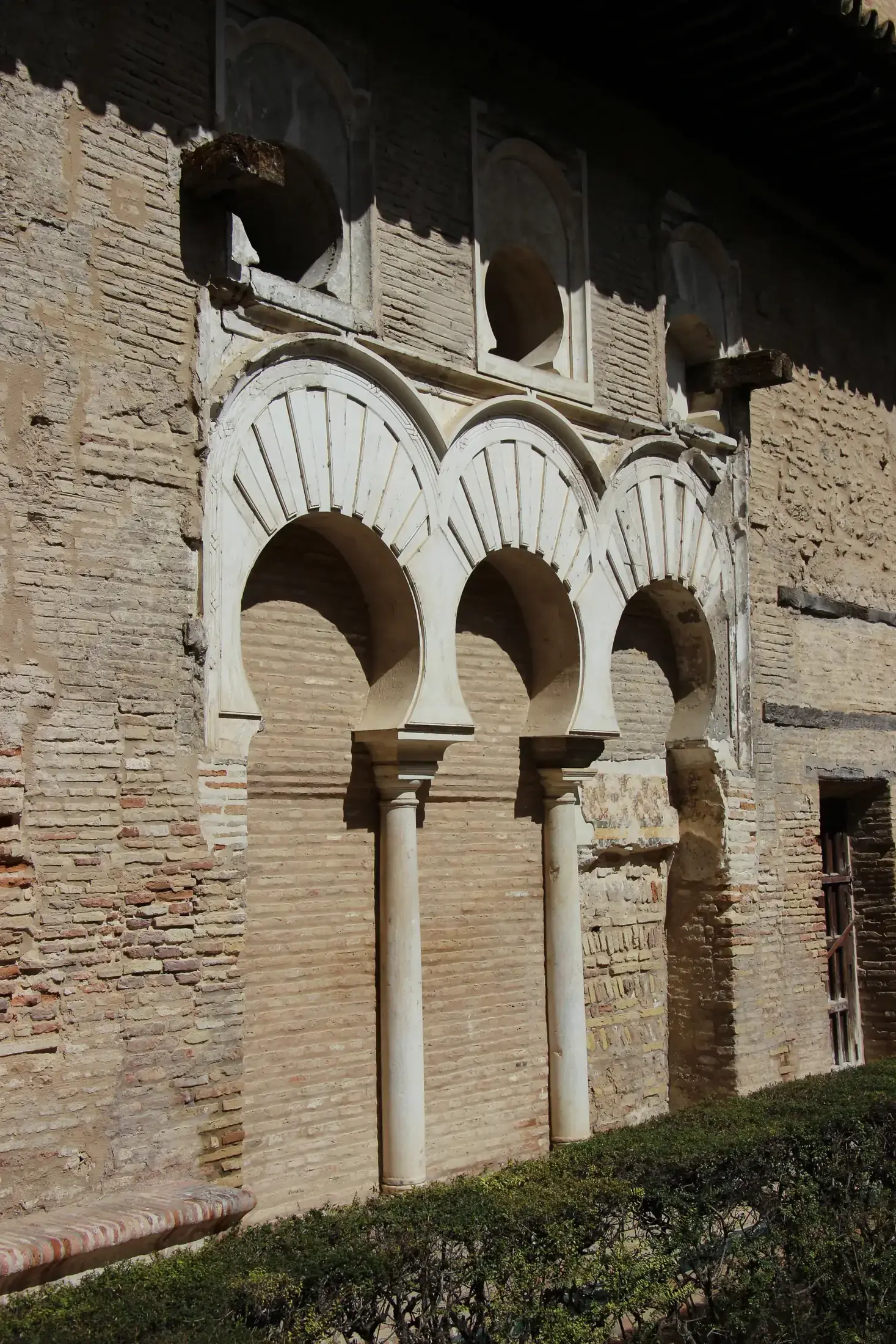
Brick and plaster arches of the Patio del Yeso, the best-preserved Almohad space in the Alcázar
Built at the end of the 12th century, before the Christian conquest of 1248. Most visitors walk past it on the way to Pedro I's palace.
Read the guide →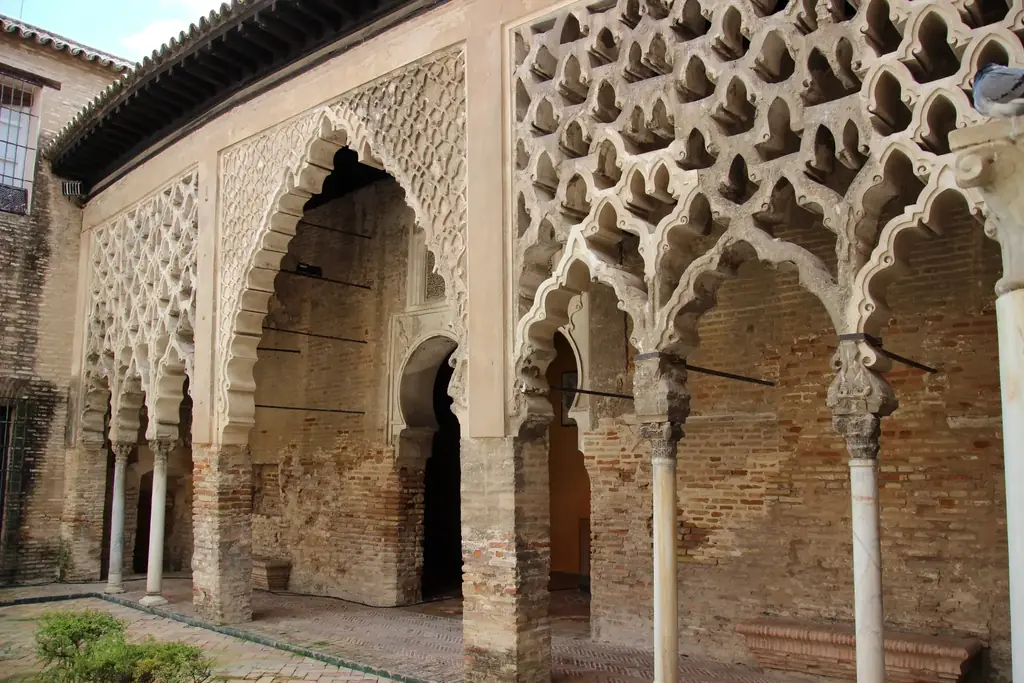
Sebka lattice carved in plaster above the arches of the Patio del Yeso, with its pool and hedge in front
Sebka is the diamond lattice of Almohad art. Compare it with the denser plaster of Pedro I's palace: same tradition, two hundred years apart.
Read the guide →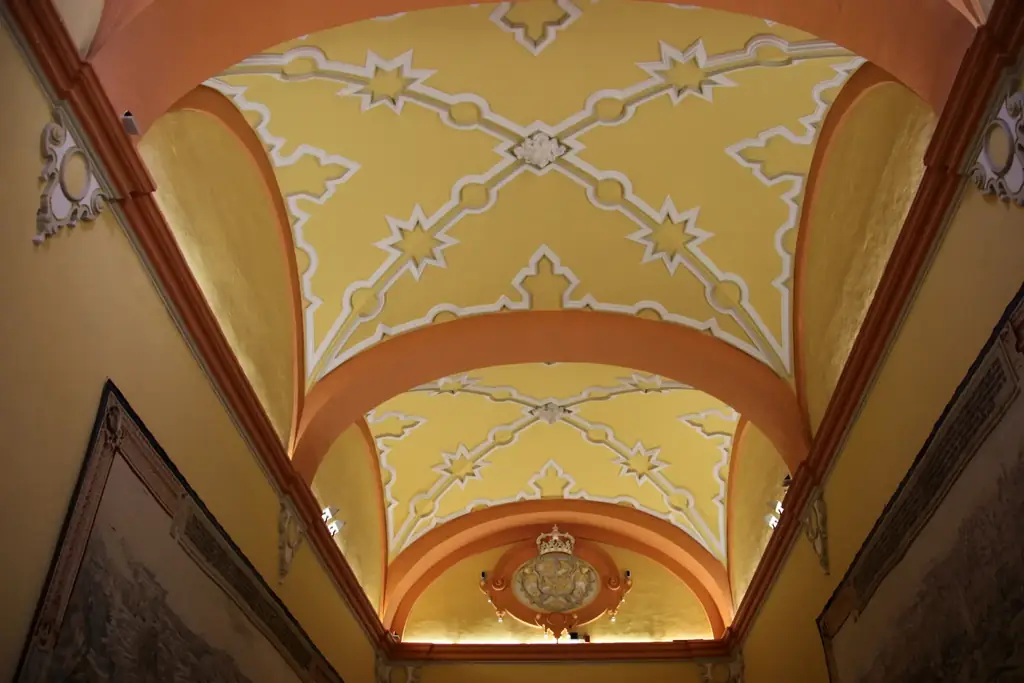
Painted vault of the Salón de los Tapices in the Gothic Palace, ribs and royal arms on a yellow ground
The great hall was rebuilt after the Lisbon earthquake of 1755 by Sebastian van der Borcht, inside the 13th-century footprint of Alfonso X.
Read the guide →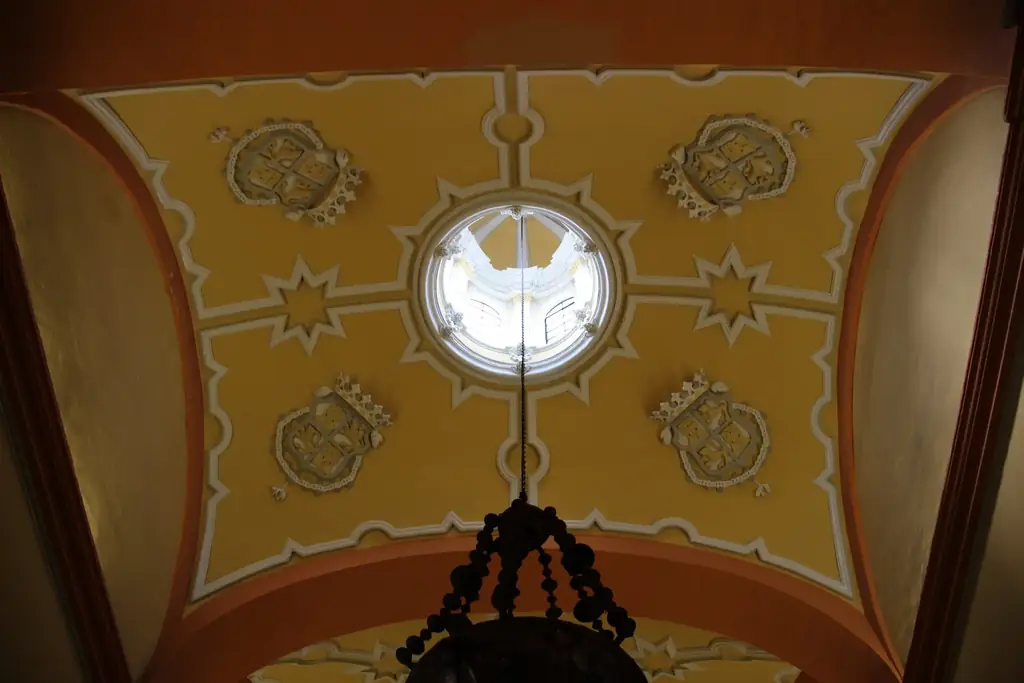
Lantern and vault of the Salón de los Tapices, an iron chandelier hanging under the glazed oculus
The hall holds the tapestries of Charles V's Tunis campaign of 1535; the pieces on show are later copies.
Read the guide →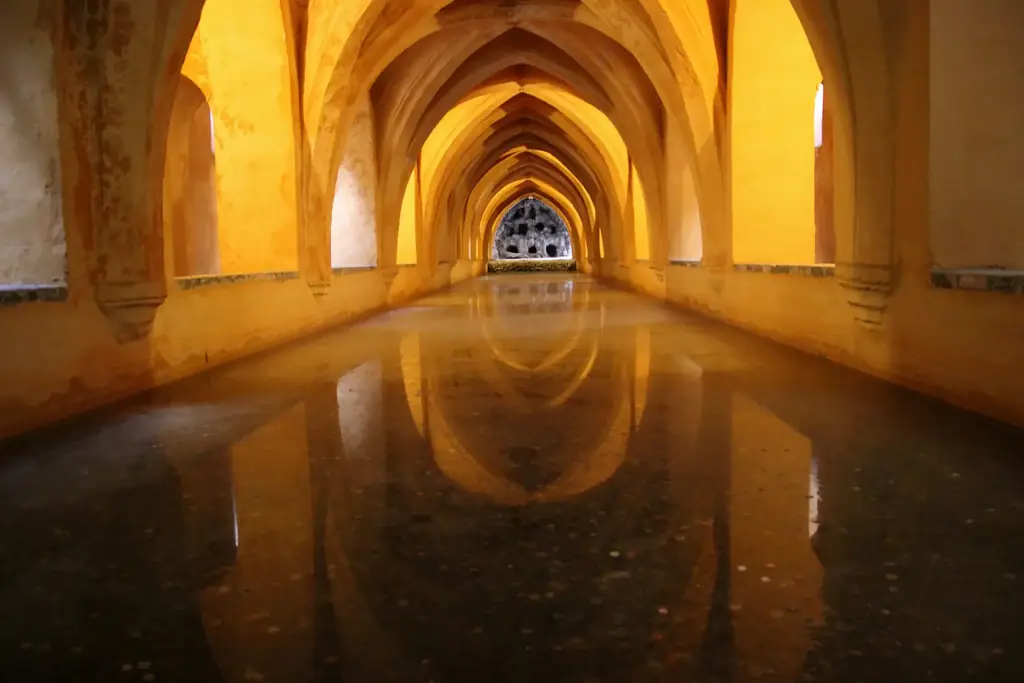
The vaulted underground pool known as the Baths of María de Padilla, Gothic ribs reflected in still water
Not a bathhouse: a water cistern under the Patio del Crucero, built with the Gothic palace of Alfonso X from the 1250s.
Read the guide →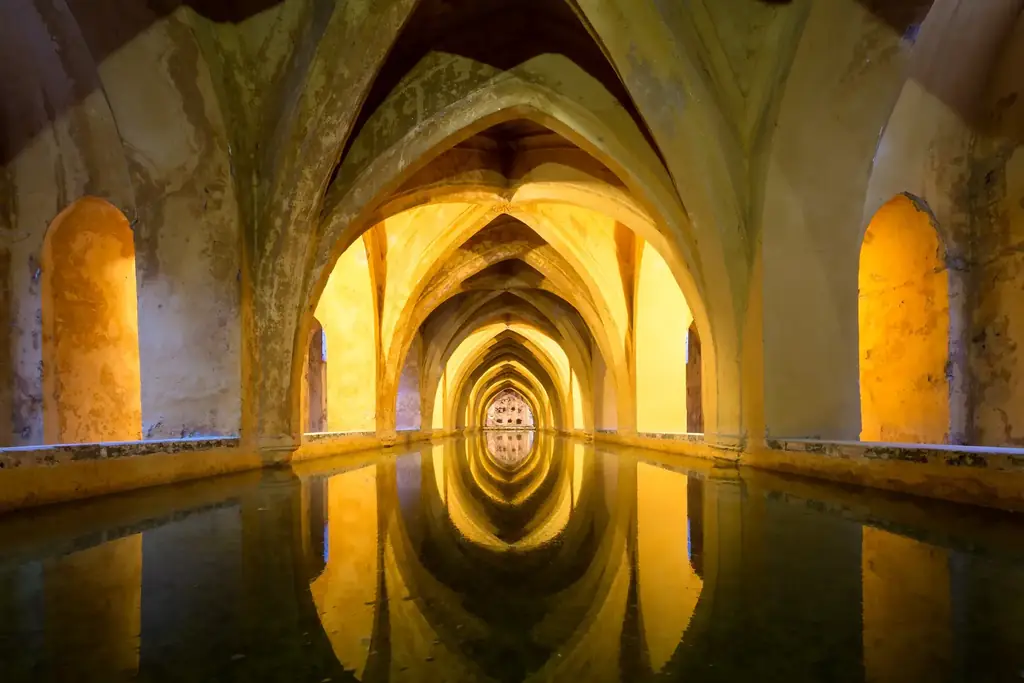
Warm light down the length of the Baths of María de Padilla, the arcade doubled in the reflection
The light comes from openings at the far end. Come early: the passage is narrow and fills with groups after mid-morning.
Read the guide →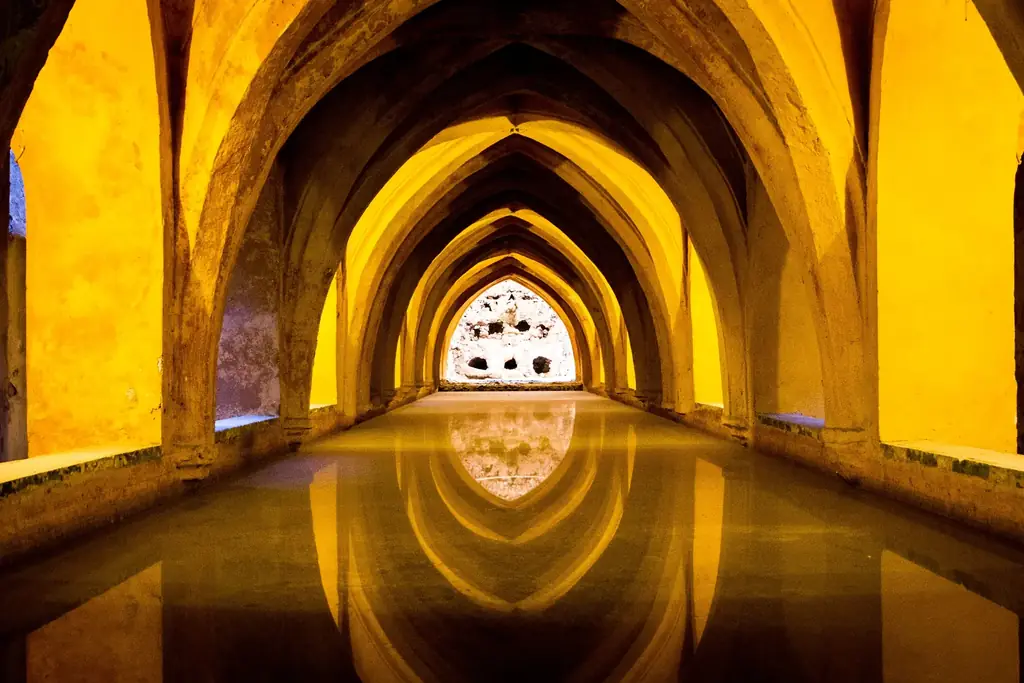
The round window at the end of the Baths of María de Padilla, its star grille mirrored in the pool below
The legend that courtiers drank the water María de Padilla had bathed in has no documentary basis. The cistern predates her by about a century.
Read the guide →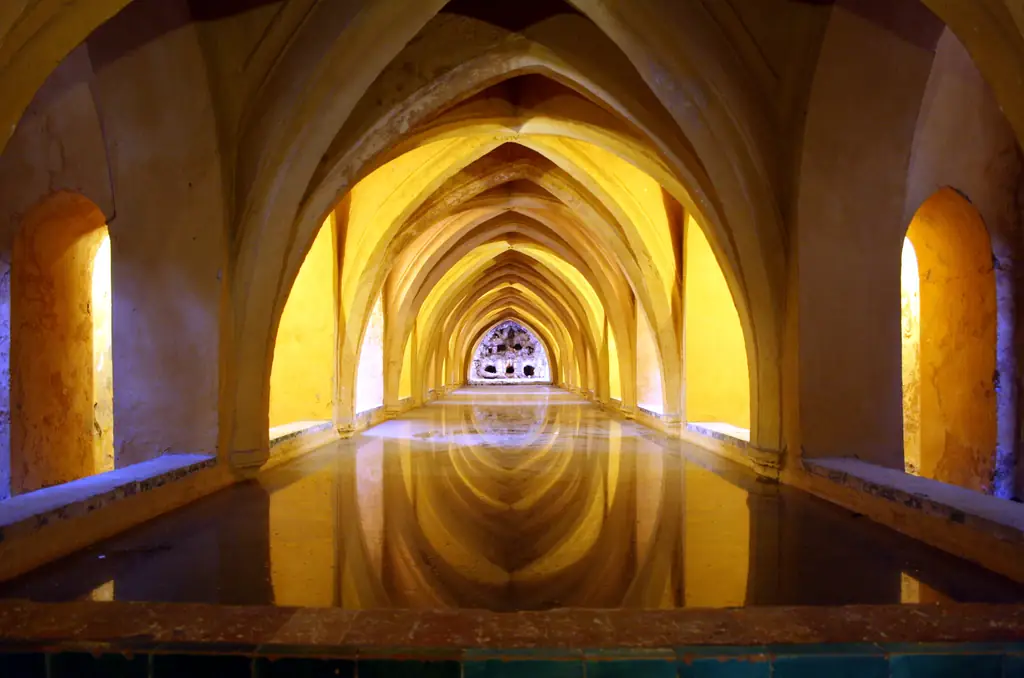
The vaulted underground pool of the Baths of Doña María de Padilla
The Alcázar stood in for the Water Gardens of Dorne in Game of Thrones season 5, which is why many visitors come looking for this vault.
Read the guide →The gardens
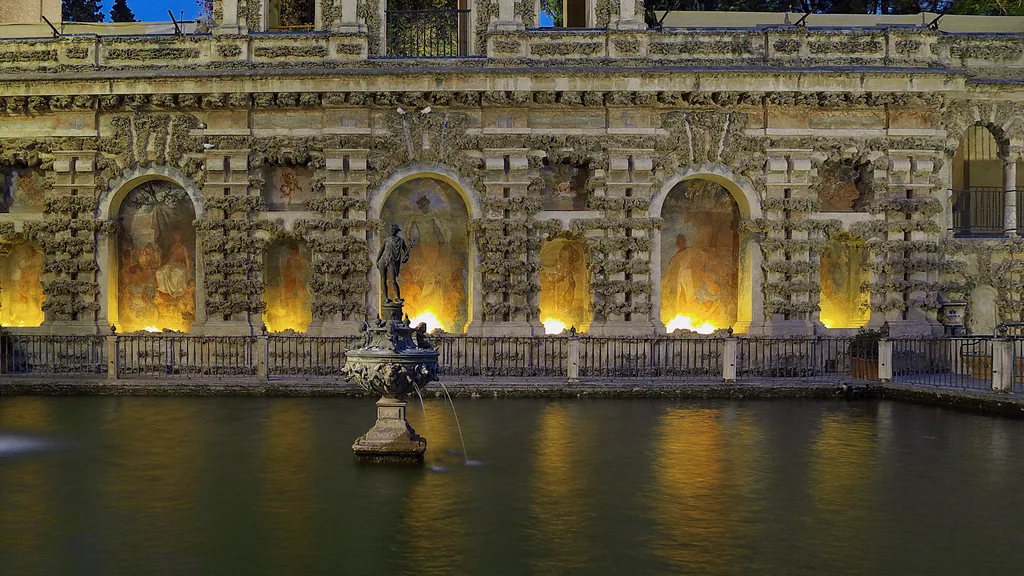
The Estanque de Mercurio lit at night, the facade reflected in dark water
The pool is lit for evening events. The ordinary day ticket does not cover them, and they are sold separately.
Read the guide →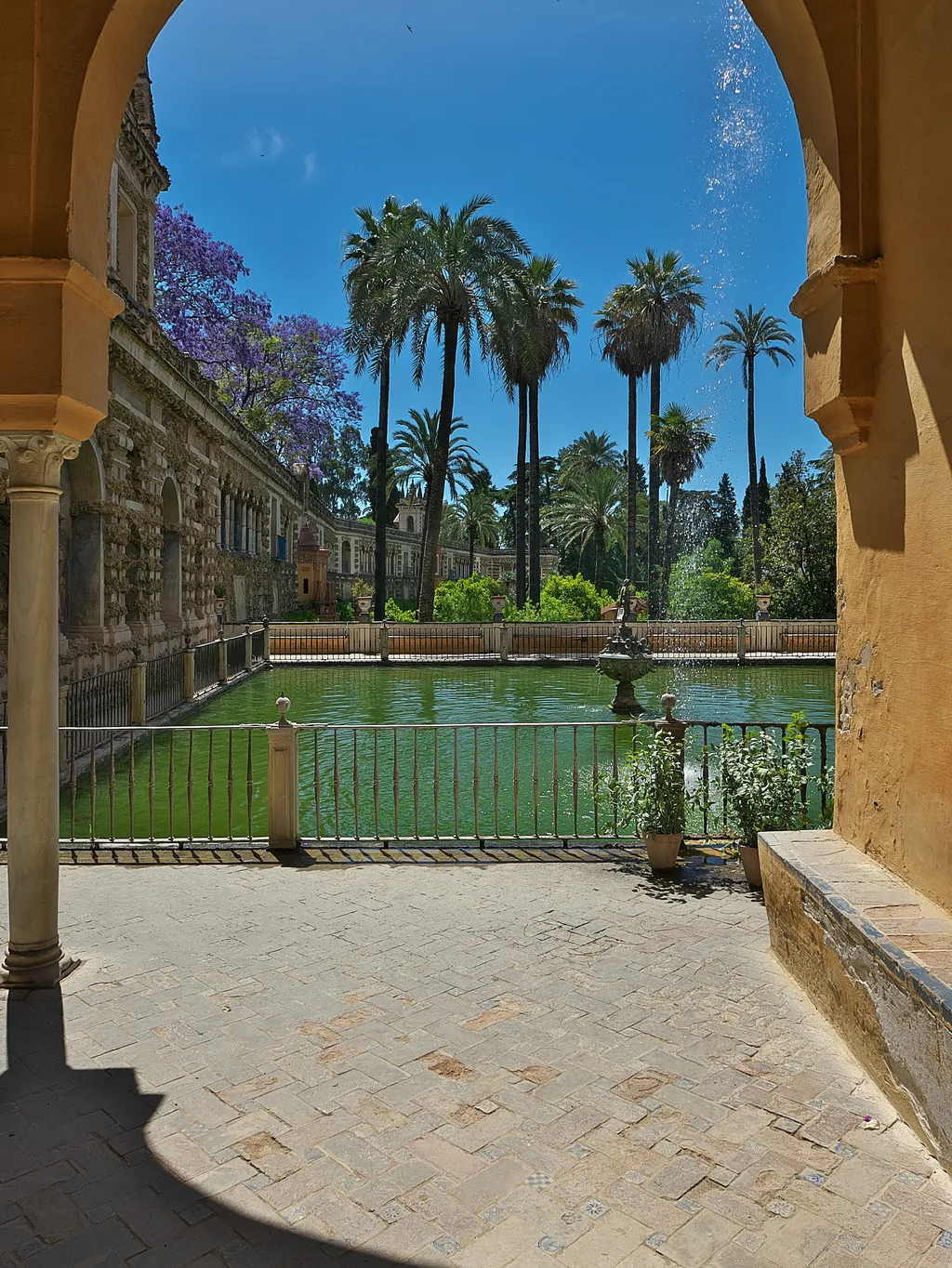
The Estanque de Mercurio framed by an arch, with palms rising behind the water
This arch is the way out of the palace into the gardens, and the point where most visitors stop for a photograph.
Read the guide →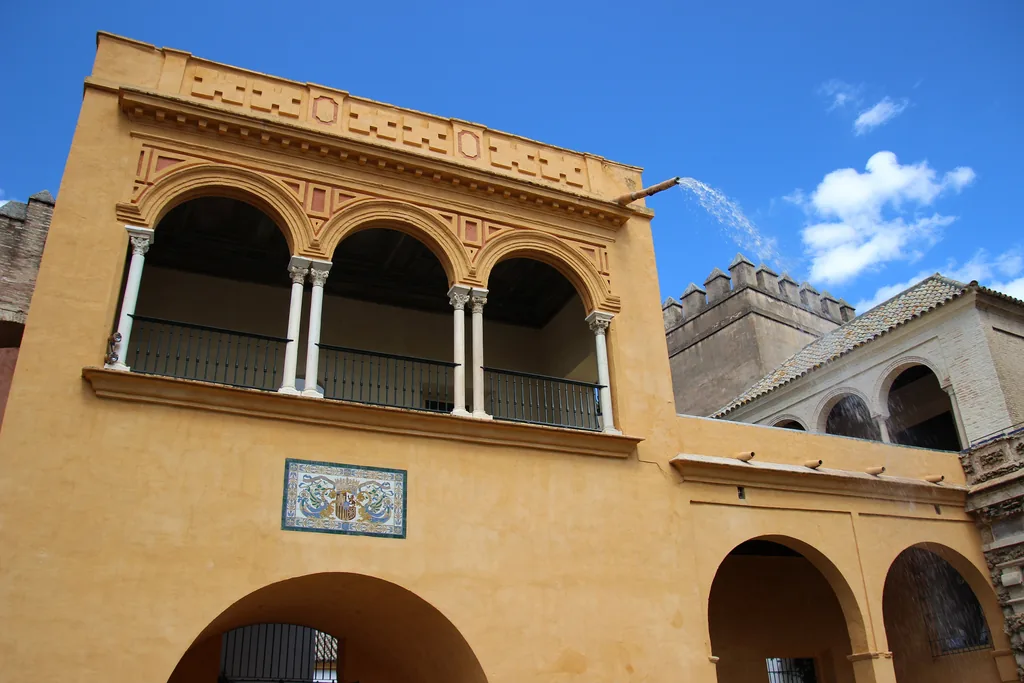
The arcaded loggia above the Estanque de Mercurio seen from below against the sky
The loggia looks out over the gardens. It marks the boundary between the palace and everything planted beyond it.
Read the guide →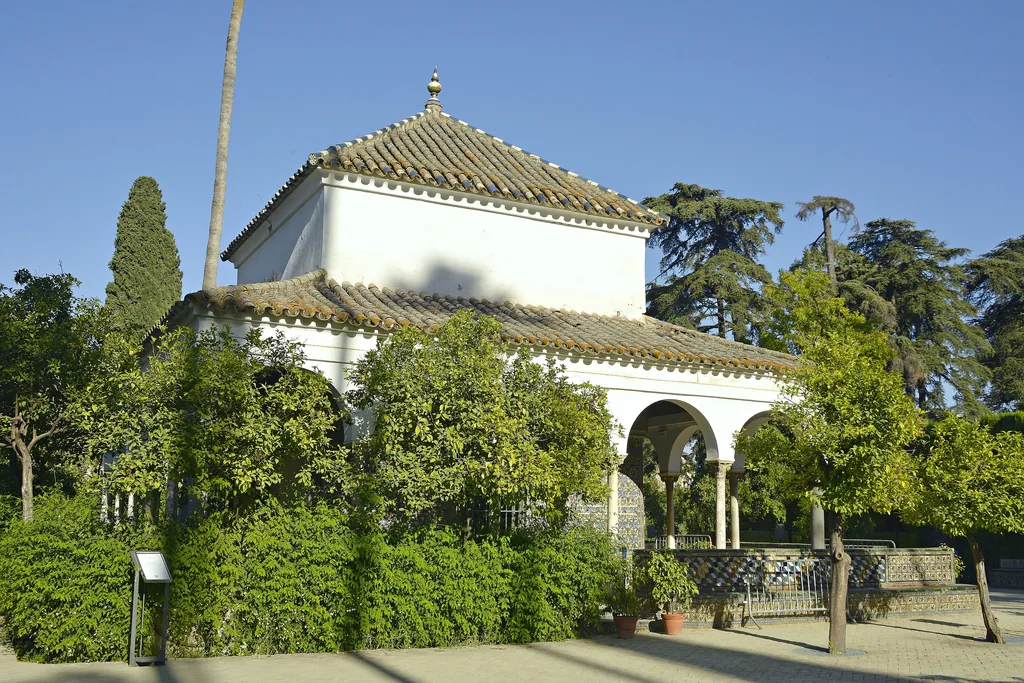
The tiled pavilion of the Cenador de Carlos V standing among hedges in the Alcázar gardens
The garden pavilion sits well beyond the palace rooms. Most of the crowd never walks this far.
Read the guide →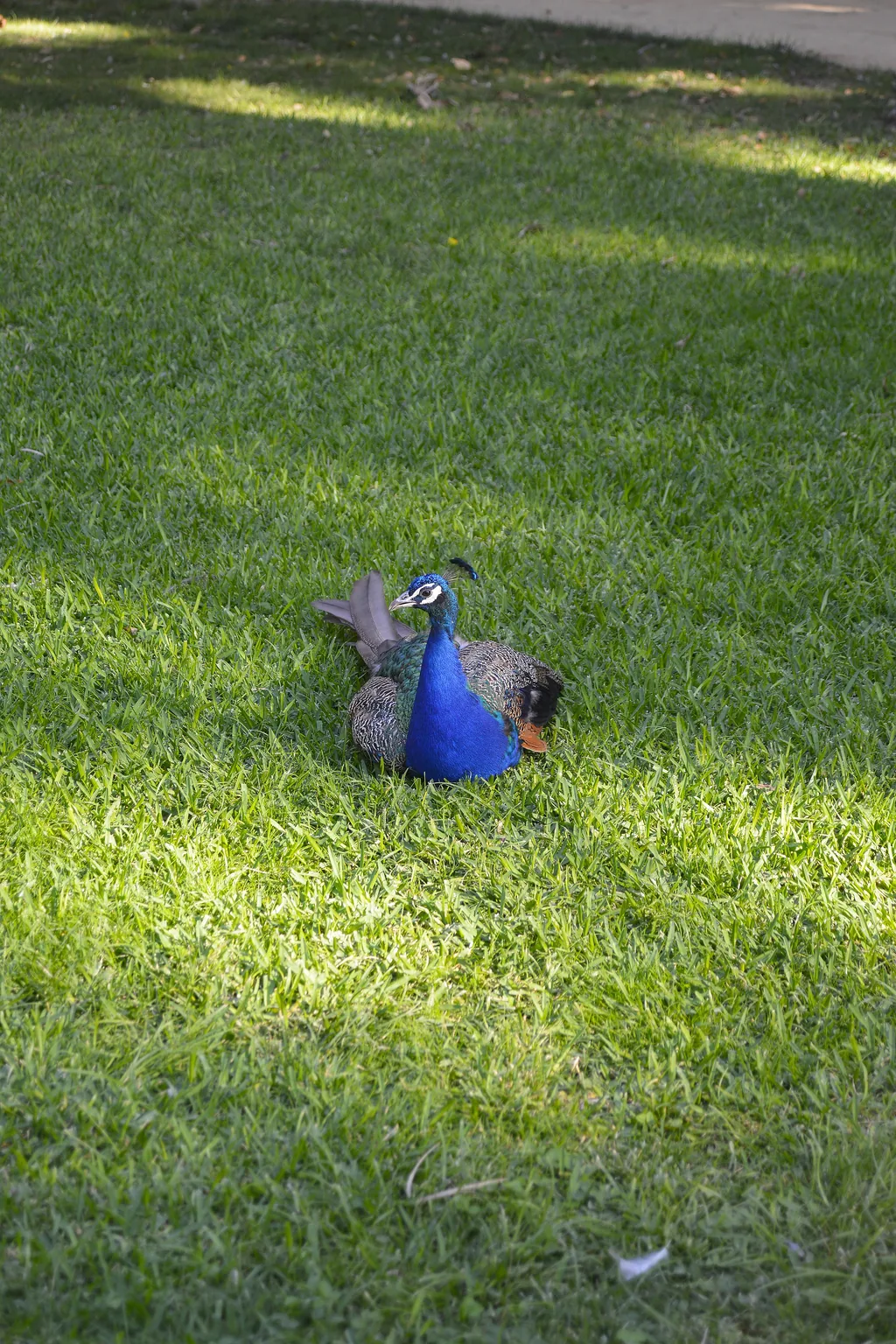
A peacock standing on the grass in the gardens of the Real Alcázar
Peacocks live loose in the gardens and are used to people. They are easiest to find in the quieter far end.
Read the guide →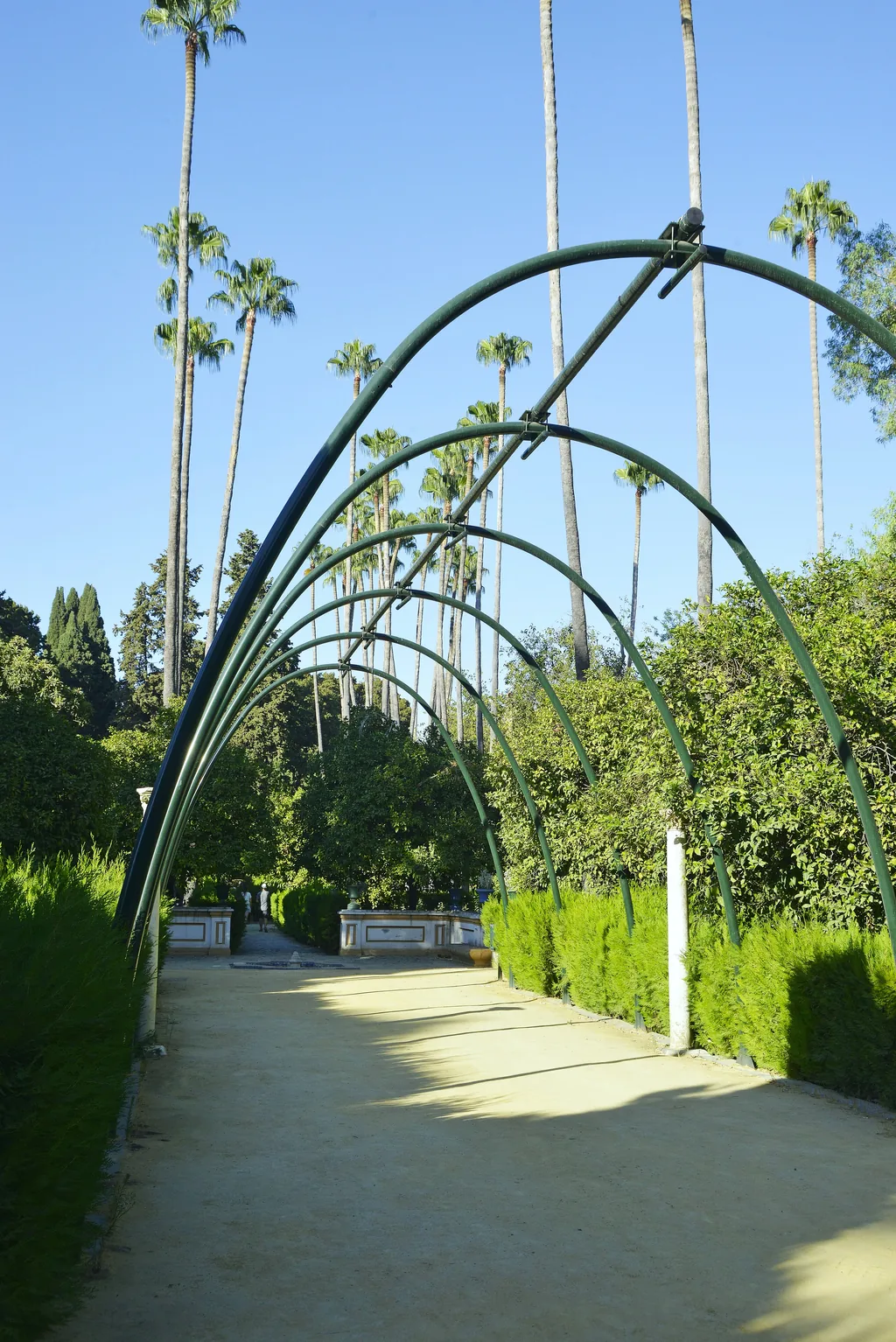
A walkway of metal arches curving over a garden path in the Alcázar gardens
The far gardens are laid out as long straight walks. They are the coolest part of the site in summer.
Read the guide →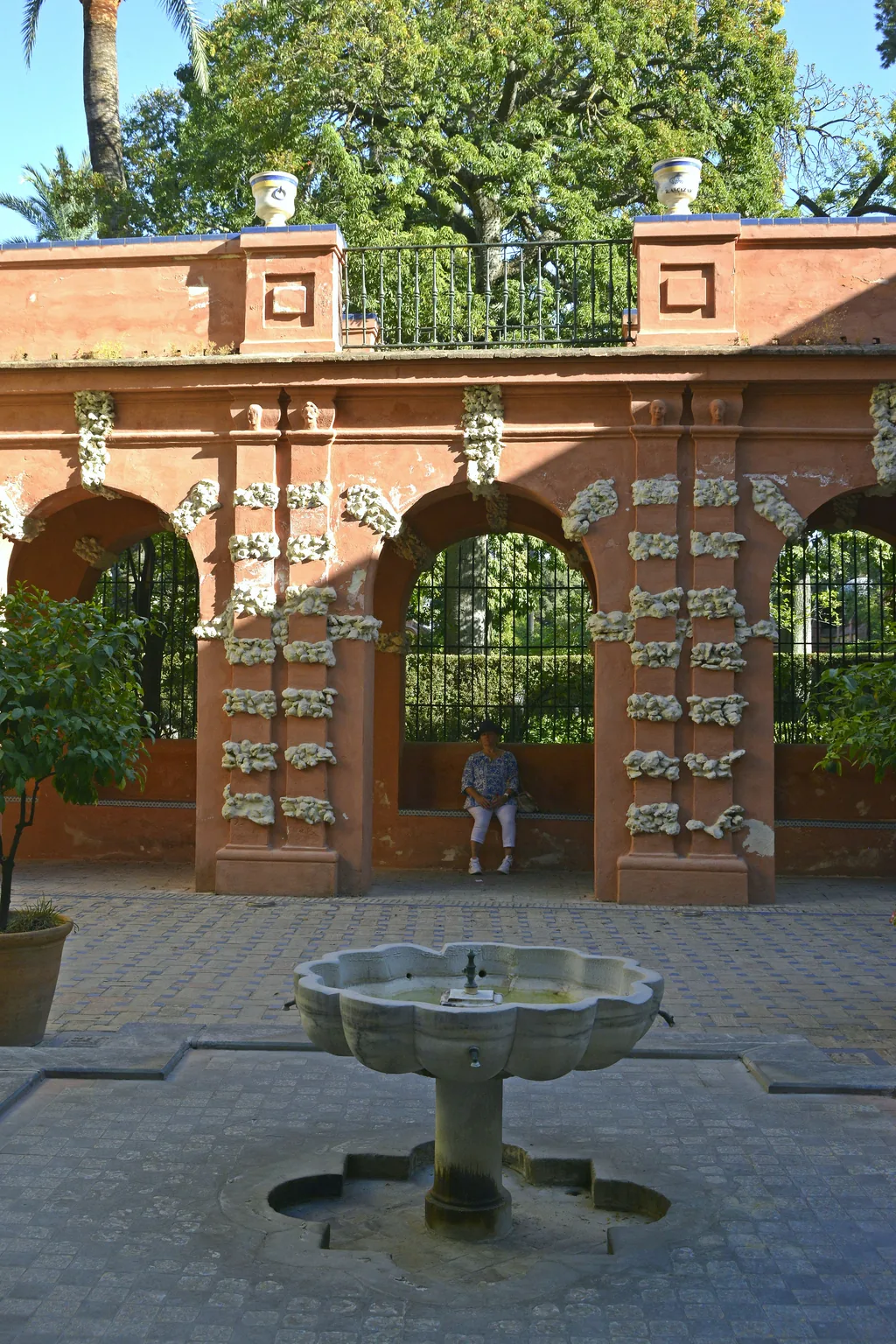
Brick arches and a small fountain in a walled section of the Alcázar gardens
The gardens are a series of walled rooms rather than one open park, which is why they feel bigger than they are.
Read the guide →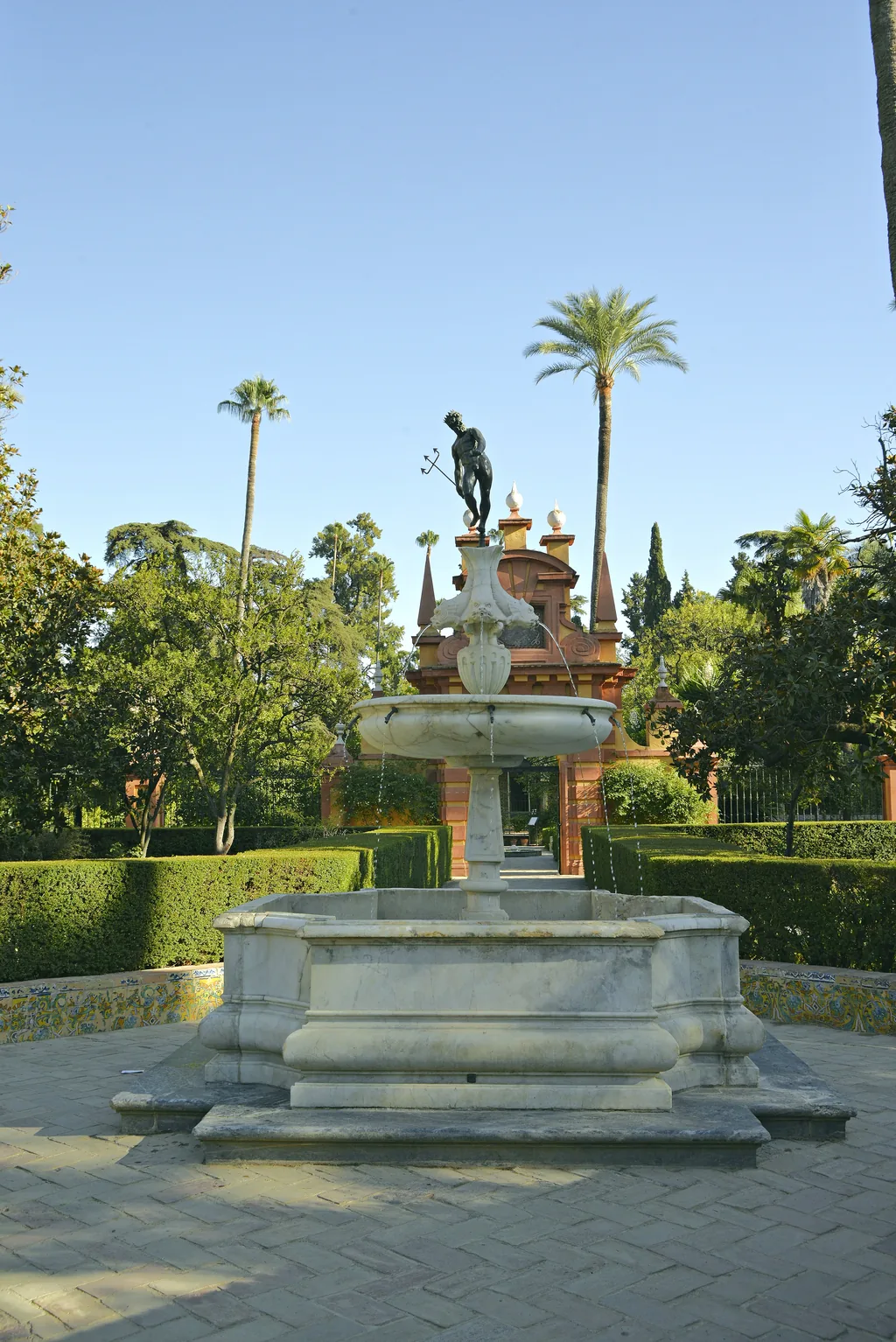
A stone fountain crowned with a bronze statue in the gardens of the Alcázar
Water runs through the whole garden by gravity, from the high pools down to the far beds.
Read the guide →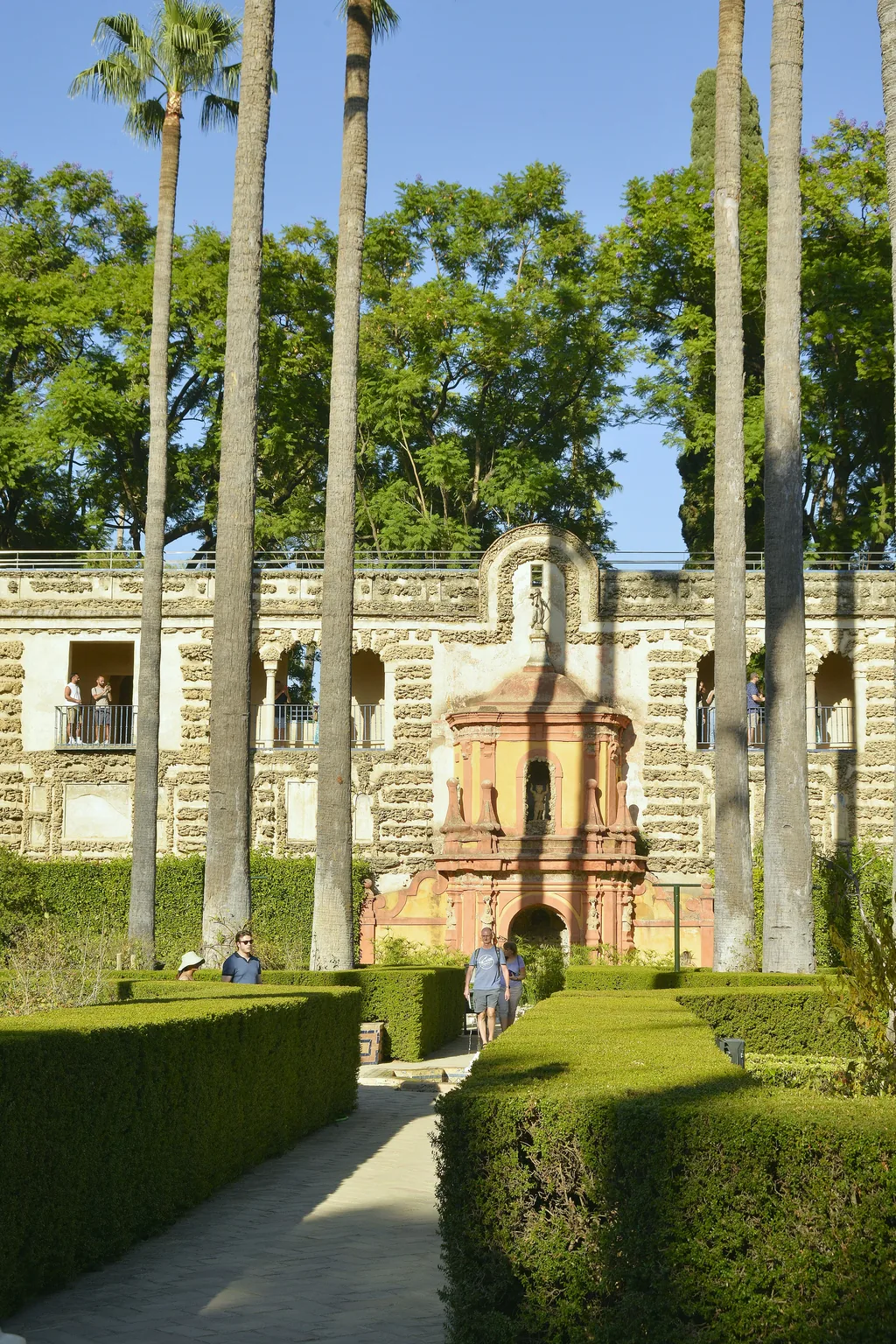
Tall palms above a garden pavilion and clipped hedges in the Alcázar gardens
Allow a full hour for the gardens alone. Visitors who only do the palace rooms miss more than half the site.
Read the guide →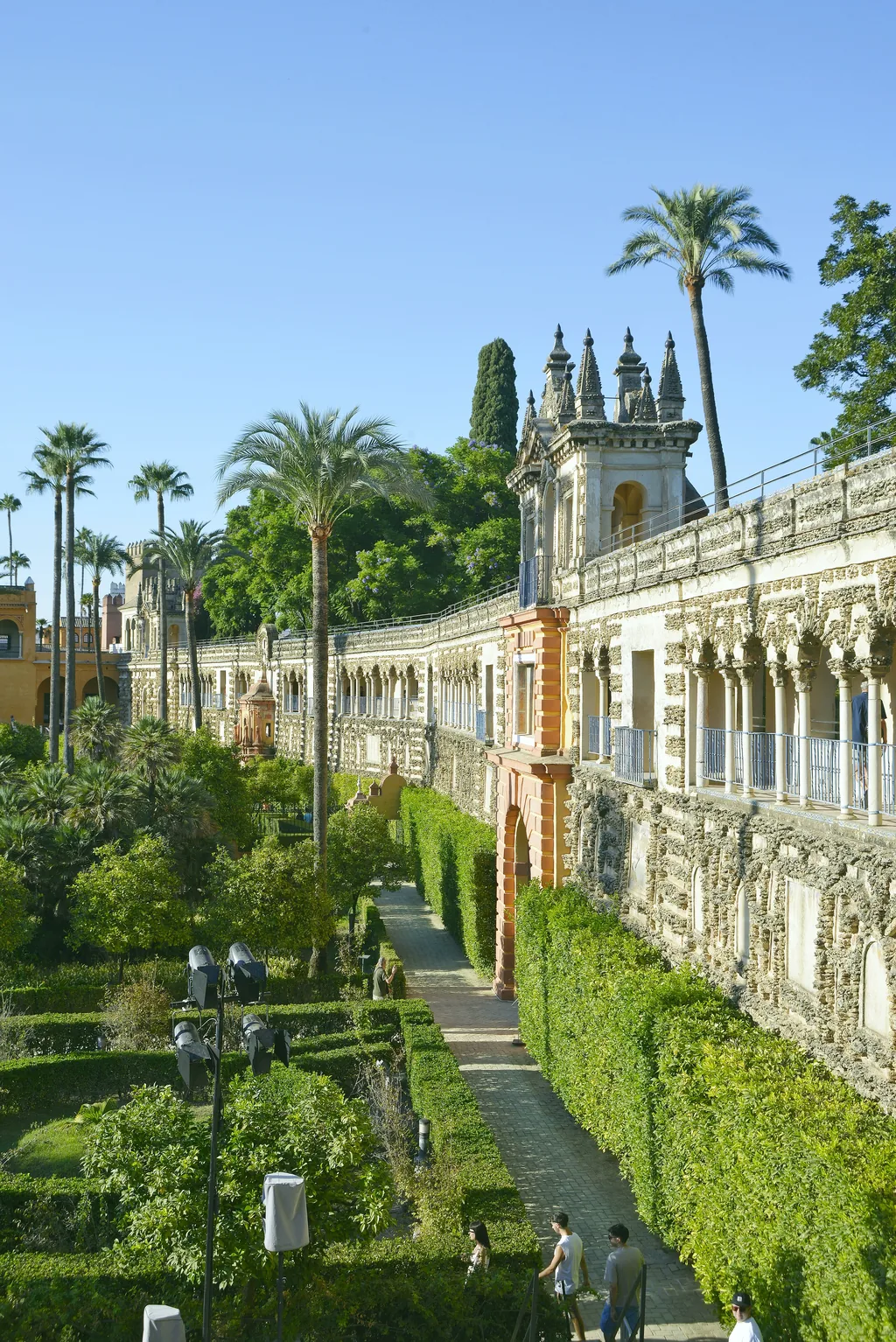
A long view down the raised gallery wall above the Alcázar gardens
The raised walk runs along the old city wall. It gives the best overview of the gardens below.
Read the guide →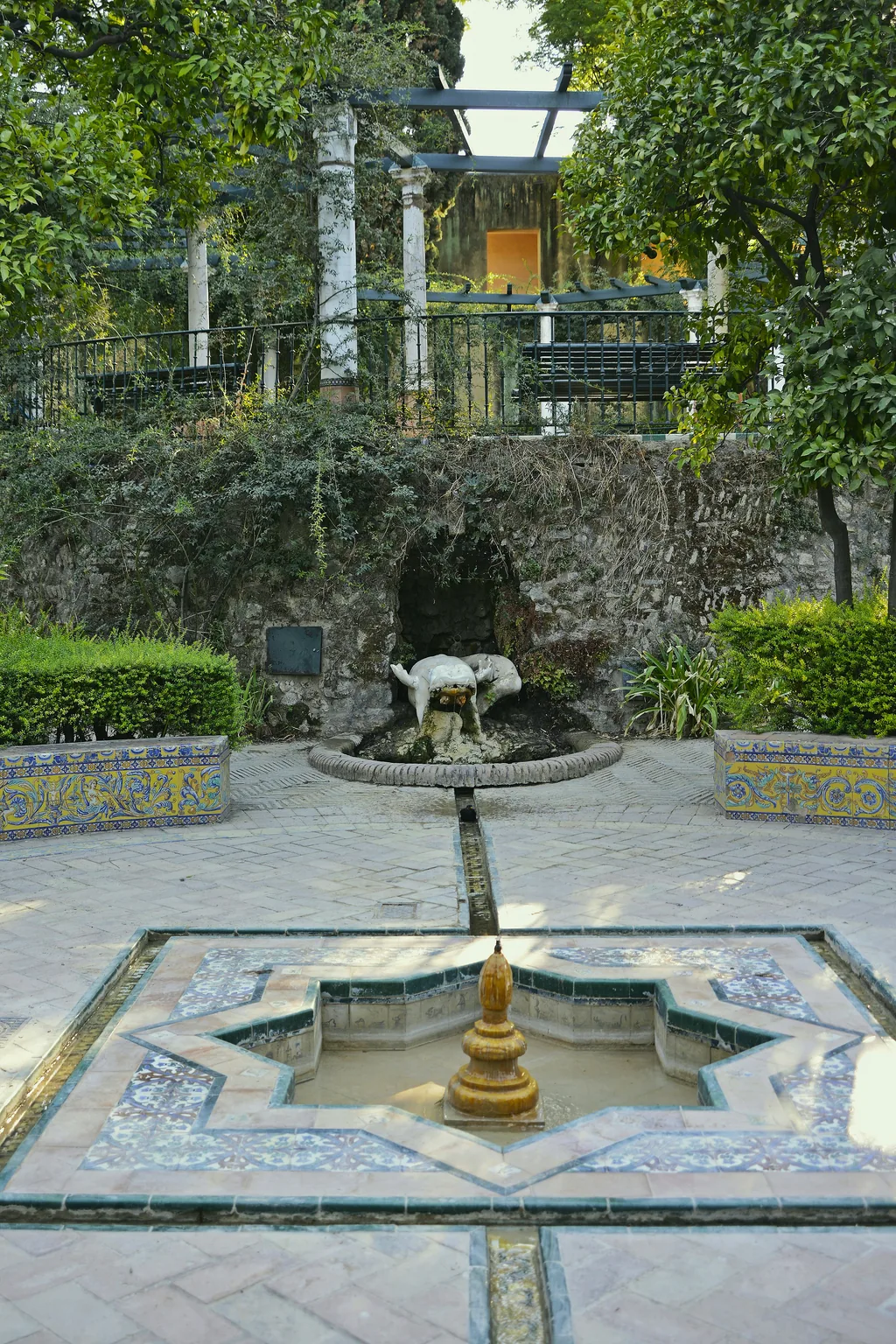
A low fountain lined with patterned azulejo tiles in the Alcázar gardens
Tilework carries on outdoors as well as in. The garden fountains are lined with the same patterns as the halls.
Read the guide →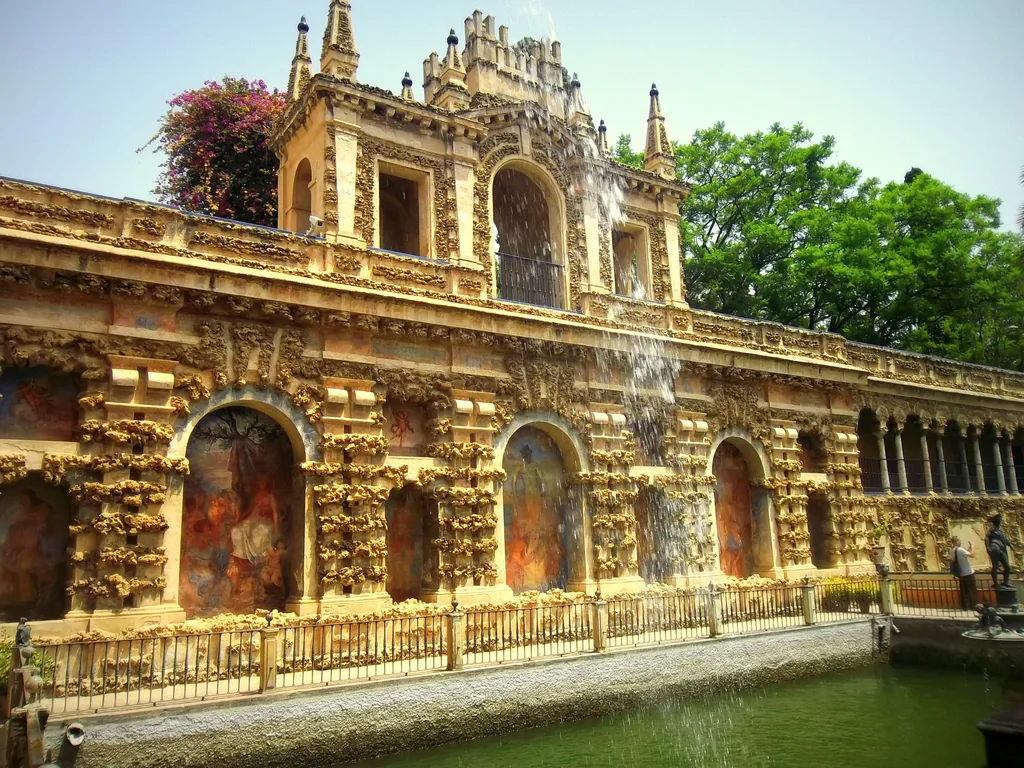
The rusticated wall of the Galería del Grutesco rising above a green garden pool
The Grutesco is a garden wall built over the old city wall, with a walkway along the top.
Read the guide →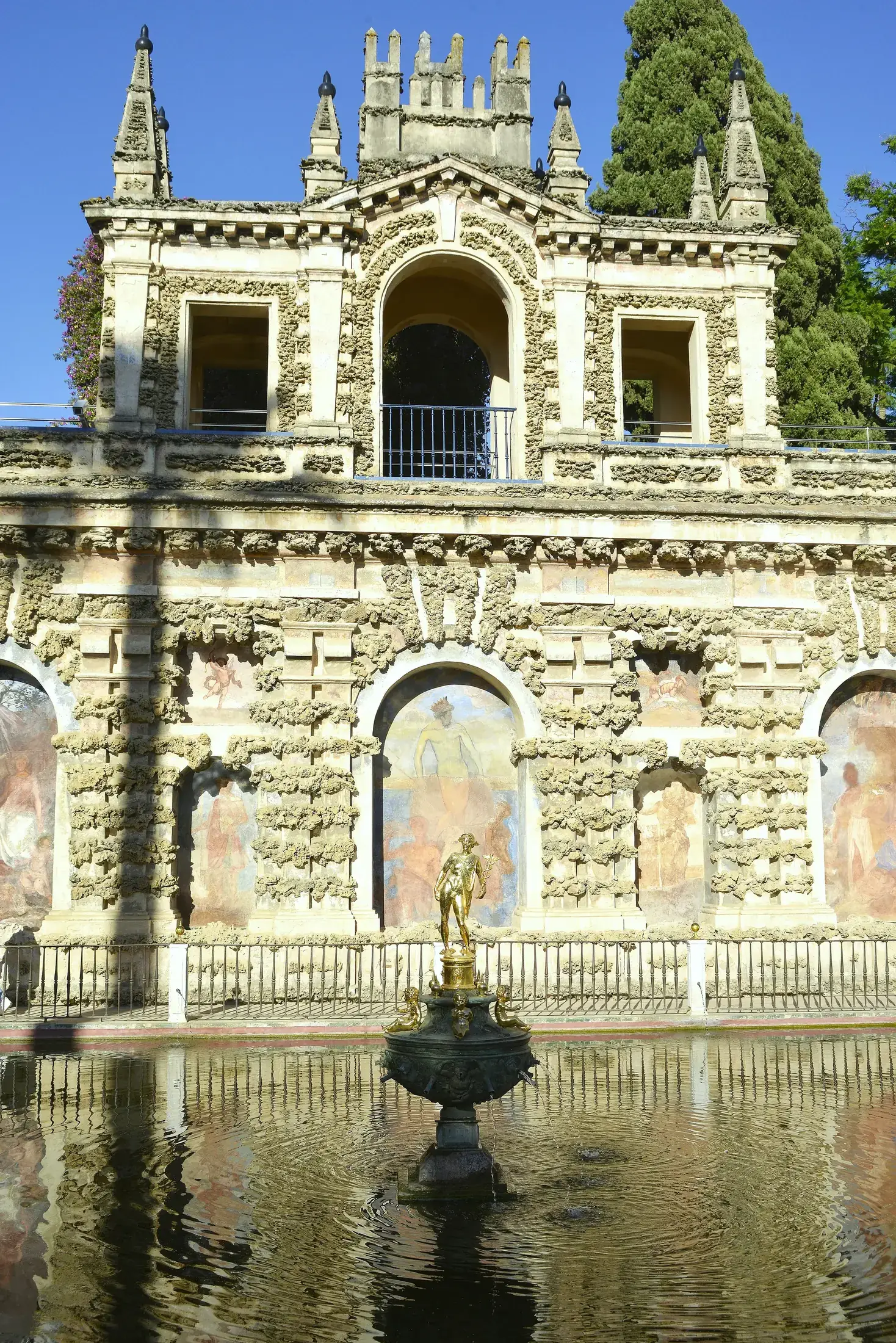
The Mercury Pool with the grotto wall behind it, the bronze Mercury on his pedestal at the centre
The pool sits where the palace meets the gardens, against the old Islamic wall that the 17th century turned into the Galería del Grutesco.
Read the guide →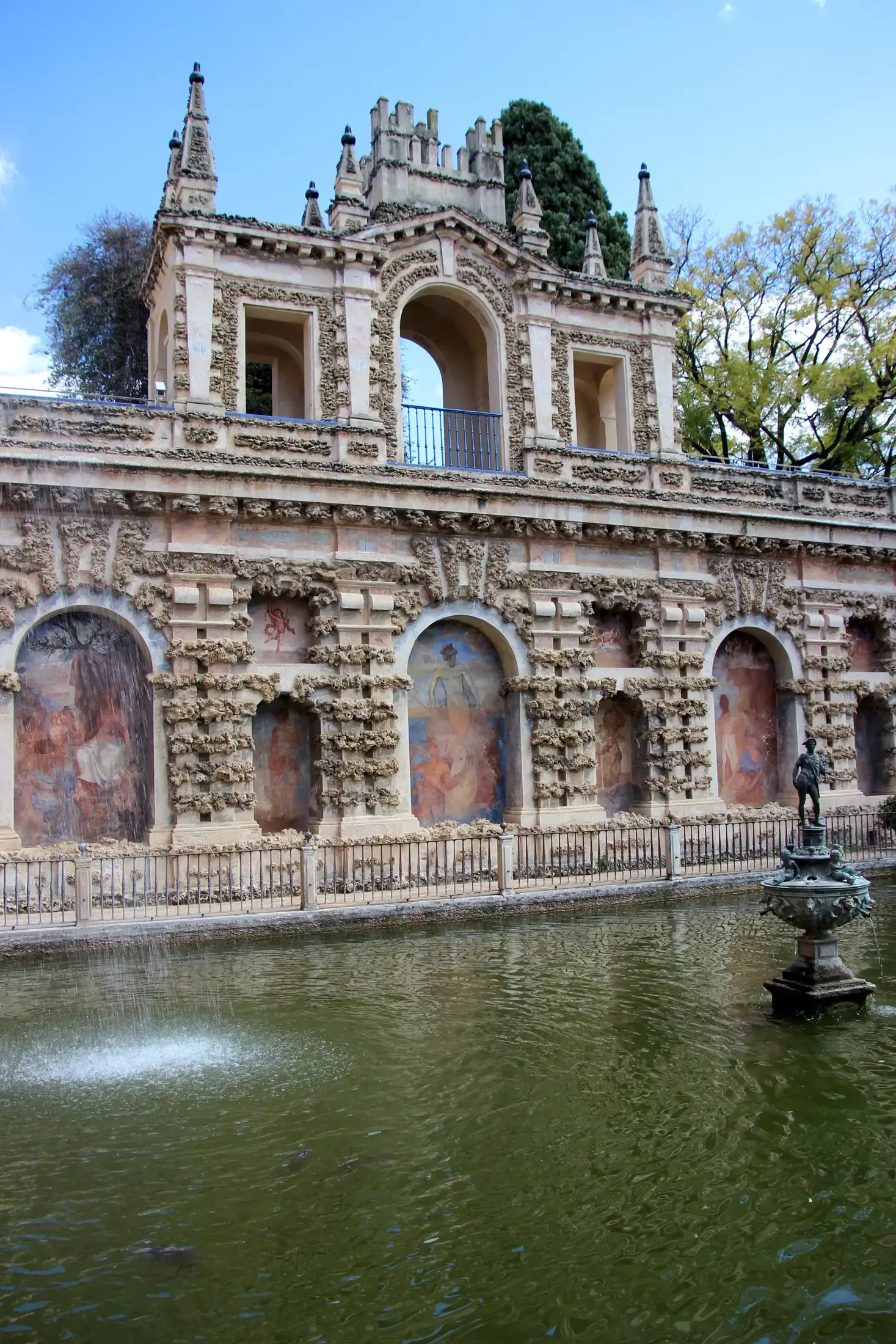
Wide view of the Mercury Pool and the painted arcaded wall above it, jets breaking the surface
The gardens were reshaped in the 17th century by the Italian Vermondo Resta, who gave this wall its Mannerist face.
Read the guide →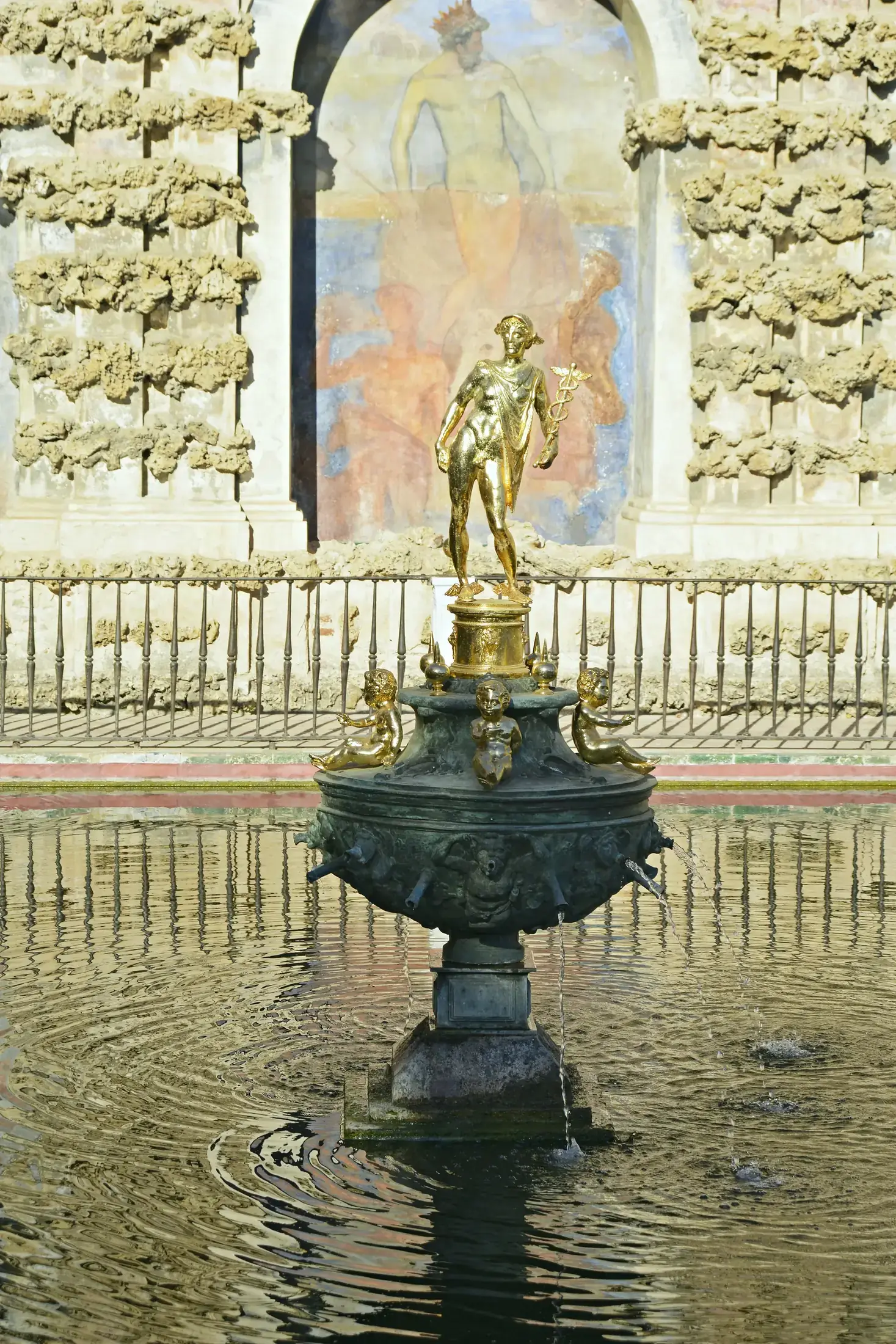
The bronze Mercury fountain close up, standing on its basin against the frescoed niche behind
The figure gives the pool its name. The Alcázar has restored it; the gardens around it are the part of the visit most people underestimate.
Read the guide →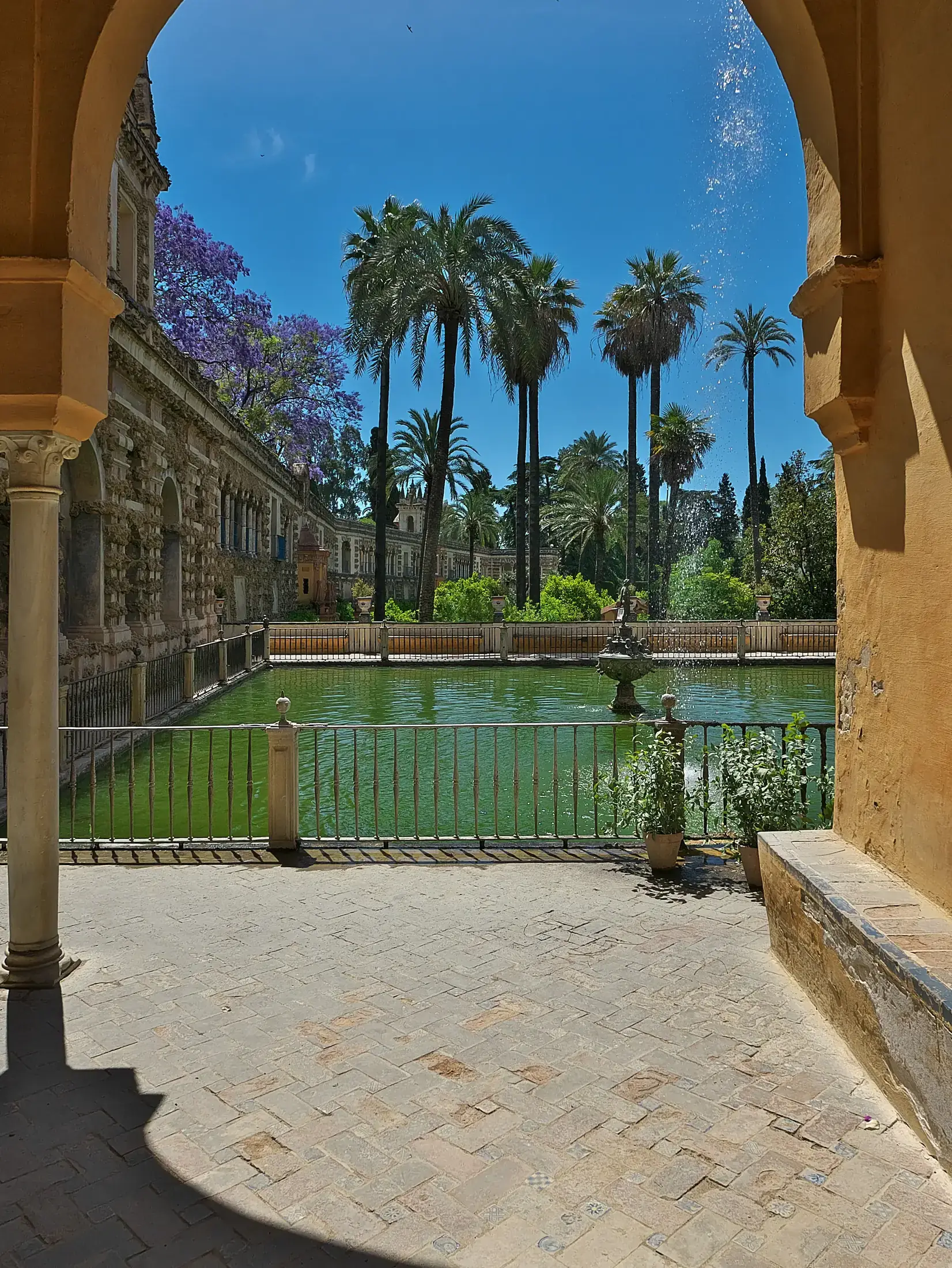
The Mercury Pool and palm trees seen through an arch of the Alcázar gardens
The pool marks the line between the palaces and the gardens. Step through and the visit changes character.
Read the guide →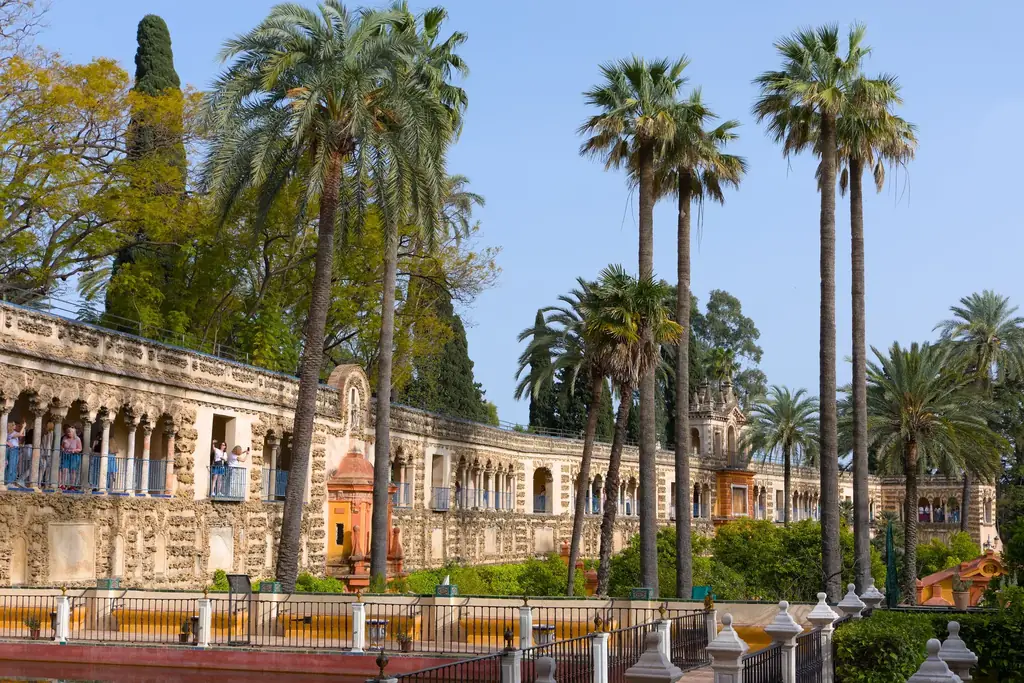
The Galería del Grutesco running the length of the gardens, palms rising in front of its long arcaded wall
The gallery is built on an old Islamic wall of the fortress, turned in the 17th century into a raised walk with views over the gardens.
Read the guide →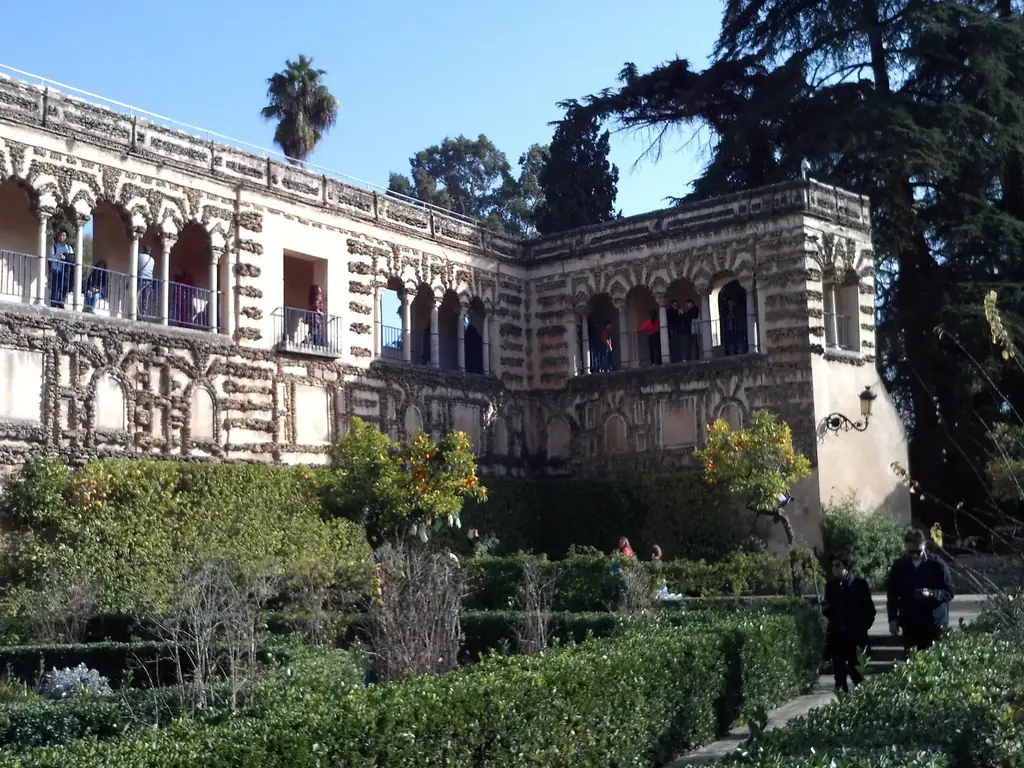
The Grutesco wall seen from the clipped hedges of the gardens below, its arcade open to the sky
From up there you look down on the box parterres; from down here you see how the fortress wall became a garden ornament.
Read the guide →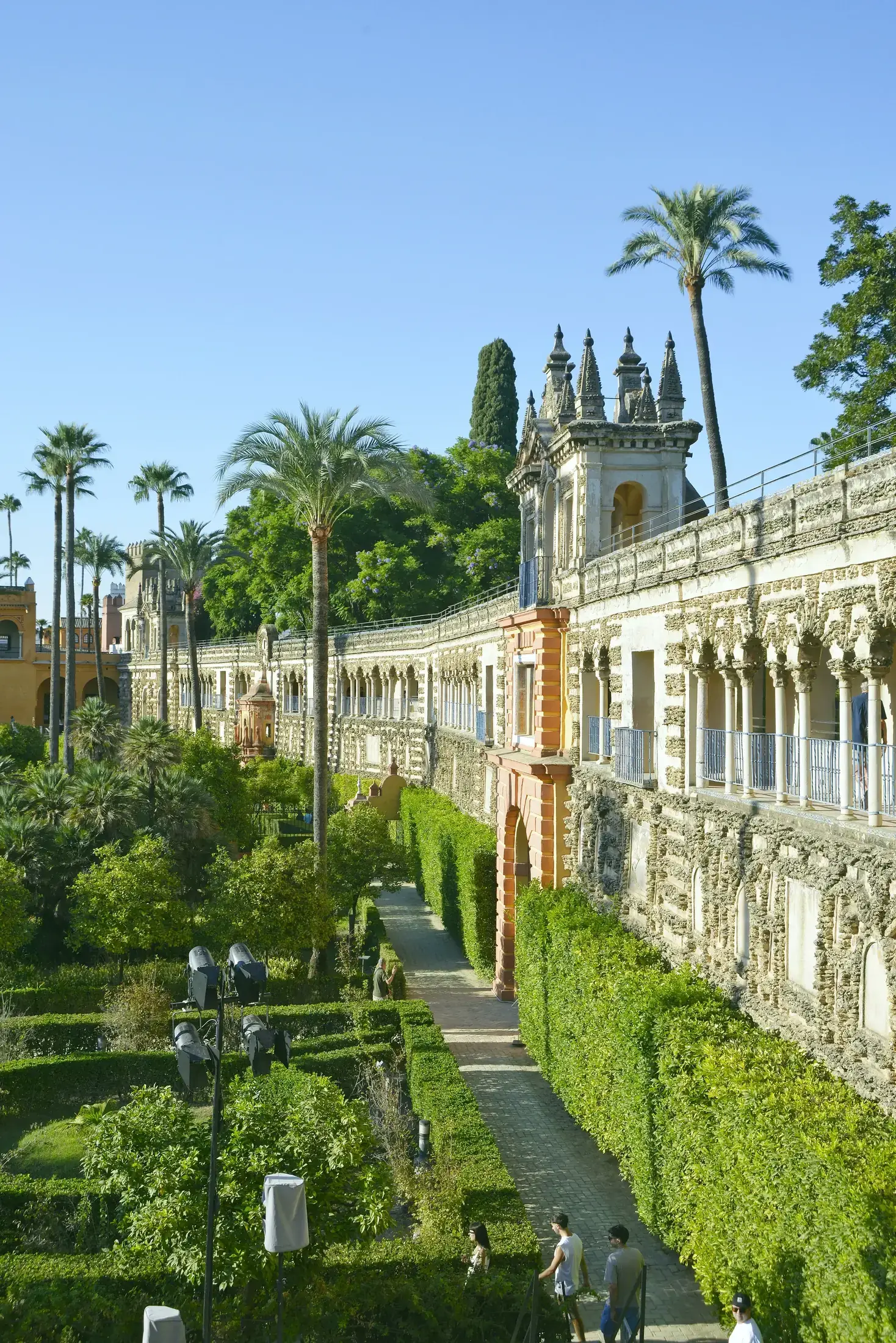
The gardens of the Real Alcázar along the Grutesco wall, box parterres and palms under a clear sky
The gardens are half the visit, not an afterthought. Allow as long for them as for the palaces.
Read the guide →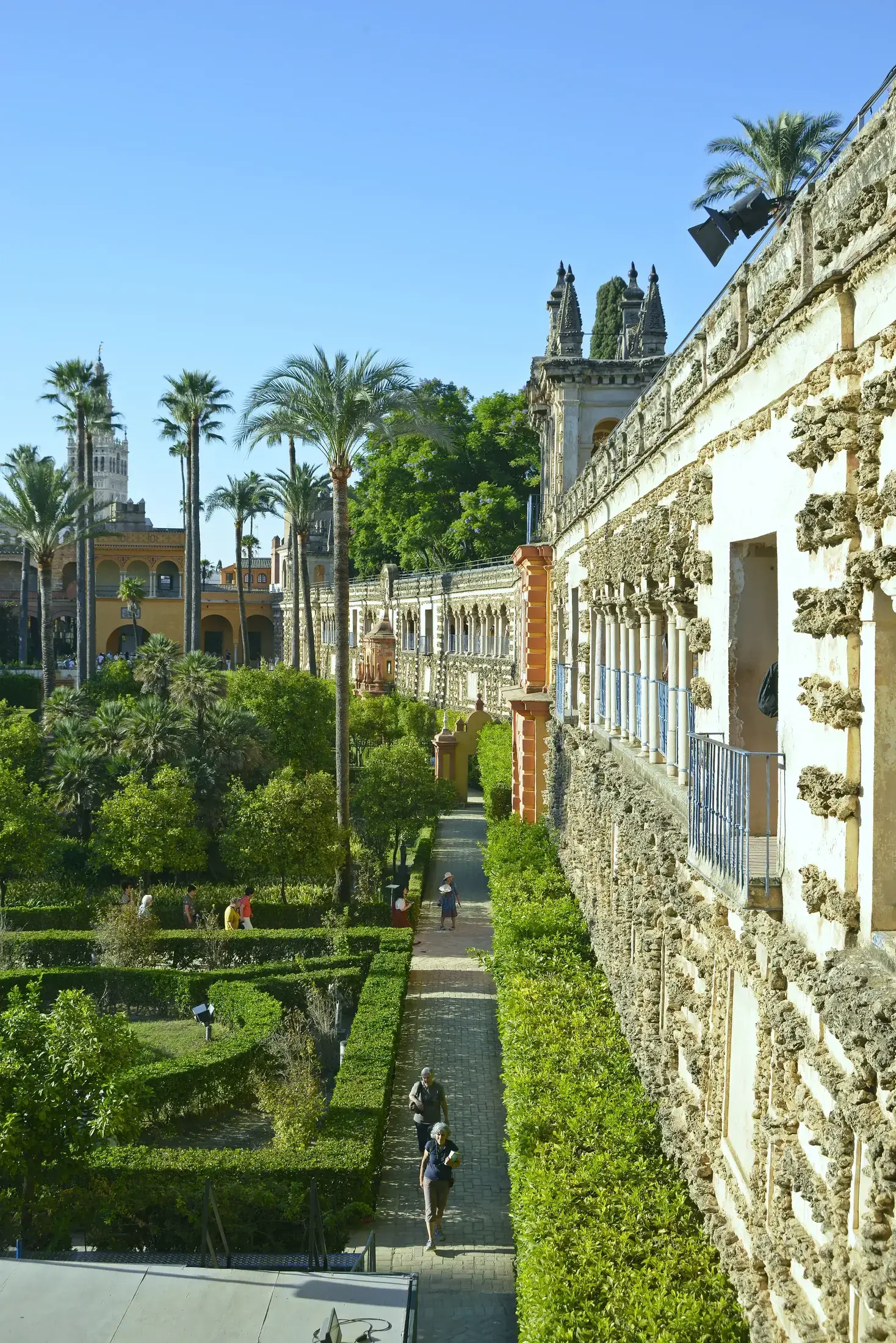
The garden terraces of the Alcázar seen from the raised walk, hedges, orange trees and palms in ranks
The terraces step down from the palace to the outer wall. In July the average high in Seville is 36.3 °C, so walk them early.
Read the guide →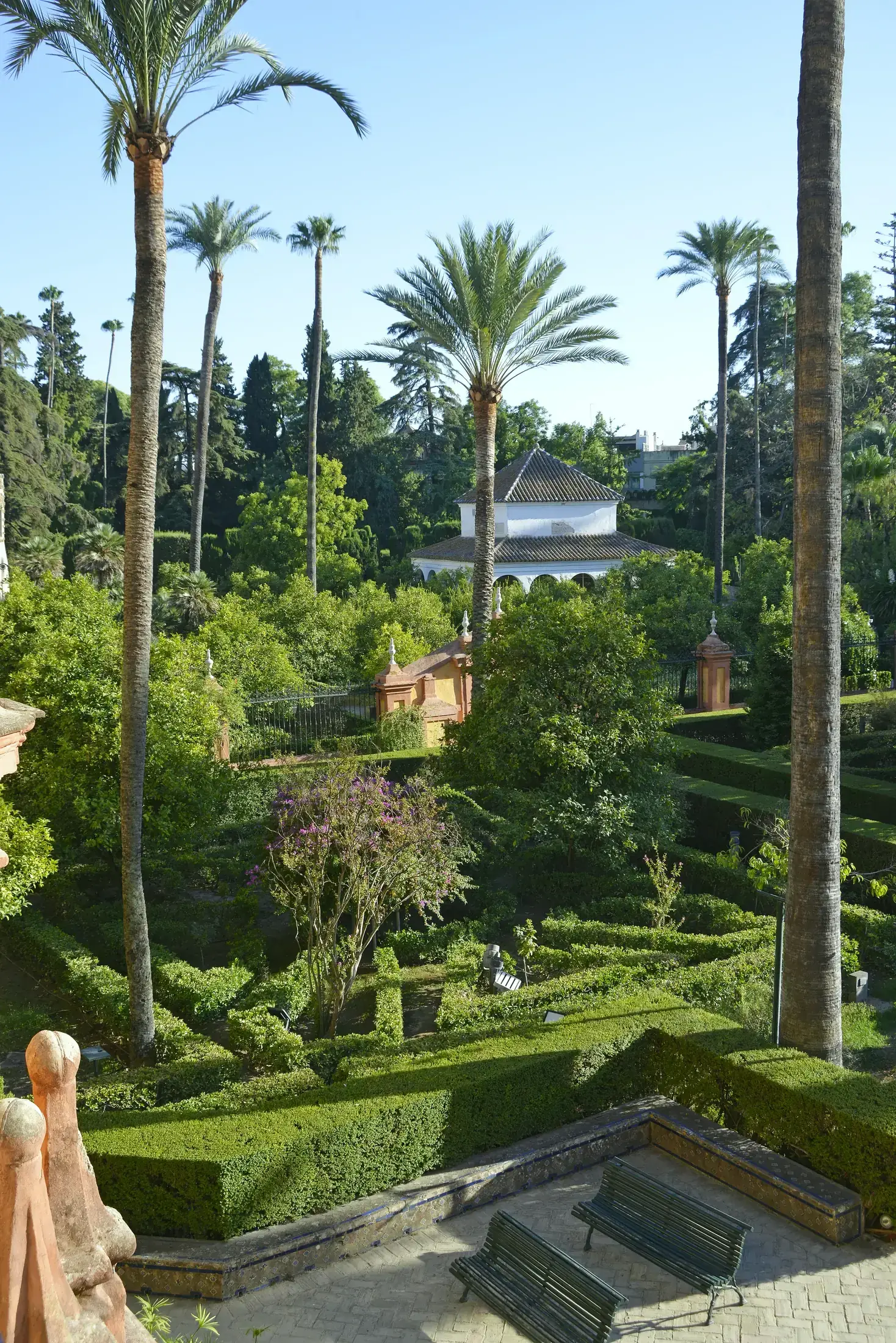
A broad view over the gardens of the Real Alcázar, palms and cypresses above the clipped hedges
Twenty minutes from the Lion Gate and the city has gone quiet. This is the reason to keep two hours free for the visit.
Read the guide →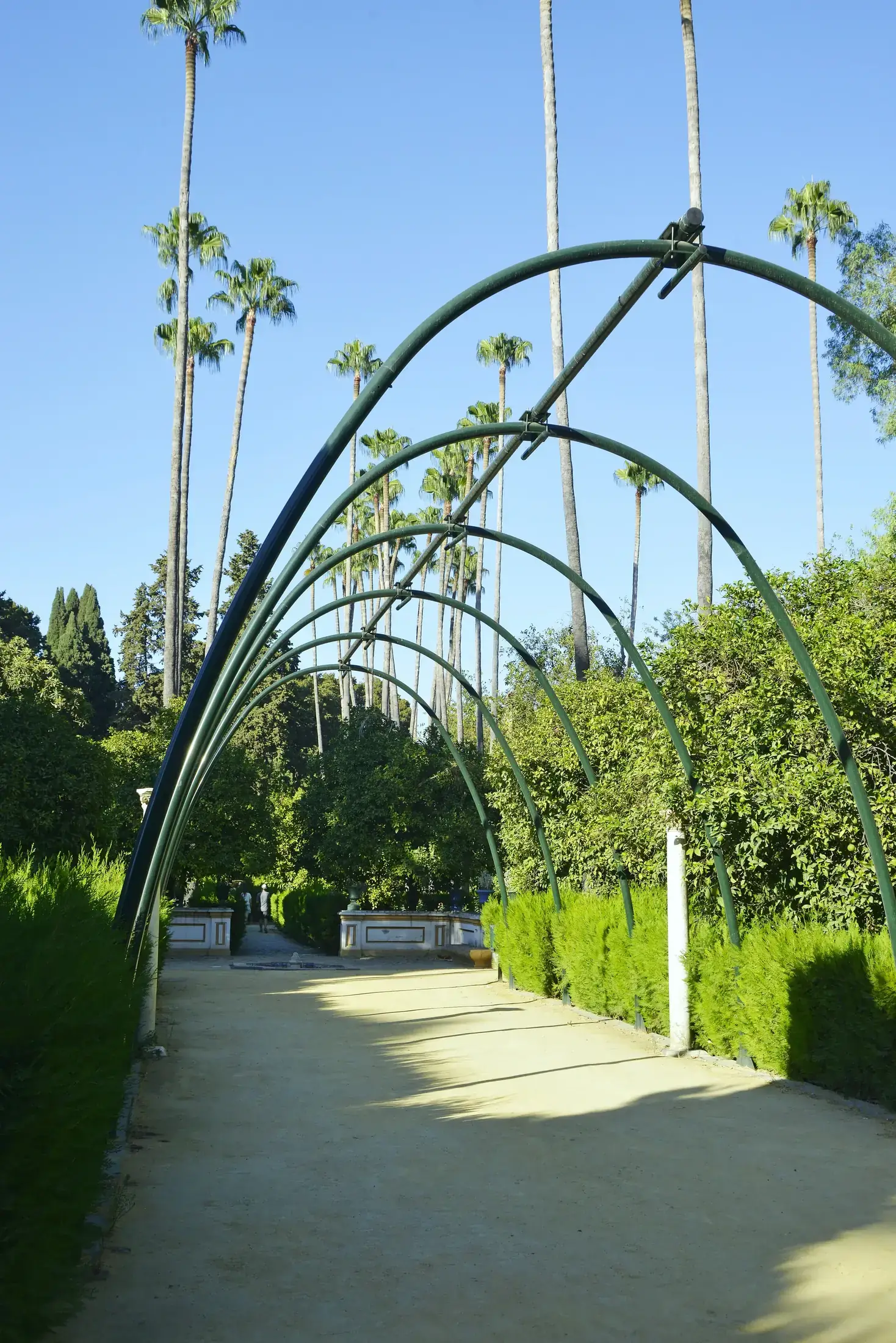
A metal pergola arching over a garden path in the Alcázar, climbers trained along its ribs
The outer gardens are the quiet half. Most visitors turn back at the Mercury Pool and never reach them.
Read the guide →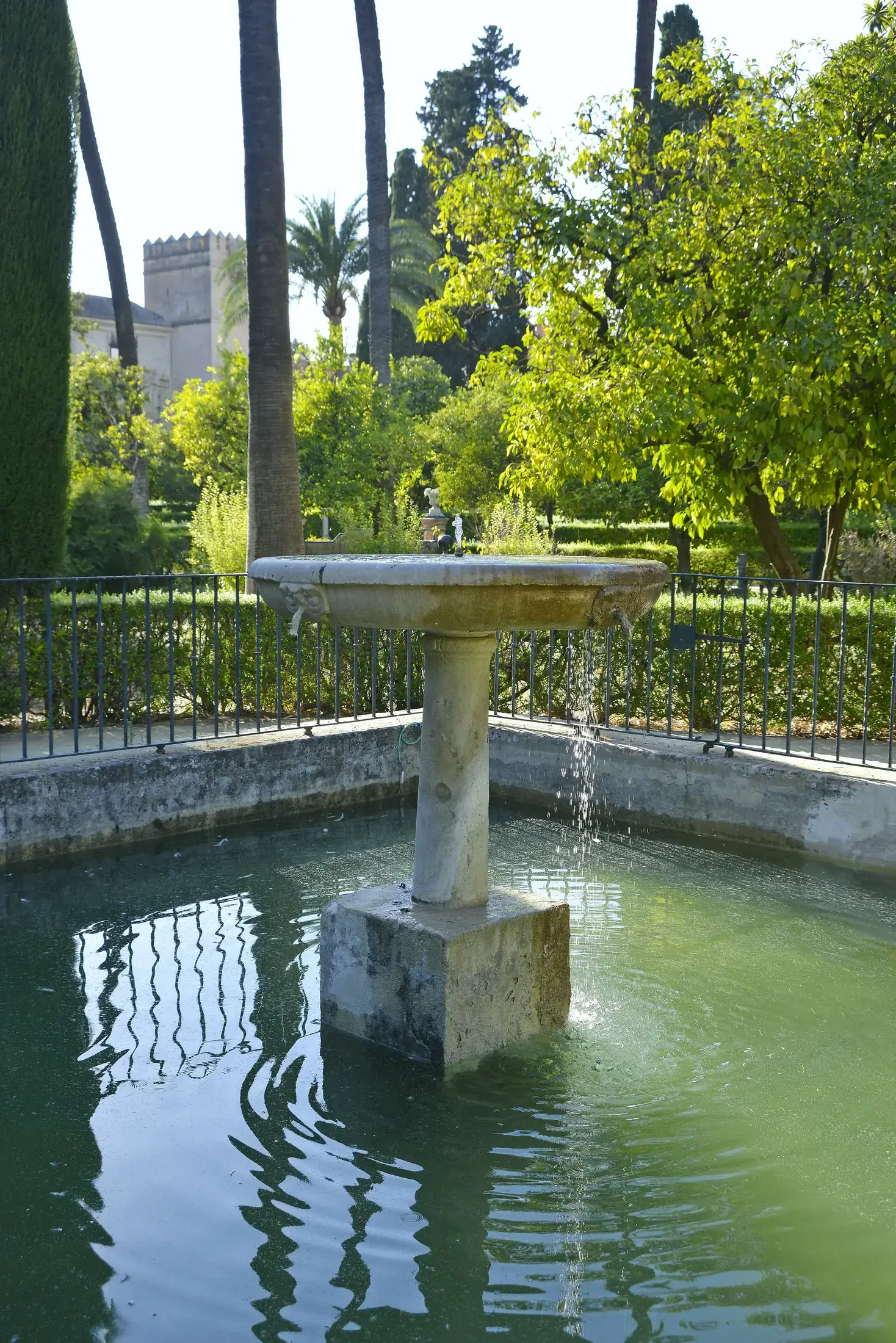
A stone fountain standing in a green pool in the gardens of the Real Alcázar, trees closing in behind
Water runs through the whole garden, in long pools and low basins. The idea comes from the gardens of al-Andalus and the palace never gave it up.
Read the guide →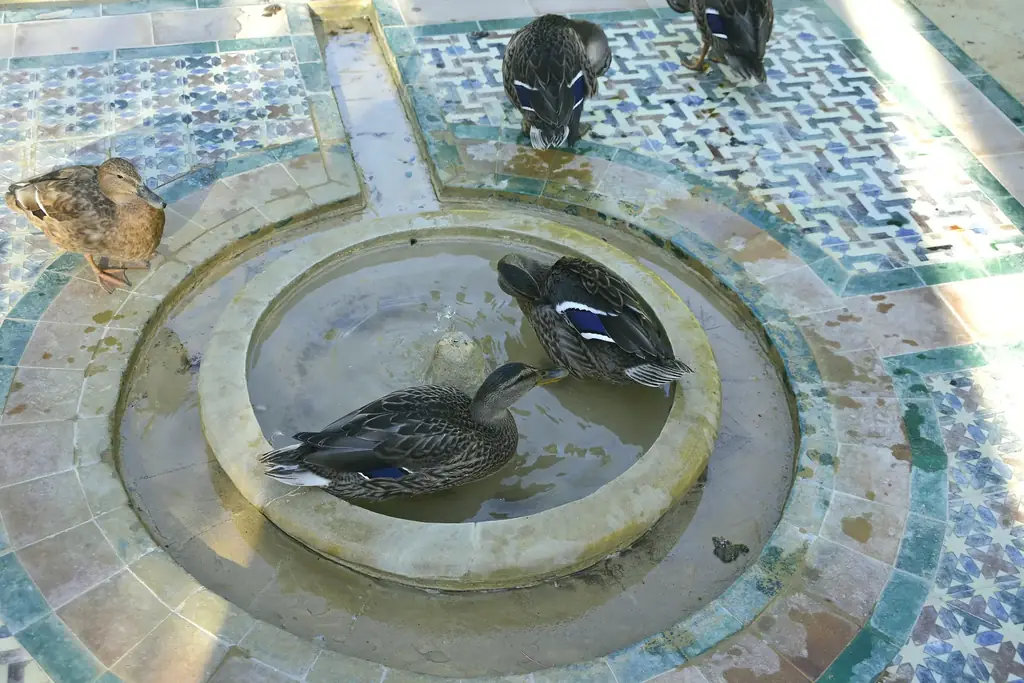
Ducks resting on the tiled rim of a low garden basin in the Alcázar, water standing in the stone bowl
The gardens are lived in. Ducks, cats and peacocks share them with the visitors, and the tilework runs right to the water.
Read the guide →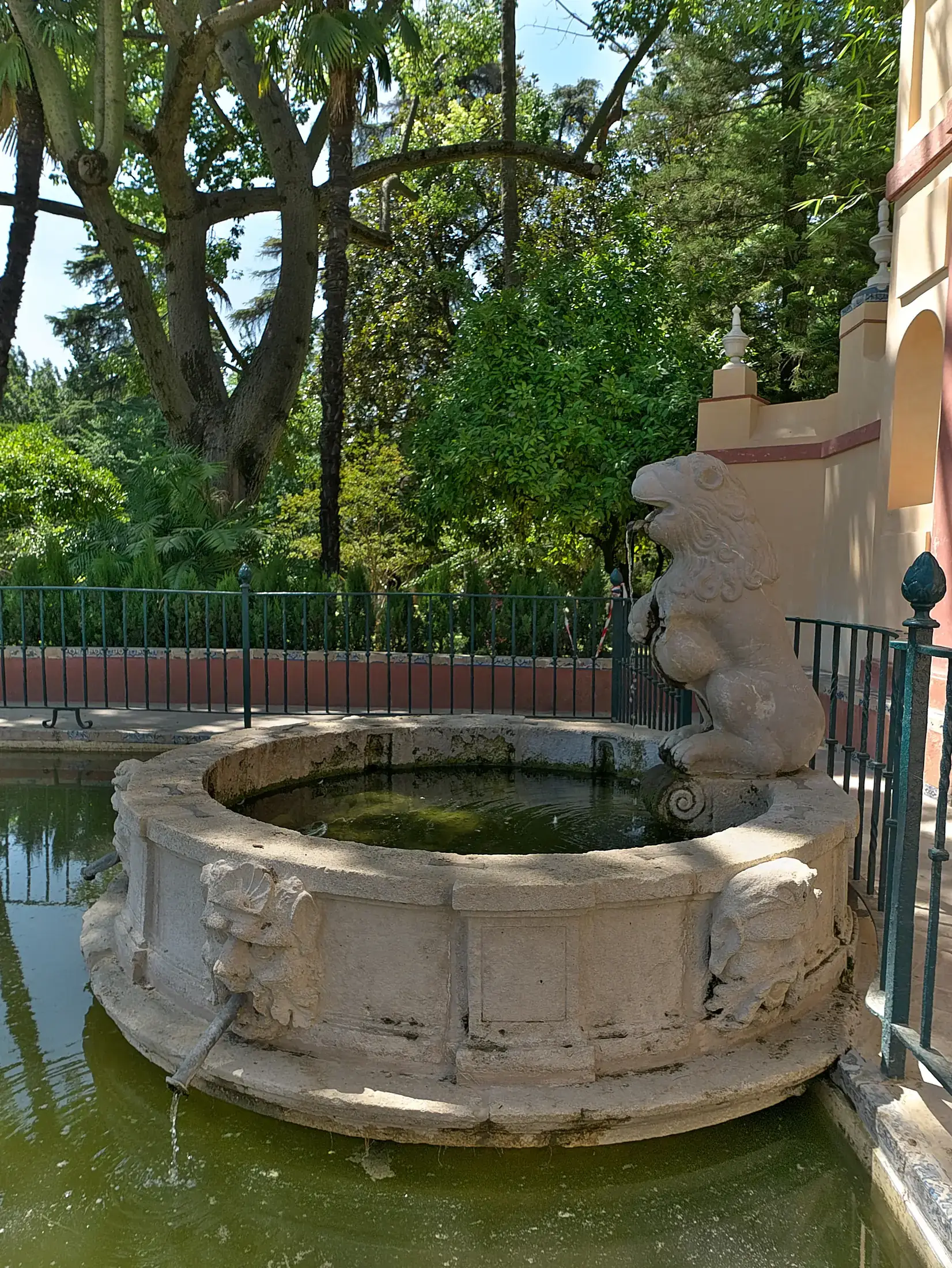
A fountain pool in the gardens of the Real Alcázar
There is a hedge maze further out, and the outer gardens stay quiet even when the palace is full.
Read the guide →Arriving: the Lion Gate
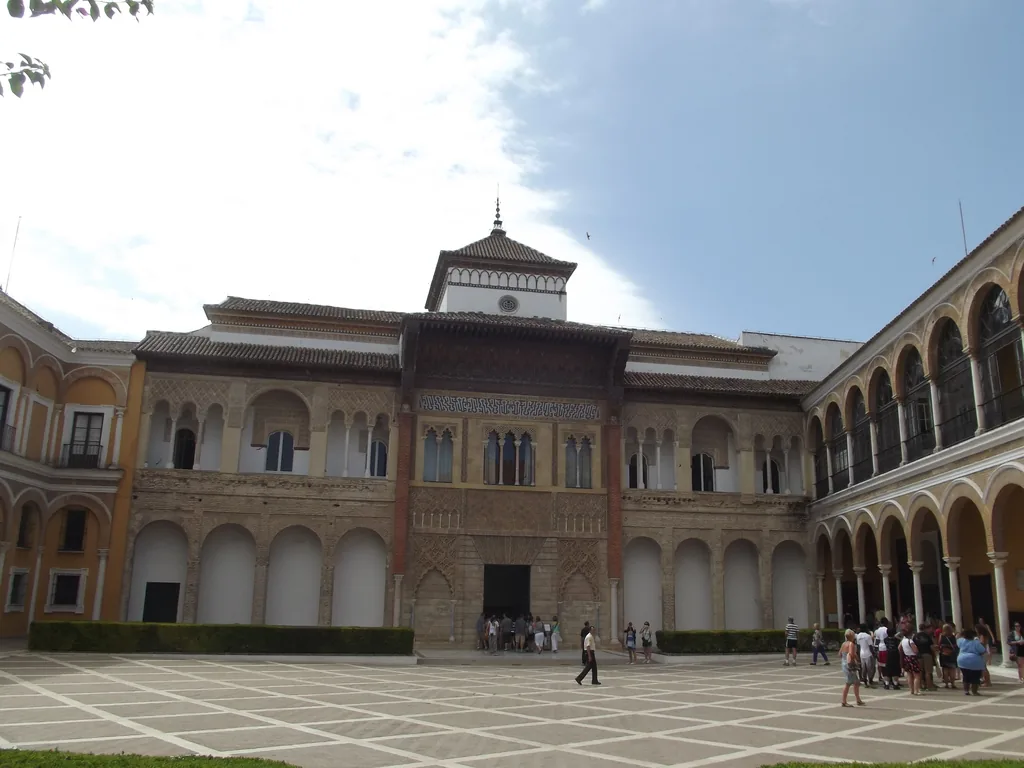
The wide courtyard of the Patio de la Montería with the palace facade at the far side
This courtyard is where timed-entry queues form. Arriving on the hour means waiting here, not outside.
Read the guide →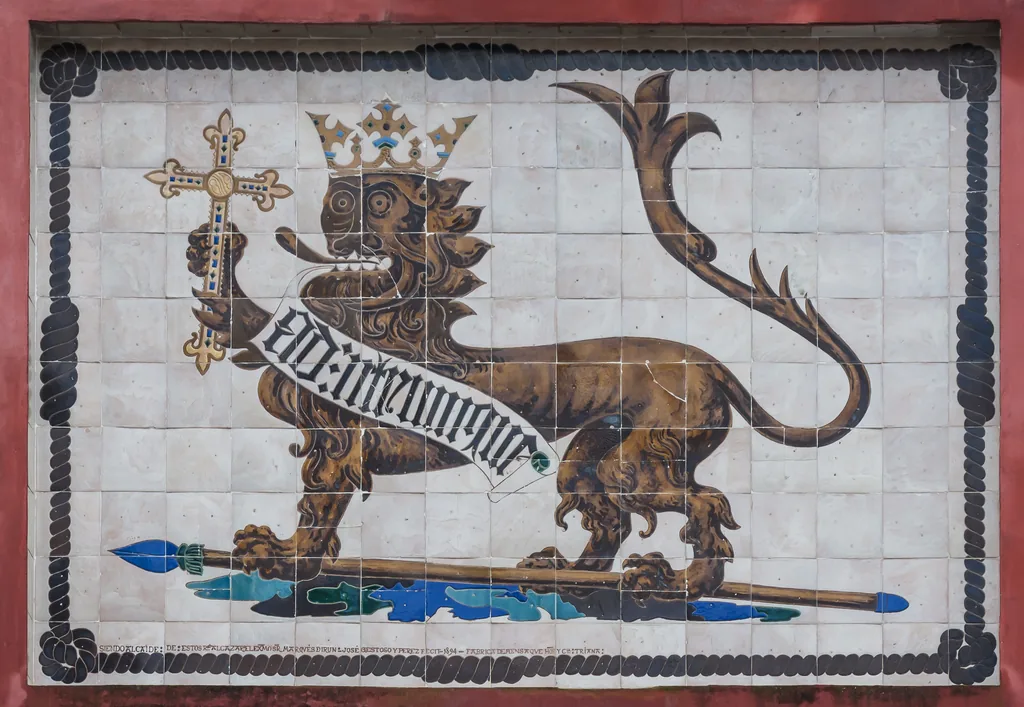
A tile panel showing a crowned lion holding a banner, framed in blue and white
The crowned lion is the emblem over the main gate, which is how the Lion Gate got its name.
Read the guide →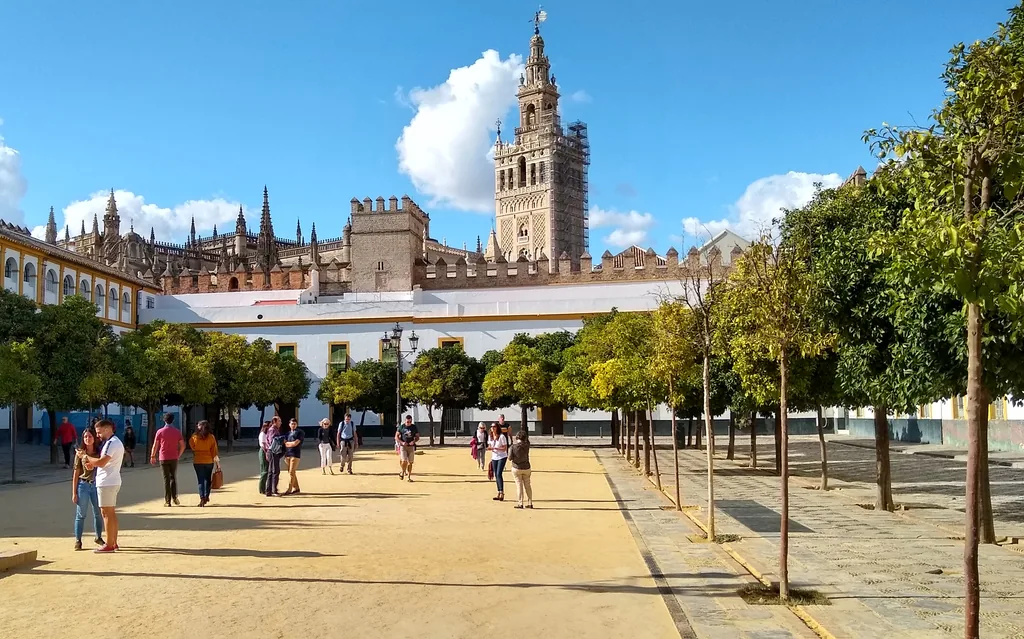
The Patio de Banderas, a wide square of orange trees enclosed by pale buildings
The exit from the Alcázar brings you out here. It is a good place to sit down before walking back into the city.
Read the guide →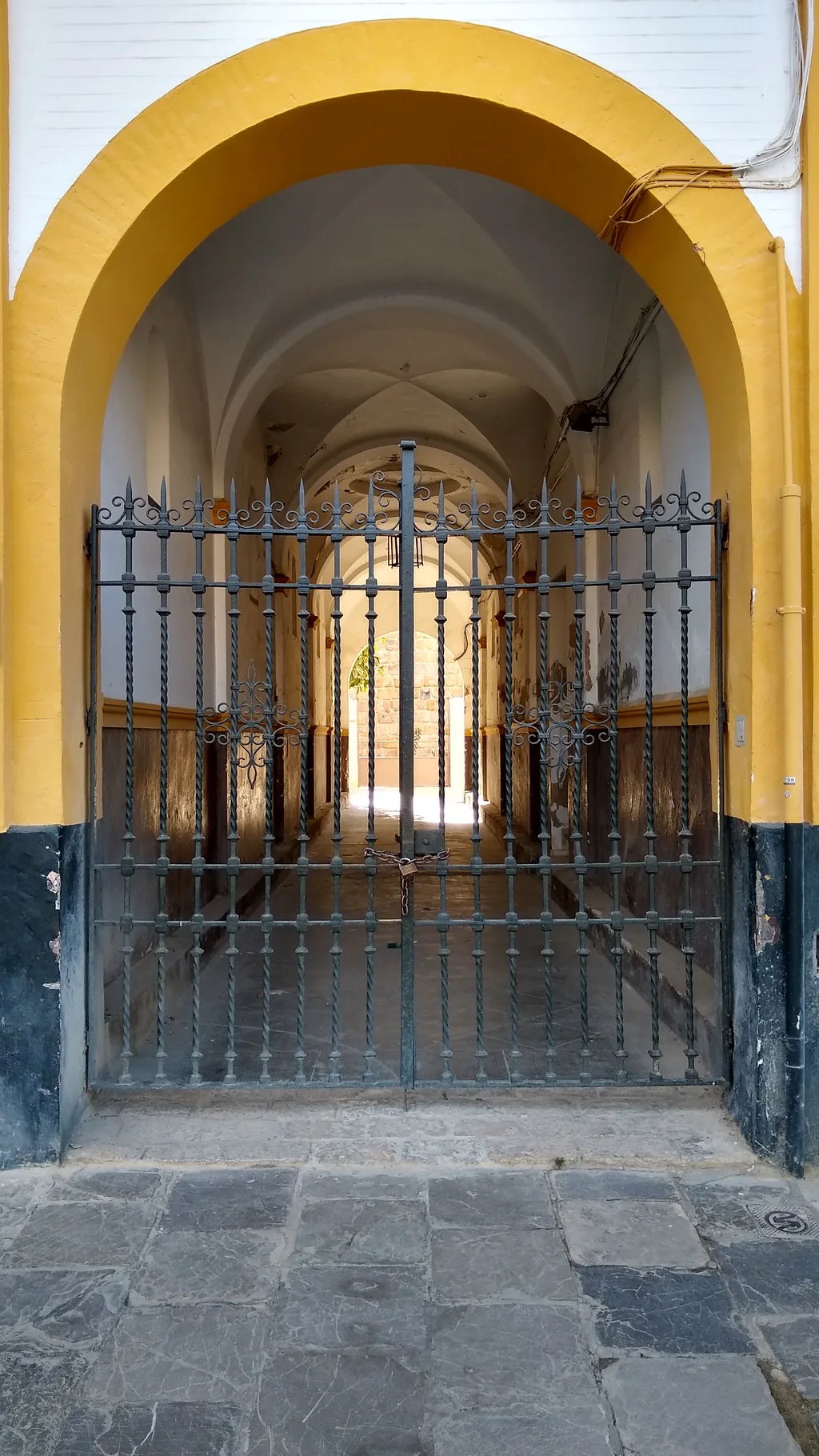
A narrow vaulted passage leading out of the Patio de Banderas
This passage leads straight into the Santa Cruz quarter, which is the obvious next hour after the Alcázar.
Read the guide →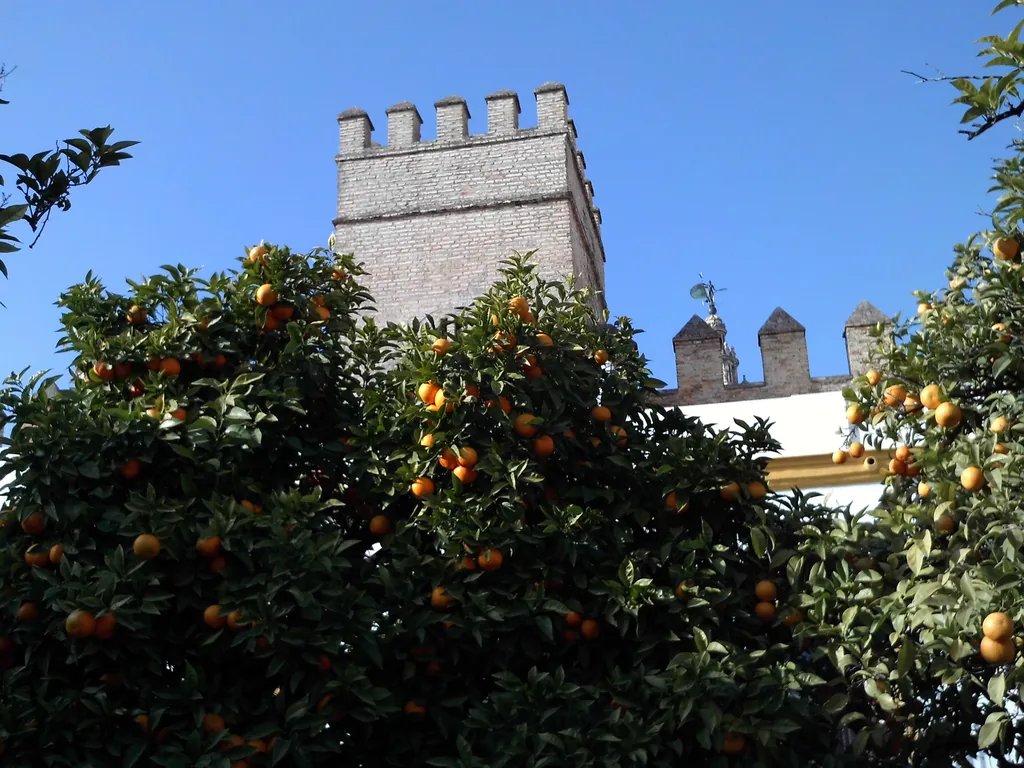
An orange tree in fruit in front of a crenellated tower of the Alcázar wall
The oranges are bitter Seville oranges, grown for marmalade and not for eating off the tree.
Read the guide →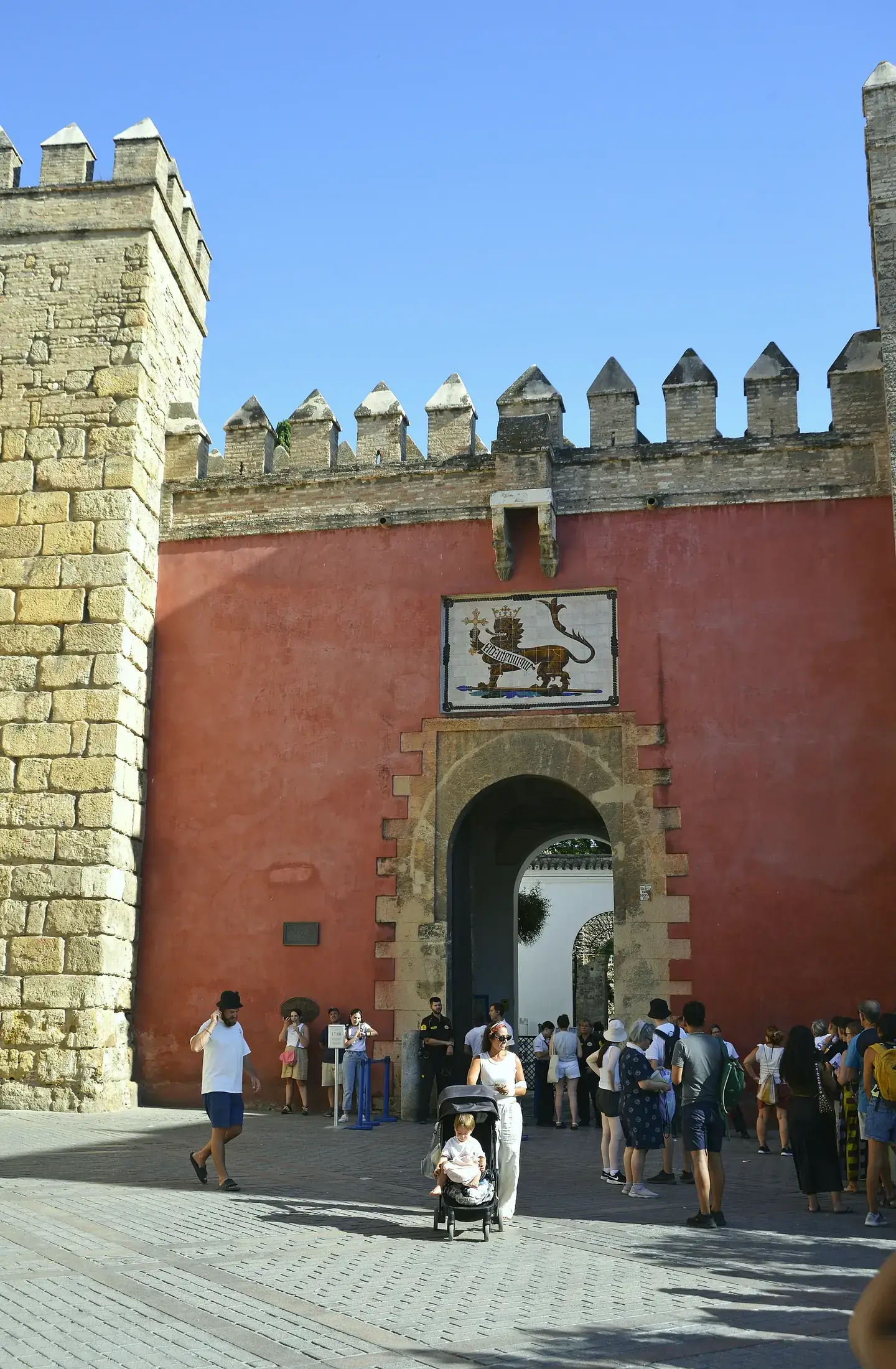
The Puerta del León, the visitors' entrance to the Real Alcázar, with its red wall and crenellated top
This is where your timed ticket is scanned. Arrive a few minutes before the hour printed on it.
Read the guide →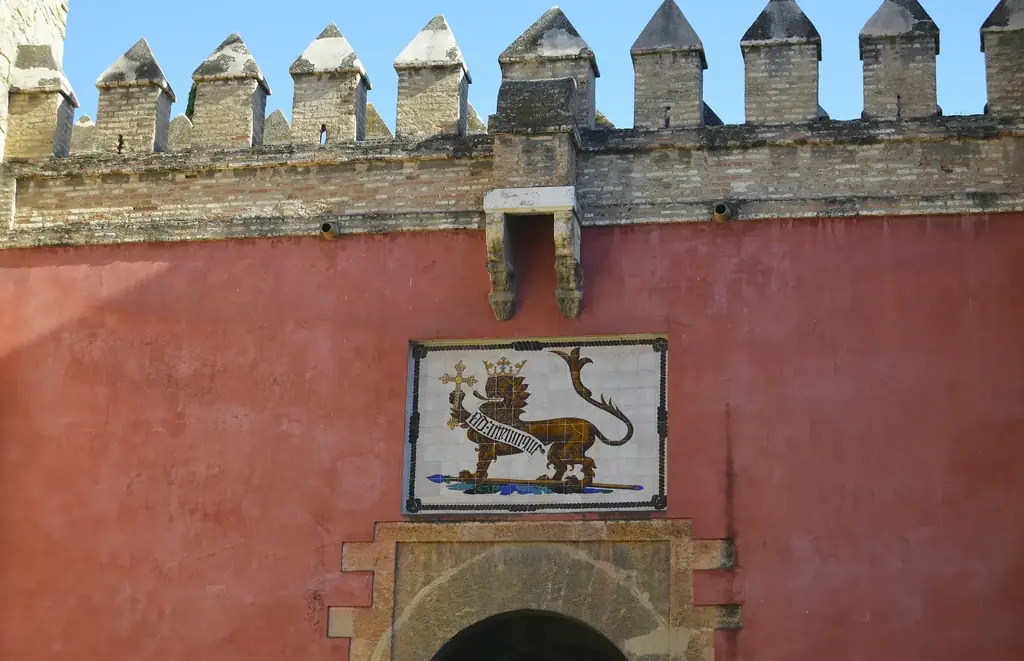
The heraldic lion in azulejos above the Puerta del León, a crowned lion holding a cross on a red wall
The tiled lion that gives the gate its name, and the first piece of Sevillian ceramic you meet on the visit.
Read the guide →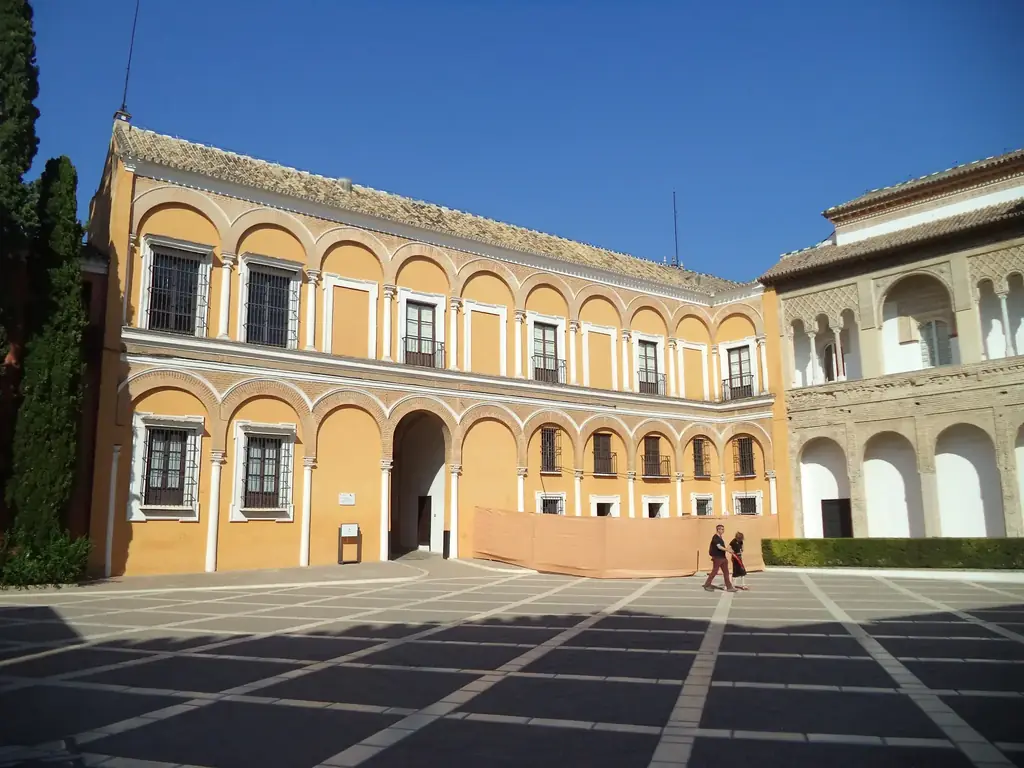
The east side of the Patio de la Montería, the courtyard in front of the façade of Pedro I's palace
You cross this courtyard after the gate. Beneath it lie the remains of al-Mubarak, the 11th-century Abbadid palace.
Read the guide →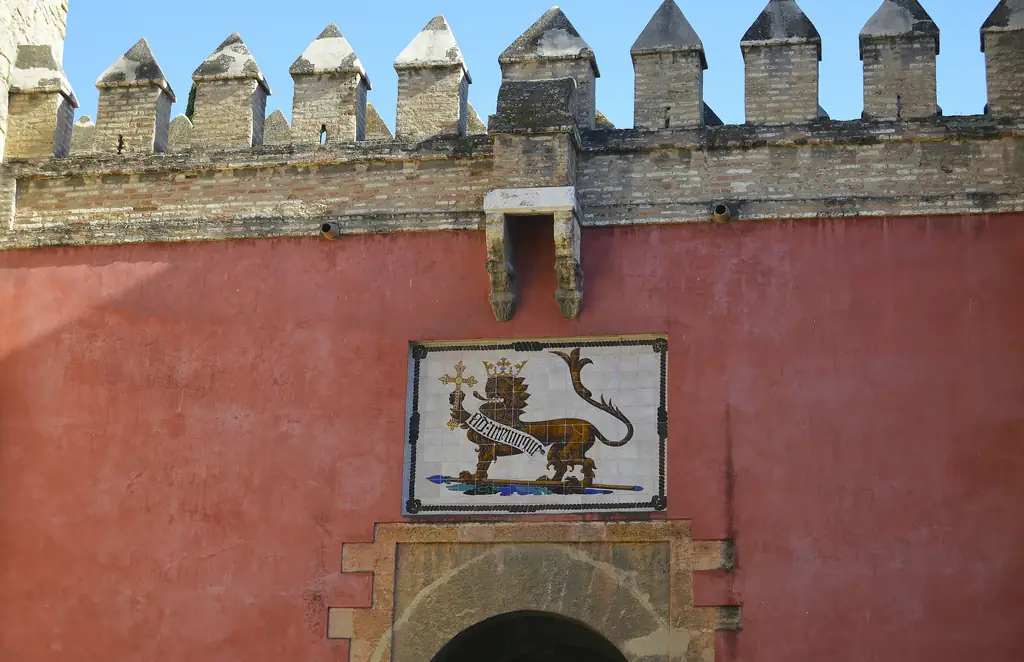
The Lion Gate, the visitors' entrance, with its tiled heraldic lion on a red wall
The queue here is outdoors and can run to an hour in high season. A timed ticket or a tour with entry included skips it.
Read the guide →Around the Alcázar
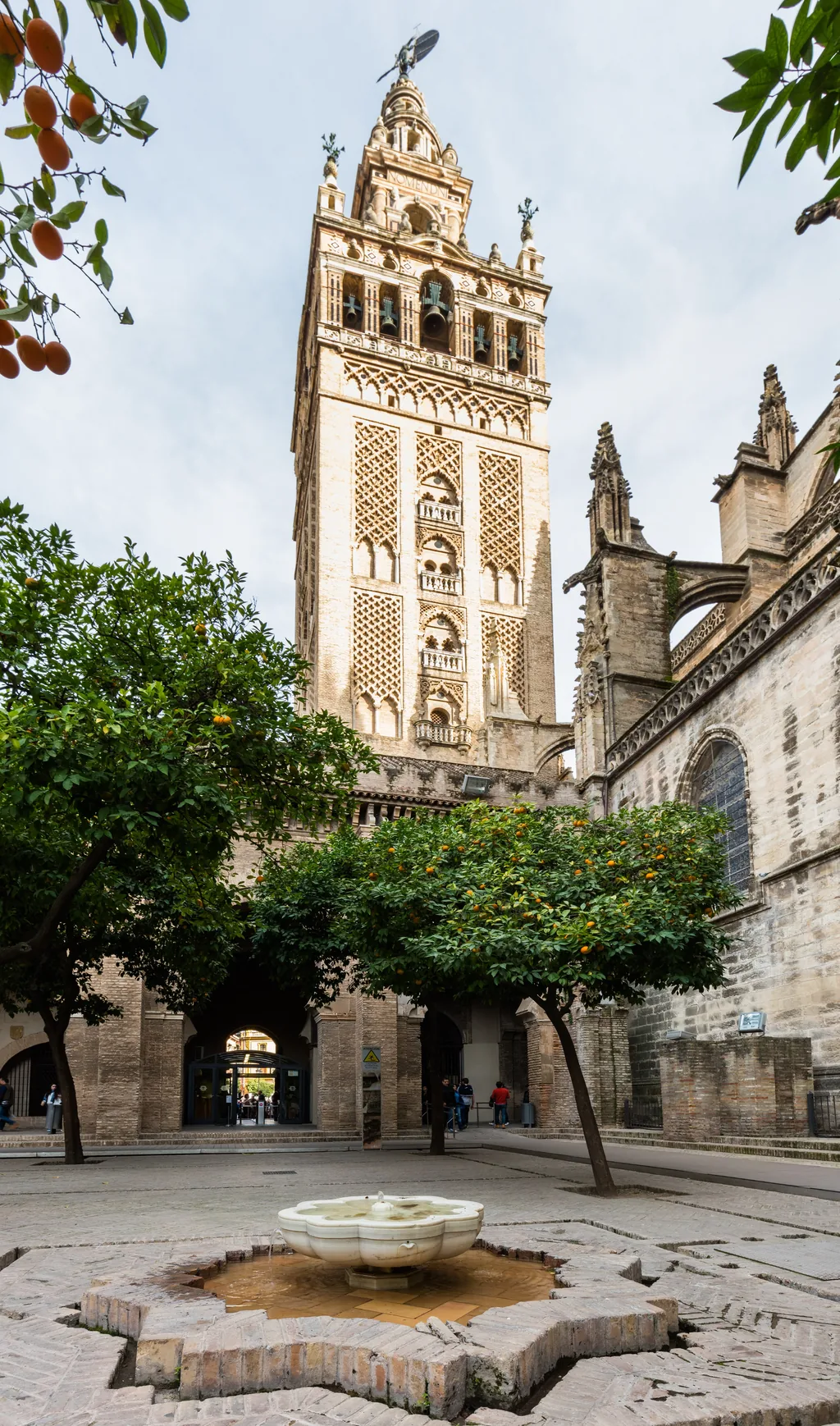
The Giralda rising above the orange trees and fountain of the Patio de Banderas
The Patio de Banderas is outside the ticket line and free to walk into. It is the best free view of the tower.
Read the guide →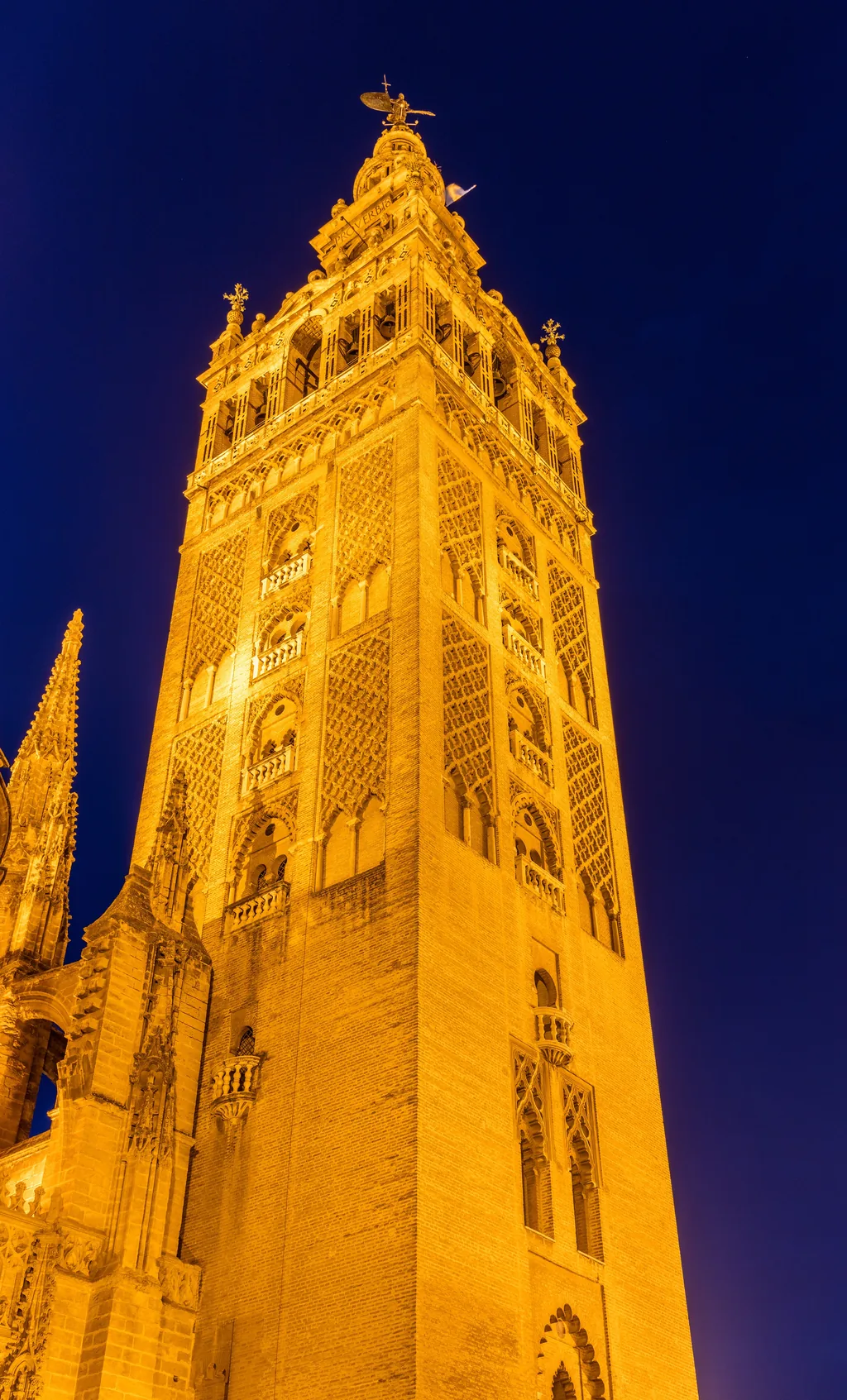
The Giralda floodlit against a deep blue evening sky
The tower is lit after dark and free to look at. The Cathedral itself closes well before the light show starts.
Read the guide →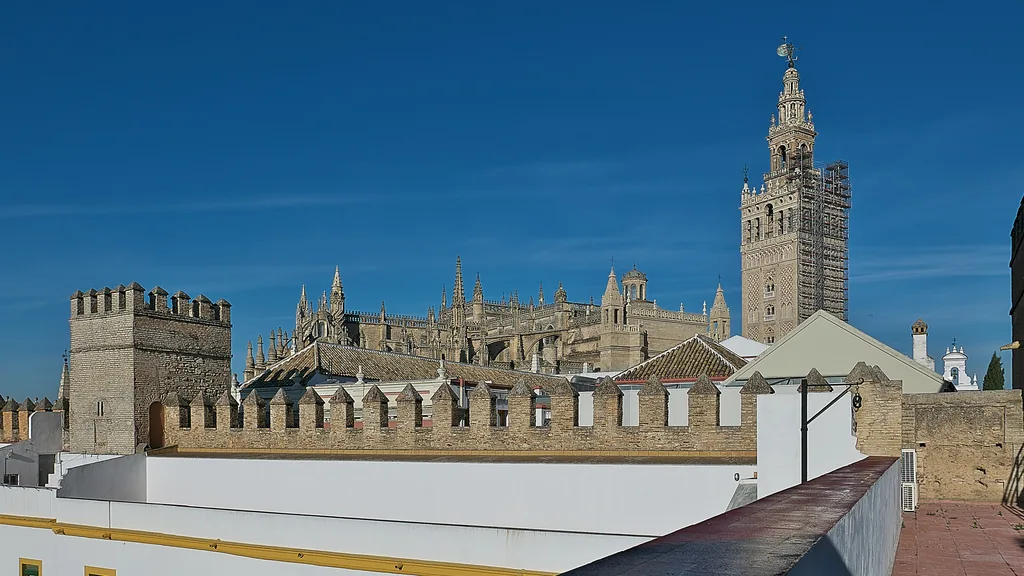
Seville Cathedral and the Giralda seen over the rooftops from inside the Alcázar
The two monuments share a UNESCO listing and stand a two-minute walk apart.
Read the guide →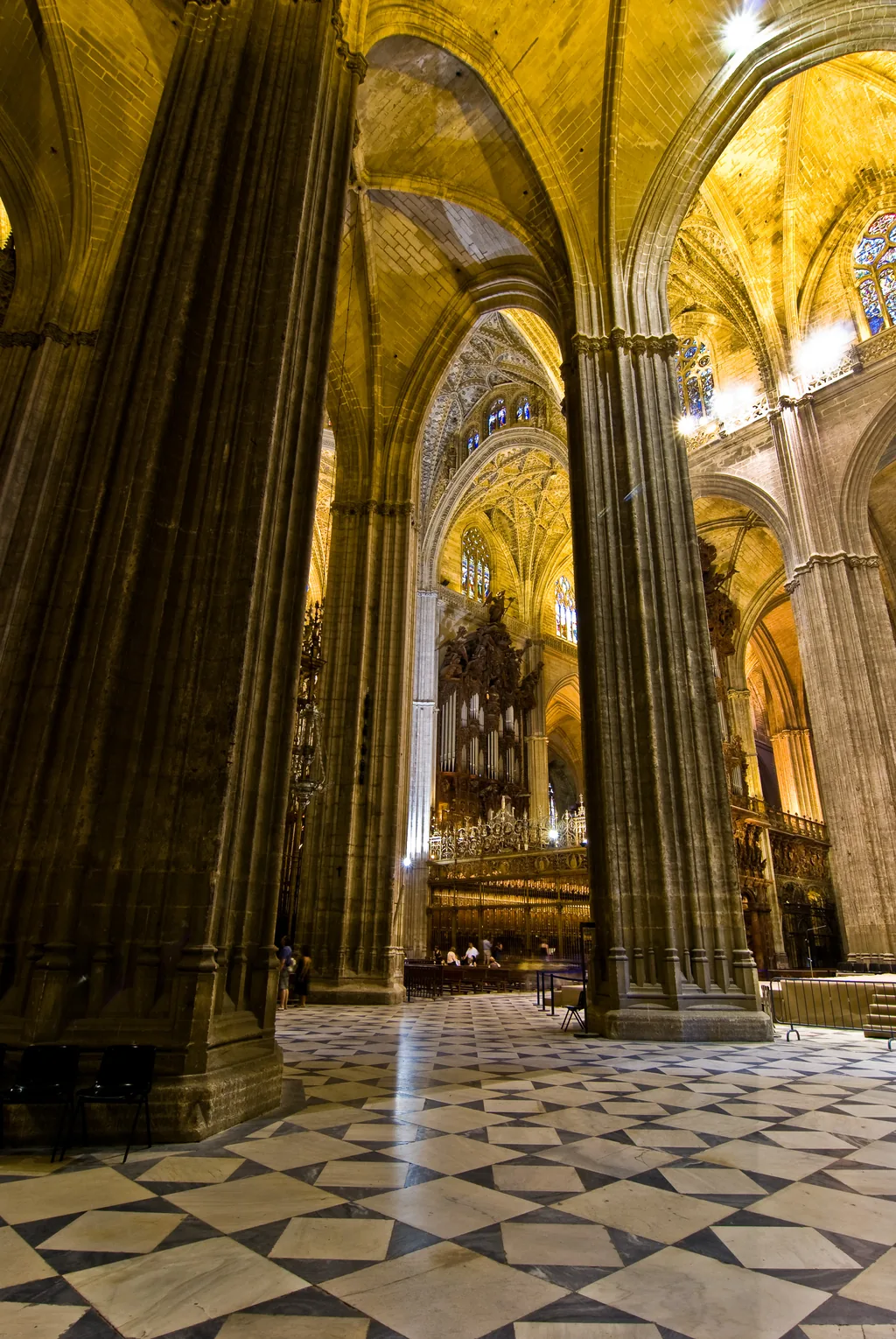
The nave of Seville Cathedral looking towards the choir and its dark timber roof
Built on the footprint of the mosque the Giralda once served, which is why the plan is so wide.
Read the guide →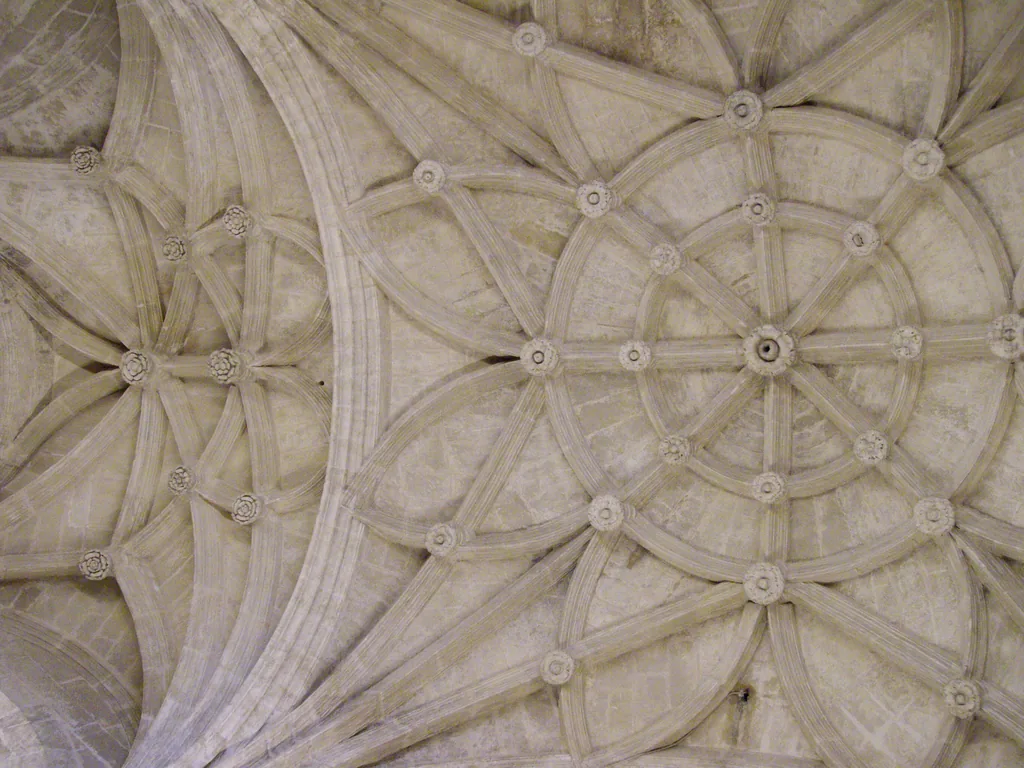
The ribbed stone vault of Seville Cathedral seen from directly below
Seville Cathedral is among the largest churches in the world by volume, and the vaults are where you feel it.
Read the guide →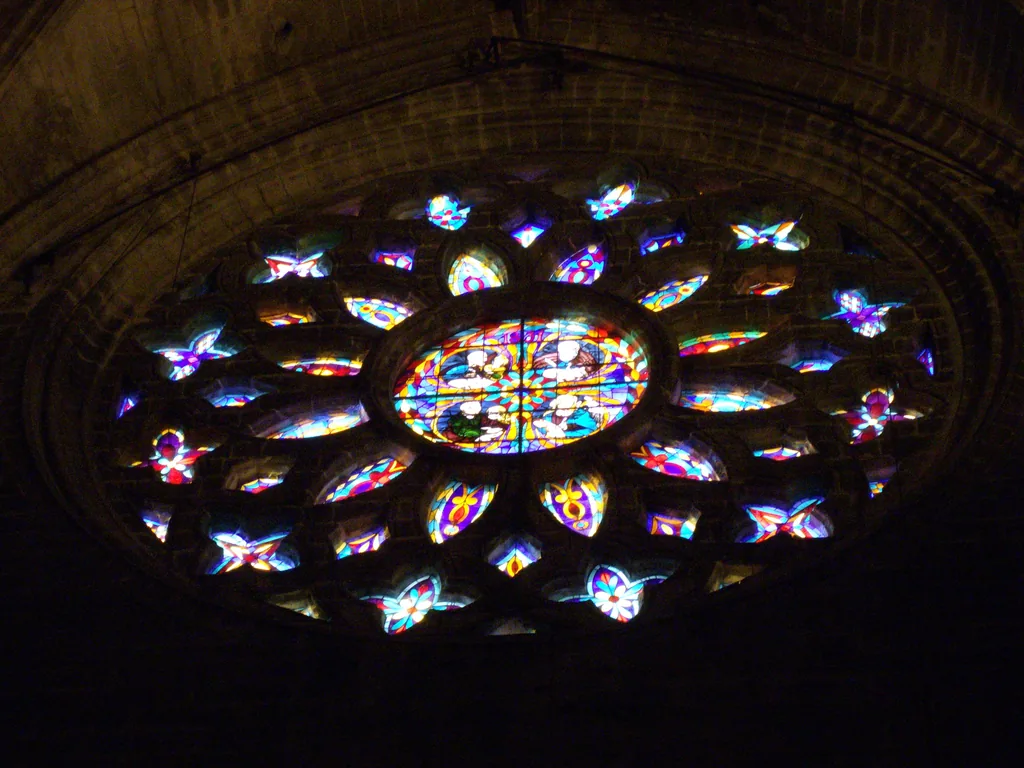
A stained glass rose window in Seville Cathedral, lit from outside
The Cathedral needs its own ticket. Buying both for the same morning is usually a mistake on time alone.
Read the guide →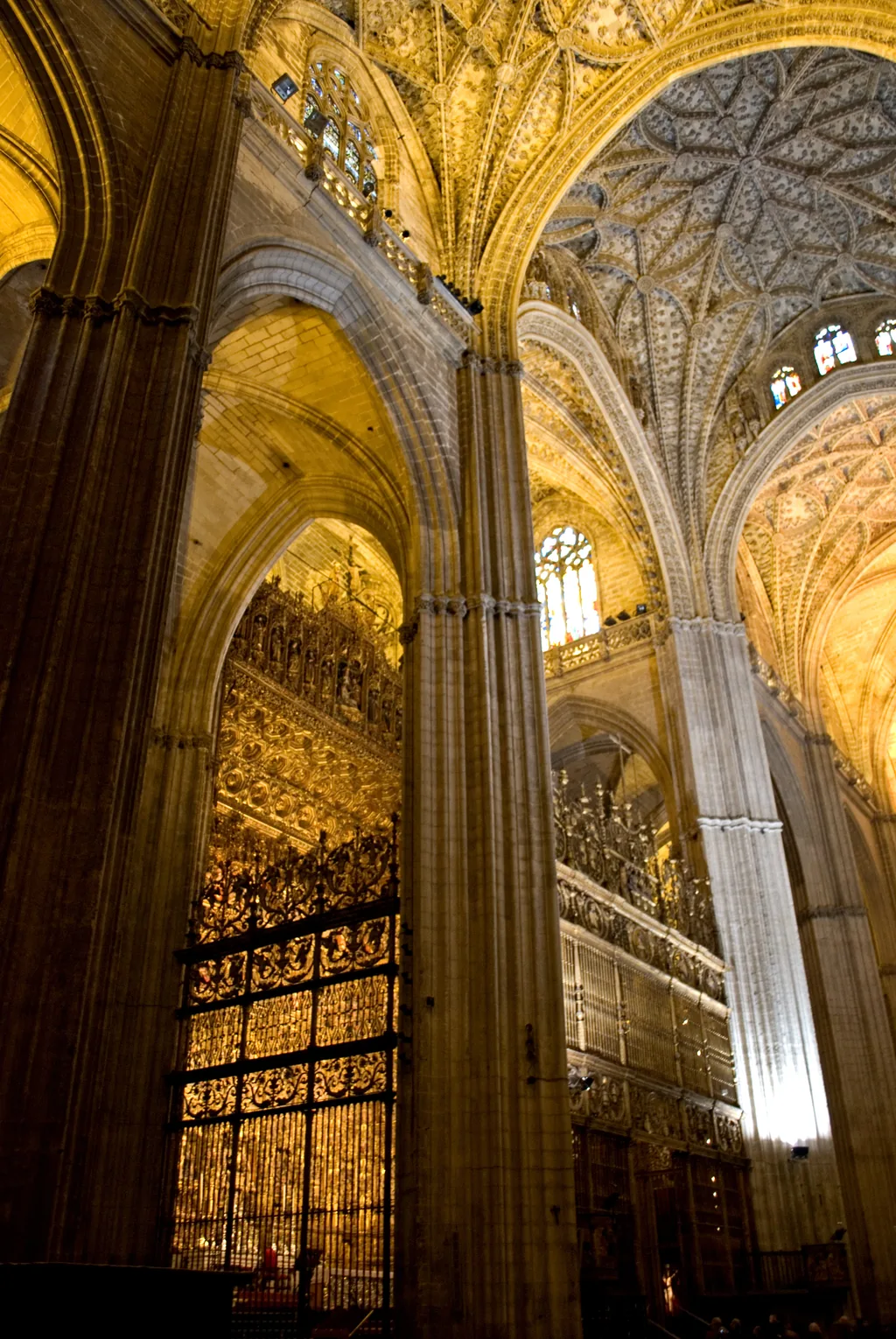
The crossing of Seville Cathedral with tall piers rising into shadow
Allow an hour and a half for the Cathedral and the Giralda climb, on top of the Alcázar.
Read the guide →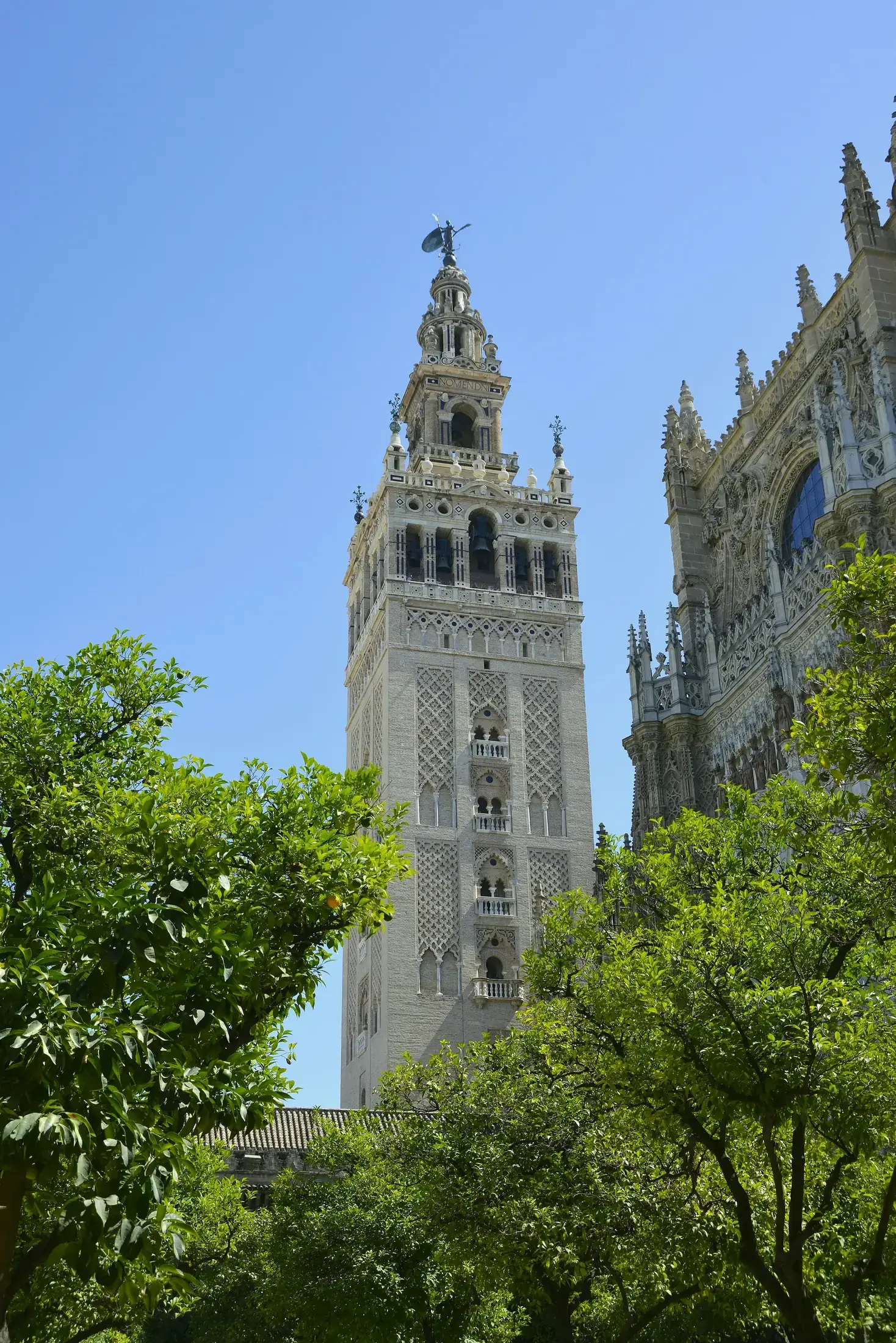
The Giralda rising above the trees, seen from the gardens beside the Real Alcázar
The Giralda is the minaret of the Almohad mosque, begun in 1184 and finished in 1198, now the bell tower of Seville Cathedral next door.
Read the guide →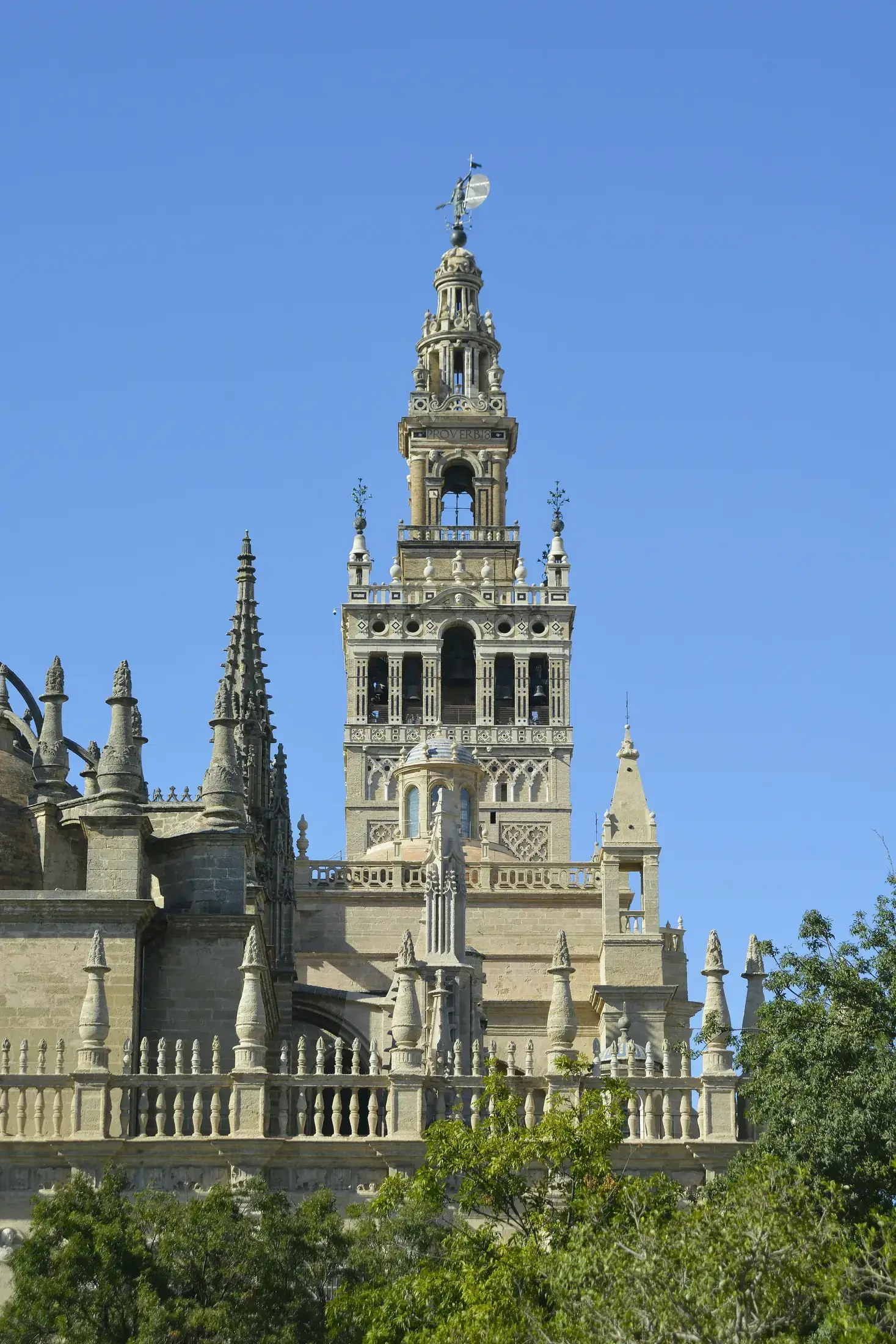
The Giralda and the Gothic roofline of Seville Cathedral, the Renaissance belfry crowning the Almohad minaret
You climb it by thirty-four ramps rather than stairs, 104.5 m in all, and from the top you look straight down on the Alcázar's gardens.
Read the guide →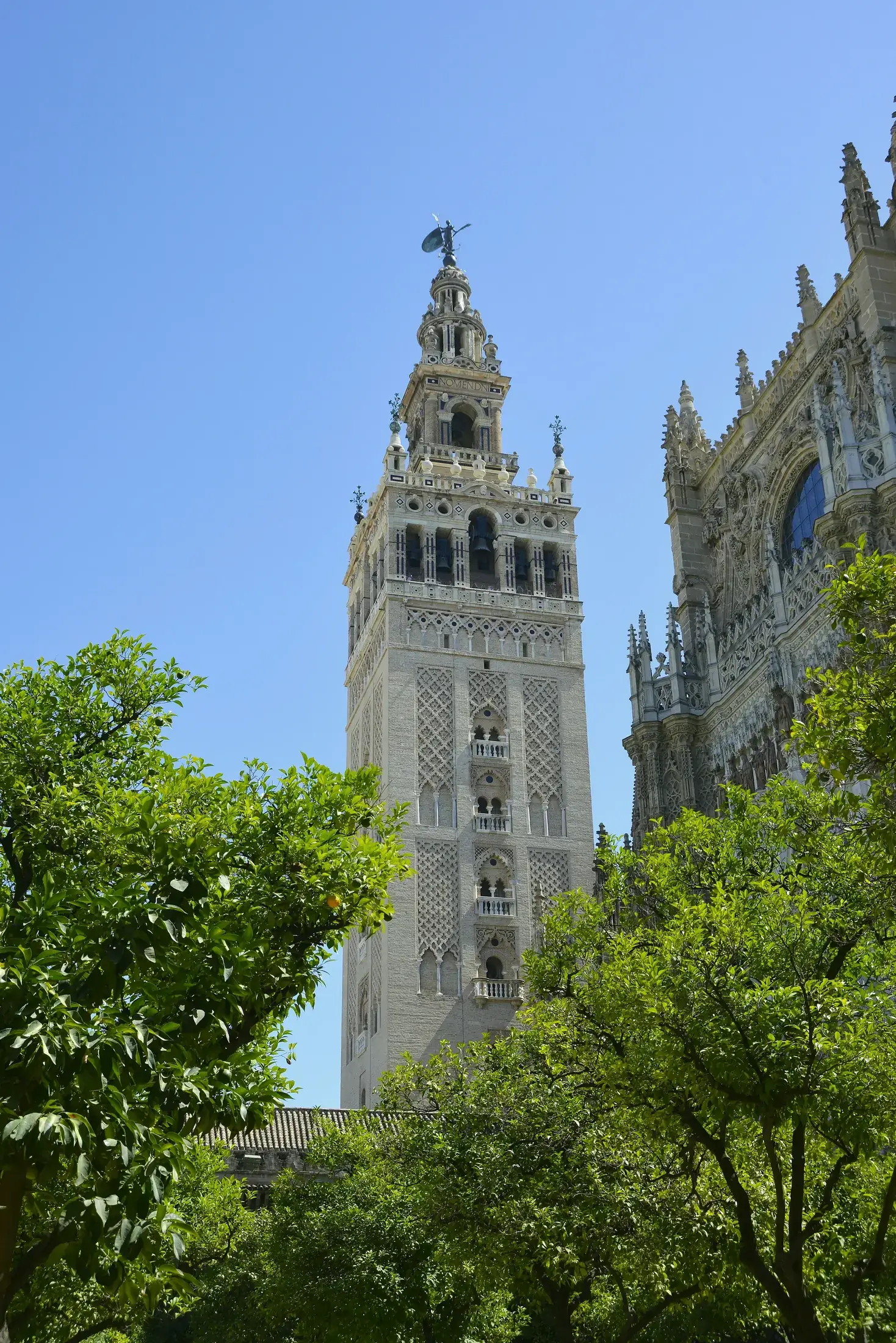
The Giralda bell tower of Seville Cathedral lit at dusk
The Cathedral is two minutes from the Alcázar and shares its UNESCO listing. Alcázar in the morning, Cathedral in the afternoon.
Read the guide →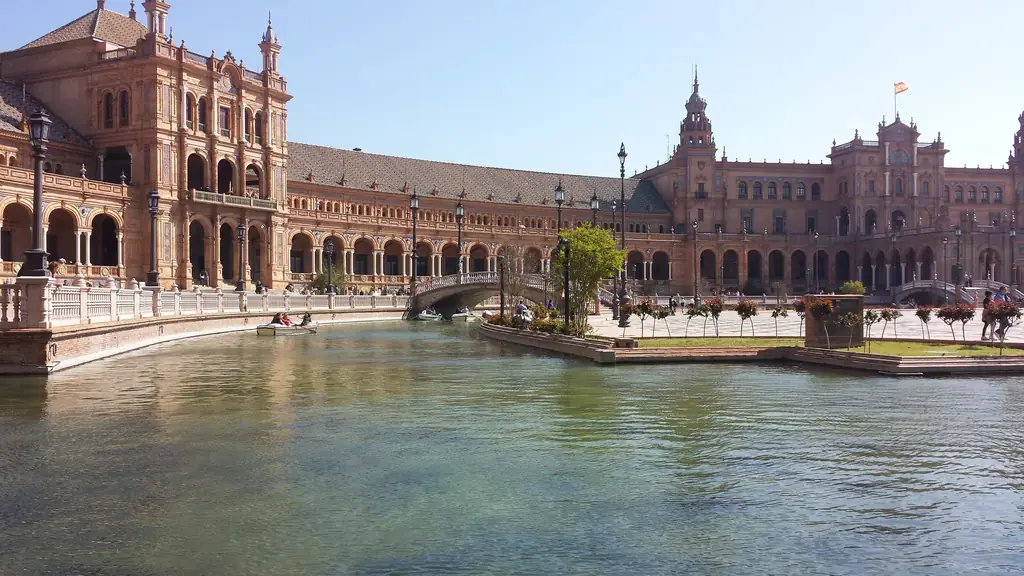
Plaza de España in Seville, with its canal and semicircular brick palace
Fifteen to twenty minutes on foot from the Alcázar, free to walk into, and at its best in the last hour before sunset.
Read the guide →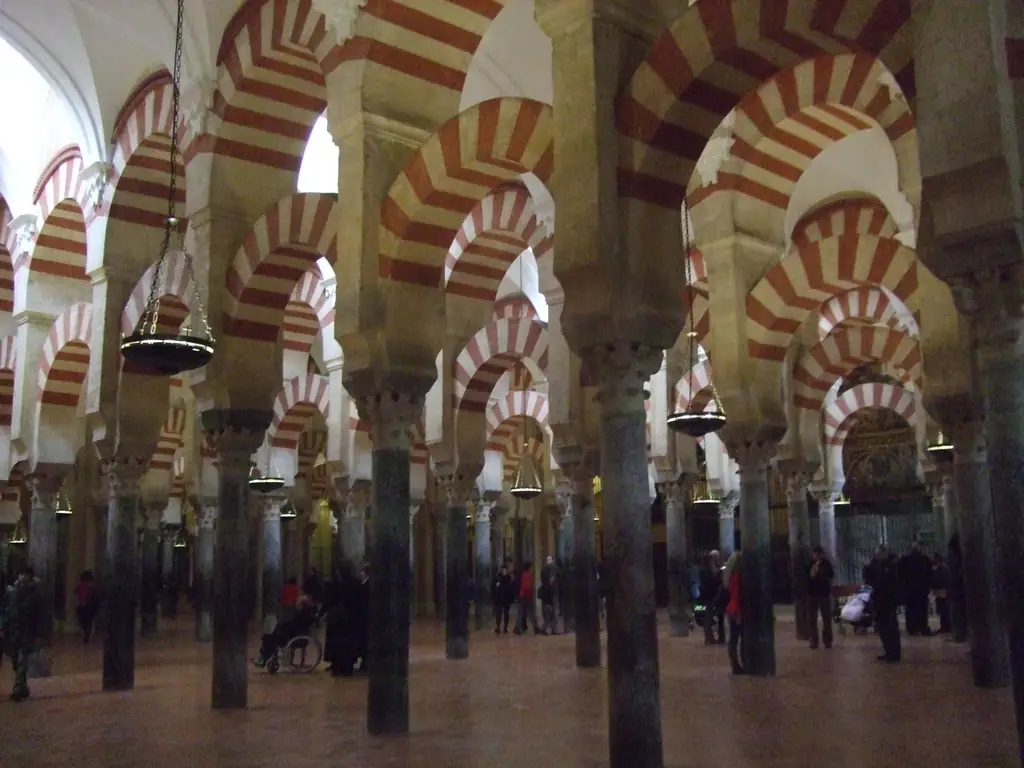
Red-and-white double arches in the prayer hall of the Mosque-Cathedral of Córdoba
Under an hour by train from Seville, and free to enter for one hour each morning. The easiest great day trip from the Alcázar.
Read the guide →From the archive
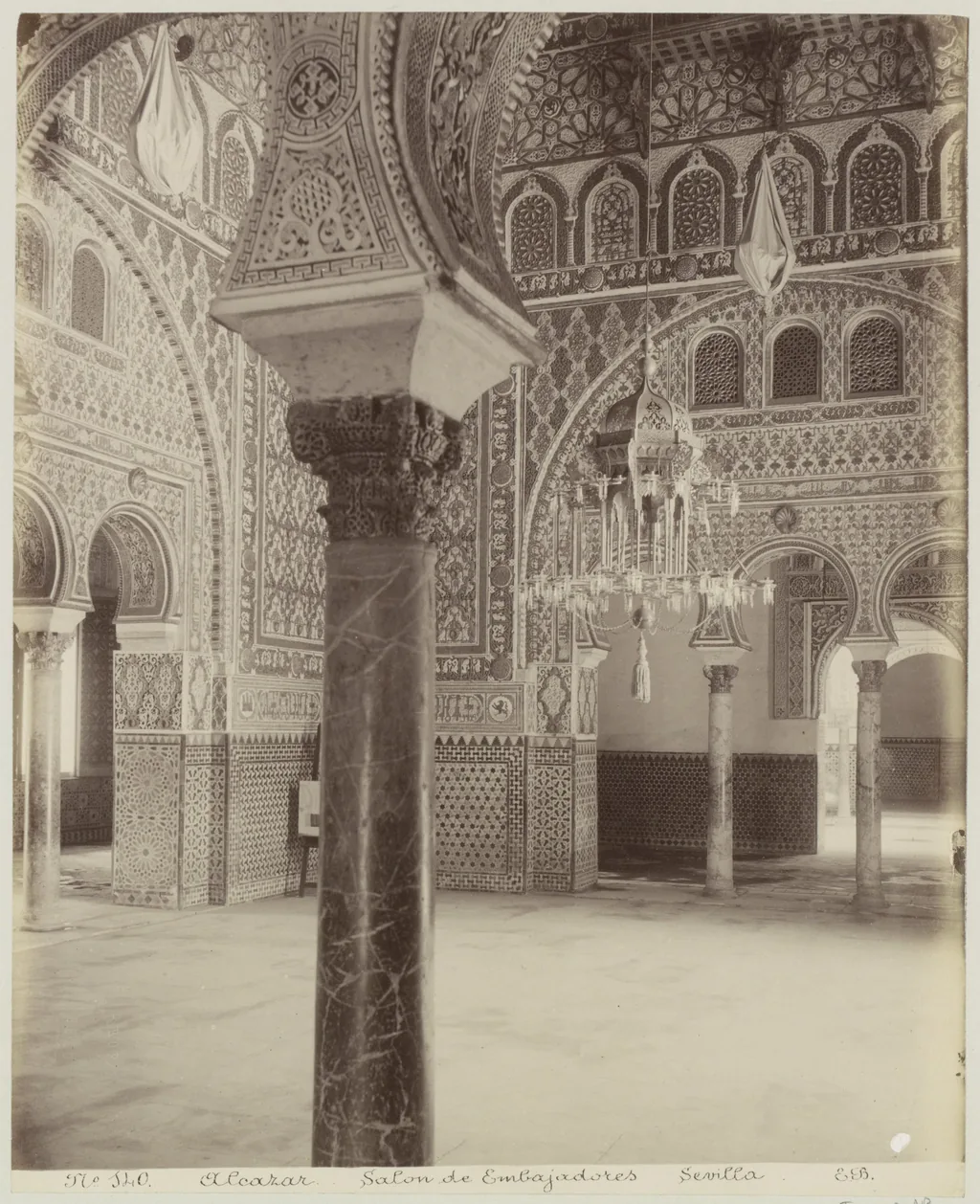
A nineteenth century photograph of the Hall of Ambassadors, its columns and arches in sepia
Photographed more than a century ago and recognisable today, which is the point of a conservation regime this strict.
Read the guide →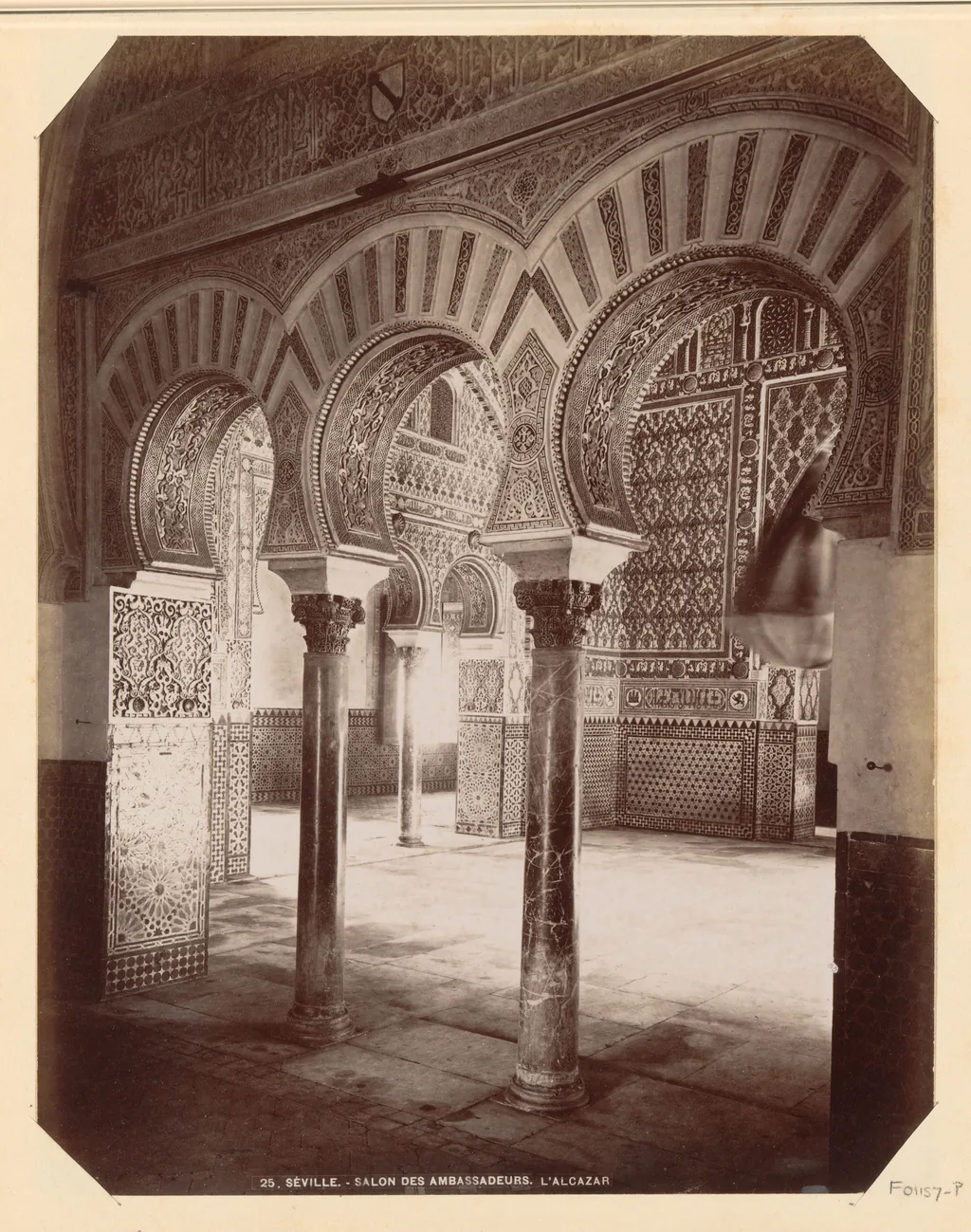
A nineteenth century photograph looking through the triple arches of the Hall of Ambassadors
The triple arch on each side of the hall is the view visitors still photograph from the same spot.
Read the guide →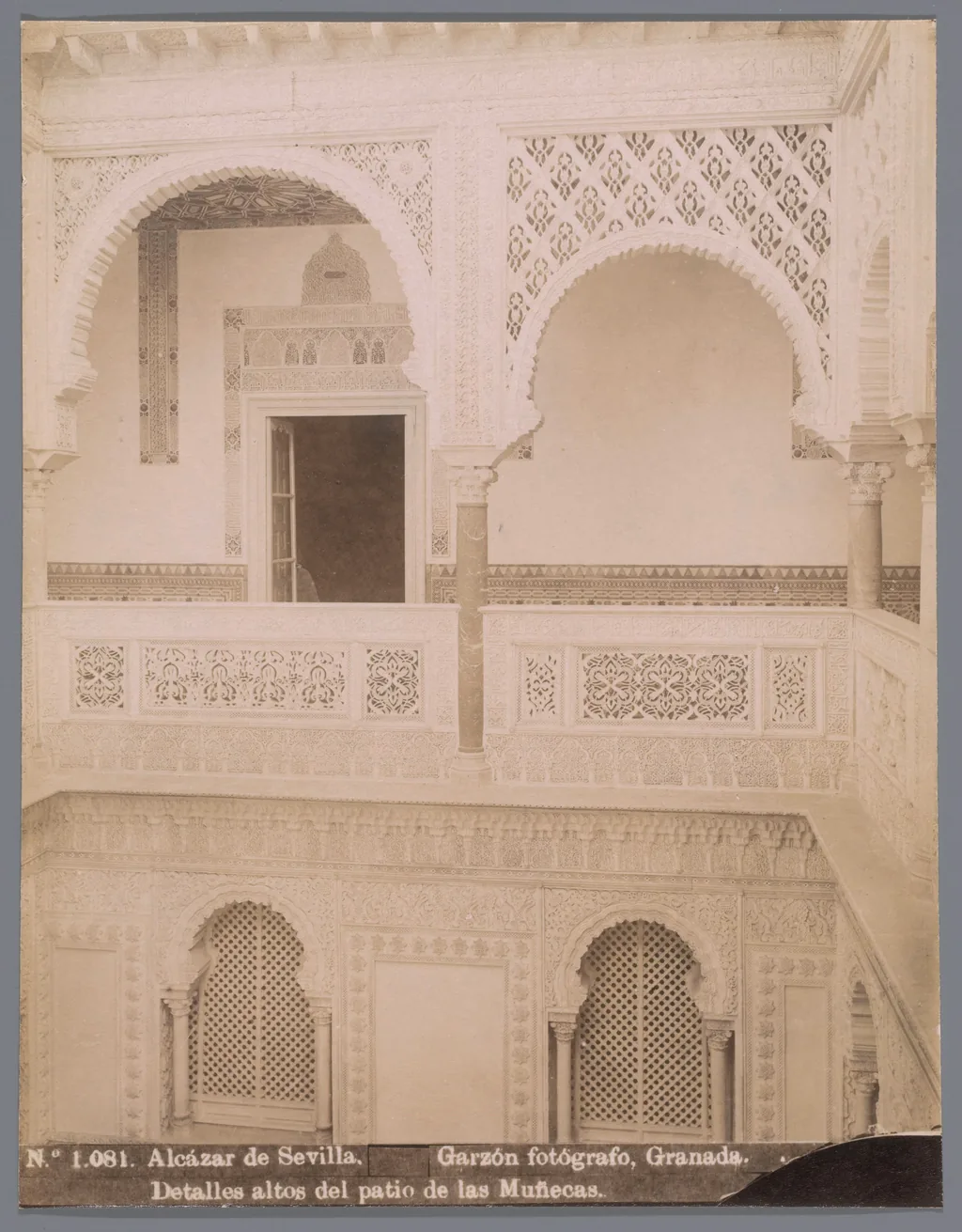
A nineteenth century photograph of the Patio de las Muñecas and its slender columns
The small courtyard was the private, family side of the palace, as against the ceremonial Doncellas.
Read the guide →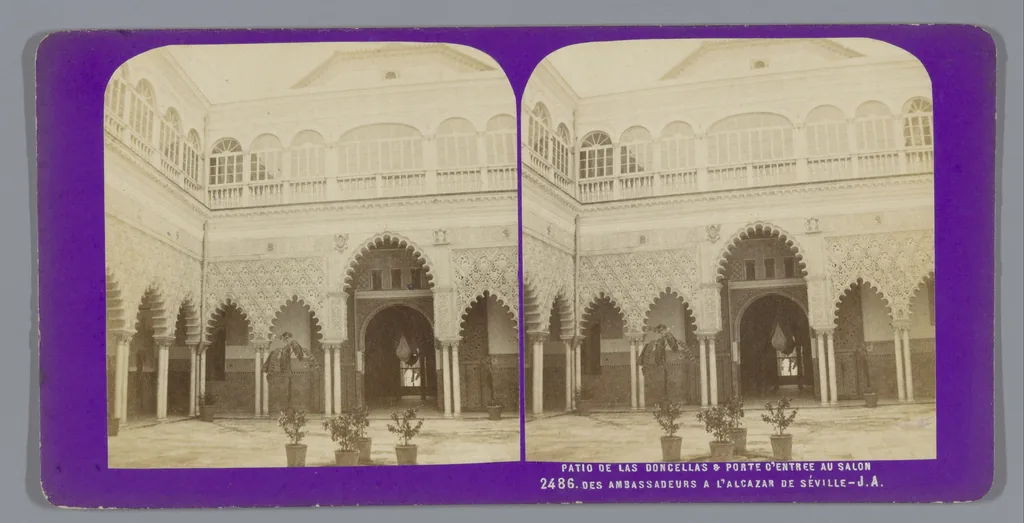
A nineteenth century stereoscopic card showing two views of the Patio de las Doncellas
Stereo cards were the tourist souvenir of their day: two near-identical views that looked solid through a viewer.
Read the guide →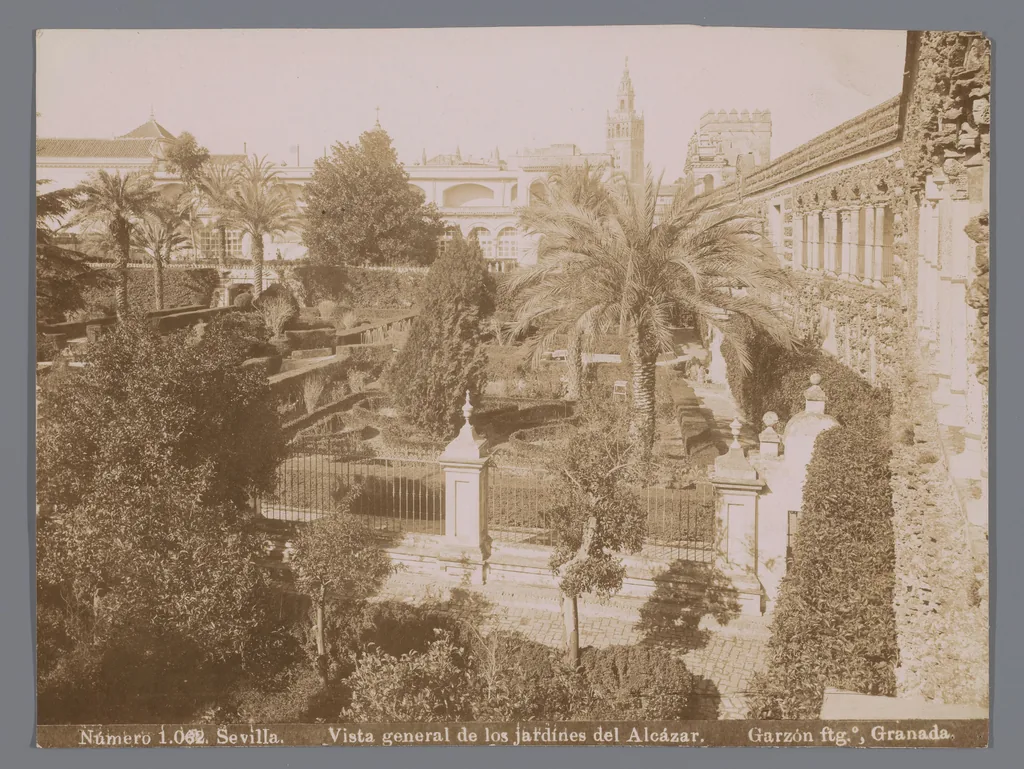
A nineteenth century photograph of the Alcázar gardens with palms above the garden walls
The gardens have been replanted many times. The walls and the water are the parts that stayed put.
Read the guide →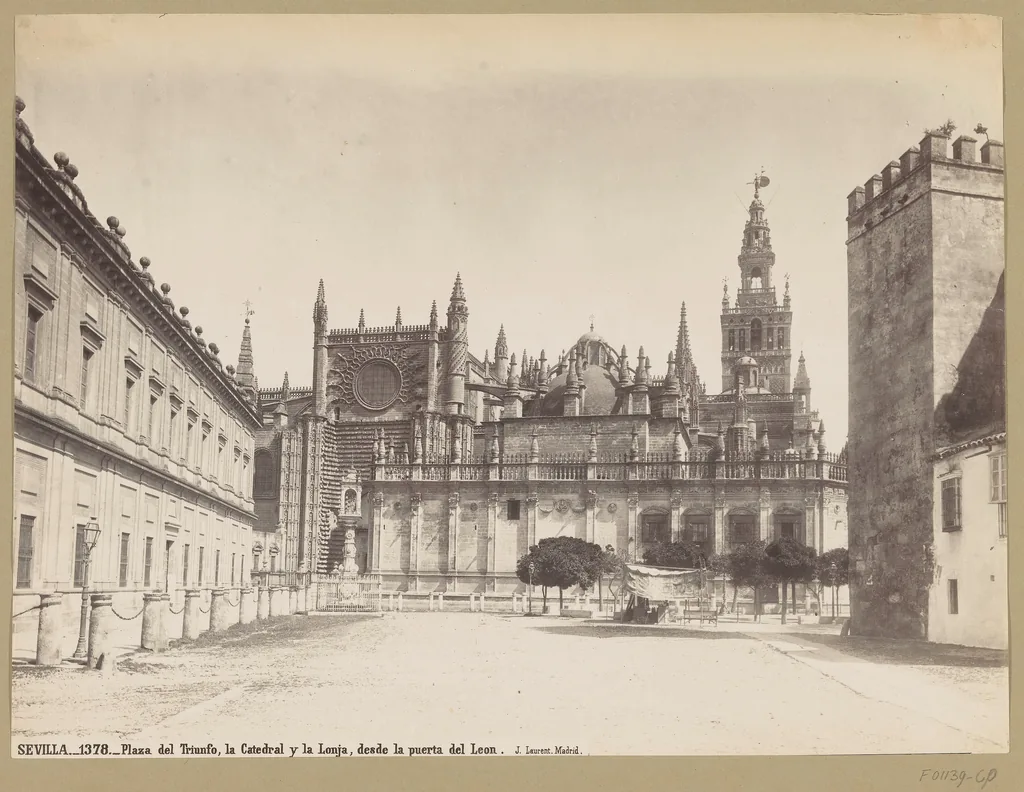
A nineteenth century photograph of the Plaza del Triunfo with the Cathedral and the Alcázar wall
This is the square you cross between the Cathedral and the Lion Gate, and it has barely changed shape.
Read the guide →