Palace of Pedro I: Guide to the Alcázar's Mudéjar Palace
Updated September 19, 2026
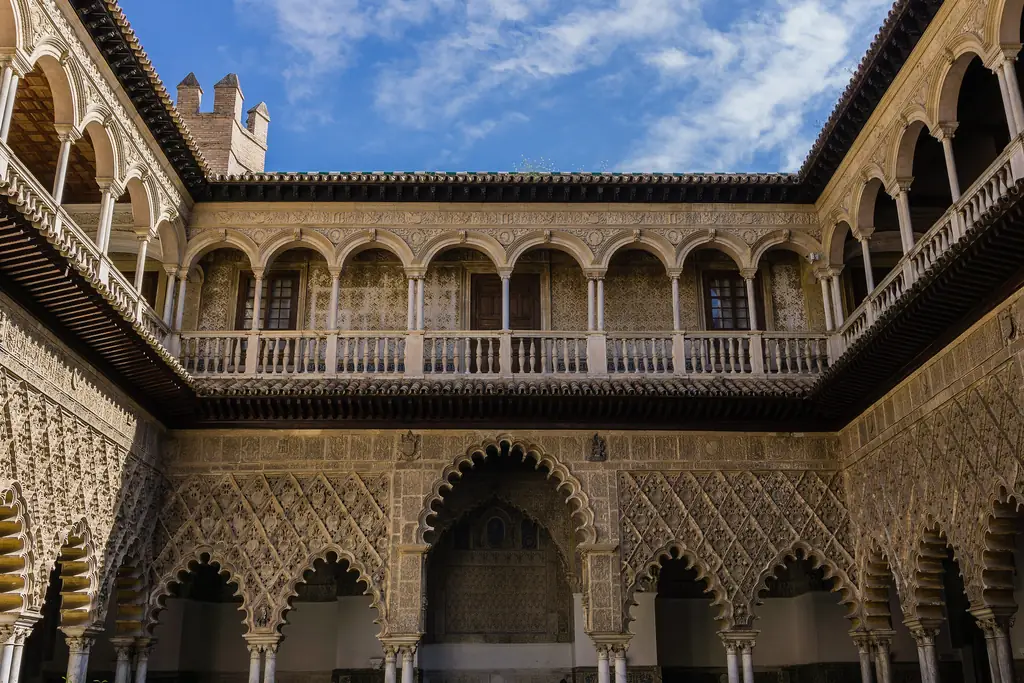
The Palace of Pedro I (Palacio del Rey Don Pedro, also called the Mudéjar Palace) is the part of the Real Alcázar that people travel to see. Built for King Pedro I of Castile in the 1360s, it is a Christian king's palace made in the architectural language of Islamic Spain: carved plaster, tile mosaic, wooden ceilings, and rooms arranged around courtyards with water.
It is the centre of the visit and included in the general ticket (€15.50).
Who was Pedro I?
Pedro I reigned over Castile from 1350 to 1369. History remembers him under two nicknames: the Cruel, used by his enemies, and the Just, used by his supporters. His reign was one long struggle, above all against his half-brother Henry of Trastámara, who killed him and took the throne in 1369.
Seville was Pedro's favourite city, and the Alcázar his favourite residence. His companion for most of his reign was María de Padilla, whose name survives in the Baths of María de Padilla. He was also an ally of the Nasrid sultan of Granada, Muhammad V, and that alliance shows in the palace.
When and how it was built
The palace went up in the 1360s. Two inscriptions date it: a Latin one on the main façade gives the year 1364, and an Arabic one in the Hall of the Ambassadors gives 1366.
The builders came from more than one place. Historians consider it likely that Muhammad V sent craftsmen from Granada, then building the Alhambra's Nasrid palaces in the same years. Craftsmen from Toledo are documented too: an inscription on the Hall of the Ambassadors' doors records their work. Local Sevillian workshops completed the team.
The palace was built against and around older parts of the Alcázar, including the Almohad and Gothic palaces to the south. See the Islamic history of the Alcázar and the Gothic Palace.
Why Mudéjar?
Mudéjar is the name historians give to art and architecture in the Islamic tradition made in Christian Spain. For Pedro I this was not a foreign style. It was the most refined architecture of his world, the style of palaces and power, and he chose it for his own. The full story is in Mudéjar architecture at the Alcázar.
The main spaces
The façade (Patio de la Montería)
The palace's front faces the Patio de la Montería. It is a tall screen of carved stone and plaster under a projecting wooden eave, with the dated Latin inscription and Arabic calligraphy. Take a minute here before going in: the façade announces, in two languages, the king who built it.
Patio de las Doncellas
The ceremonial courtyard, with its long pool and sunken garden, and a Renaissance upper floor added in the 16th century. Full guide: Patio de las Doncellas.
Hall of the Ambassadors
The throne room under a gilded wooden dome rebuilt in 1427. Full guide: Hall of the Ambassadors.
Patio de las Muñecas
The Courtyard of the Dolls is the small courtyard of the palace's private quarters. Its name comes from tiny faces carved into the base of one of its arches; finding them is a traditional game for visitors. The upper levels of this patio were rebuilt in the 19th century, so not everything you see is medieval.
Other rooms
Around the two courtyards are halls and bedrooms with more tilework, plaster and wooden ceilings, including the Salón del Techo de Carlos V, whose ceiling dates from the reign of Charles V.
How to read the decoration
Three techniques cover almost everything you will see:
| Technique | Spanish term | What to look for |
|---|---|---|
| Carved plaster | yesería | Lattices, plant scrolls and inscriptions above the arches and around doors |
| Tile mosaic | alicatado | Geometric star patterns on the lower walls, built from small cut tiles |
| Wooden ceilings | artesonado | Coffered or domed ceilings of joined and painted wood |
The inscriptions are both decoration and message. Some repeat pious formulas in Arabic; others praise the king, in some places calling Pedro I "sultan".
Visiting tips
- See the palace first, then the gardens, especially in summer. See visiting in summer.
- Take the first slot (09:30) for the courtyards without crowds, via the official shop.
- Allow an hour for the palace alone; two to three hours for the whole Alcázar. See how long you need.
- Consider a guide. The history of this palace is its main attraction, and most of it is written in details. The guided tour with priority access (from €37.40, free cancellation) covers it; the Viator best seller combines it with the Cathedral.
Frequently asked questions
When was the Palace of Pedro I built?
In the 1360s. Inscriptions give 1364 (Latin, façade) and 1366 (Arabic, Hall of the Ambassadors).
Is the Mudéjar palace Islamic or Christian?
It was built for a Christian king, in the architectural style of Islamic Spain, with craftsmen from Granada and Toledo among others.
Why is Pedro I called "the Cruel"?
The name comes from his opponents during a violent reign and civil war. His supporters called him "the Just".
Is the palace included in the ticket?
Yes, the general ticket (€15.50) covers it.
What is the difference between the Palace of Pedro I and the Gothic Palace?
The Gothic Palace is older, begun under Alfonso X in 1258, in a European style. Pedro I's palace, a century later, is Mudéjar.
Did Pedro I live here?
Seville was his favourite city and the Alcázar his favourite residence.
Four ways in with a guide
Entry included in every tour
- Best seller on Viator
Alcazar and Cathedral of Seville Tour with Skip the Line Tickets
★ 4.6 · 5,396 reviews · 3 hours 30 minutes
✓ Free cancellation
See today’s price
Check availability → - Most flexible
Royal Alcázar of Seville Guided Tour with Priority Access
★ 4.9 · 344 reviews · 1 hour
✓ Free cancellation · Reserve now, pay later
from€37.40
Check availability → - Before opening time
Alcazar of Seville: Exclusive Early Access Tour
1 hour 30 minutes
✓ Free cancellation
See today’s price
Check availability → Skip the Line Seville Alcázar, Cathedral & Giralda Guided Tour
★ 4.8 · 1,103 reviews · 2 hours 30 minutes
Non-refundable once booked
from€56.40
Check availability →
Tour prices, ratings and conditions as shown on Viator when last checked; they can change. Affiliate links.