Mudéjar Architecture at the Real Alcázar: A Visitor's Guide
Updated September 19, 2026
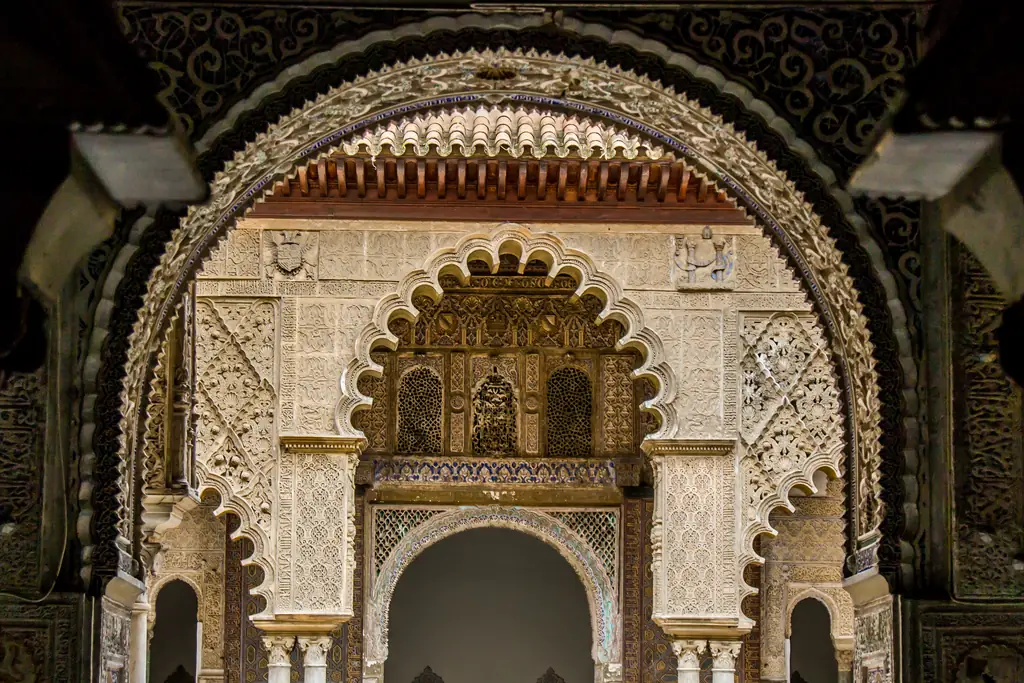
Mudéjar is the word for the art and architecture of the Islamic tradition made in Christian Spain, and the Real Alcázar of Seville is one of its greatest examples. If you understand three techniques and one historical idea, the palace stops being a blur of beautiful patterns and starts to make sense. This guide gives you both.
What "Mudéjar" means
The word comes from the Arabic mudajjan, "one permitted to remain": the name for Muslims who went on living in the Christian kingdoms of Iberia after their towns were conquered. Art historians borrowed it to describe buildings that use the forms and crafts of al-Andalus for Christian patrons, roughly from the 13th to the 16th century, across Castile, Aragon, Toledo and beyond. The Mudéjar architecture of Aragon is itself a UNESCO World Heritage listing.
At the Alcázar the style reaches its peak in the Palace of Pedro I, built in the 1360s.
Why would a Christian king build in the Islamic style?
It seems a paradox, and it is the most interesting question about the Alcázar. The answer is that, for a 14th-century Castilian king, the architecture of al-Andalus was not the style of an enemy. It was the most refined and prestigious way of building a palace in his world, admired, imitated and associated with luxury and power.
Pedro I was also allied with the Nasrid sultan of Granada, Muhammad V, whose court was building the palaces of the Alhambra in the same years. Historians consider it likely that Muhammad V sent craftsmen to Seville. Others came from Toledo, a city with a long Mudéjar tradition. The result is a palace whose inscriptions, in Arabic, praise a Christian king as "sultan". See the Islamic history of the Alcázar for what came before.
The three techniques to recognise
Carved plaster: yesería
Almost every arch, door frame and upper wall in Pedro I's palace is covered with carved plaster. Look for three families of motifs:
- Geometric lattices, often the diamond-shaped sebka inherited from Almohad art.
- Plant scrolls (ataurique): stylised leaves and palmettes.
- Inscriptions: Arabic calligraphy running in bands, some religious formulas, some praising the king.
The plaster was carved while soft, then painted. Traces of colour still survive in places.
Tile mosaic: alicatado
The lower walls are lined with glazed tiles cut into small pieces and assembled like a jigsaw into star and ribbon patterns (lacería). Each colour is a separate piece. This is slow, precise work, and different from the flat painted tiles you will see in the Gothic Palace, made two centuries later.
Wooden ceilings: artesonado
The ceilings are carpentry: coffered or domed structures of joined wood, often painted and gilded. The most spectacular is the dome of the Hall of the Ambassadors, rebuilt in 1427, where the geometry of the tilework is repeated overhead in gilded wood.
Other things to notice
- Horseshoe and polylobed arches. Round arches that close inwards, and arches with scalloped edges.
- The alfiz: a rectangular frame around an arch.
- Water and courtyards. Rooms open onto patios with pools, like the Patio de las Doncellas. The courtyard is the organising idea of the whole palace.
- Symmetry and axes. Doorways line up so that you look through several rooms at once.
Mudéjar, Nasrid, Renaissance: telling them apart
| Style | Where at the Alcázar | Tell-tale sign |
|---|---|---|
| Almohad (Islamic, 12th c.) | Patio del Yeso | Restrained sebka lattices |
| Gothic (13th c.) | Vaults under the Patio del Crucero | Pointed, cross-ribbed vaults |
| Mudéjar (14th c.) | Palace of Pedro I | Dense plaster, tile mosaic, Arabic inscriptions |
| Renaissance (16th c.) | Upper gallery of the Patio de las Doncellas | Round arches, classical columns, balustrades |
The Alcázar and the Alhambra
Visitors who know the Alhambra often feel at home in Pedro I's palace, and for good reason: they are contemporaries, made in the same tradition, perhaps partly by the same hands. The difference is who commissioned them. The Alhambra's Nasrid palaces were built for Muslim sultans; the Alcázar's Mudéjar palace for a Christian king. See Alcázar or Alhambra?
Seeing it with a guide
Mudéjar decoration is the kind of beauty that rewards explanation: once someone points out the king's name in an inscription or the difference between cut and painted tiles, you see it everywhere. The guided tour with priority access (from €37.40, free cancellation) covers the palace's main rooms.
Frequently asked questions
What does Mudéjar mean?
It comes from the Arabic mudajjan, "one permitted to remain", and describes Islamic-tradition art made in Christian Spain.
Is the Alcázar of Seville Mudéjar or Moorish?
Both, in different parts. Some spaces are Islamic (Almohad); the famous palace of Pedro I is Mudéjar, built for a Christian king.
Who built the Mudéjar palace?
Craftsmen from Seville, Toledo and probably Granada, for King Pedro I, in the 1360s.
What is yesería?
Carved plaster decoration, the main ornament of the palace's upper walls and arches.
What is the difference between alicatado and azulejo?
Alicatado is mosaic made of cut tile pieces; azulejo usually refers to flat, painted tiles.
Where is the best Mudéjar work in the Alcázar?
In the Hall of the Ambassadors and around the Patio de las Doncellas.
Four ways in with a guide
Entry included in every tour
- Best seller on Viator
Alcazar and Cathedral of Seville Tour with Skip the Line Tickets
★ 4.6 · 5,396 reviews · 3 hours 30 minutes
✓ Free cancellation
See today’s price
Check availability → - Most flexible
Royal Alcázar of Seville Guided Tour with Priority Access
★ 4.9 · 344 reviews · 1 hour
✓ Free cancellation · Reserve now, pay later
from€37.40
Check availability → - Before opening time
Alcazar of Seville: Exclusive Early Access Tour
1 hour 30 minutes
✓ Free cancellation
See today’s price
Check availability → Skip the Line Seville Alcázar, Cathedral & Giralda Guided Tour
★ 4.8 · 1,103 reviews · 2 hours 30 minutes
Non-refundable once booked
from€56.40
Check availability →
Tour prices, ratings and conditions as shown on Viator when last checked; they can change. Affiliate links.