Patio de las Doncellas: History, Architecture & Details
Updated September 19, 2026
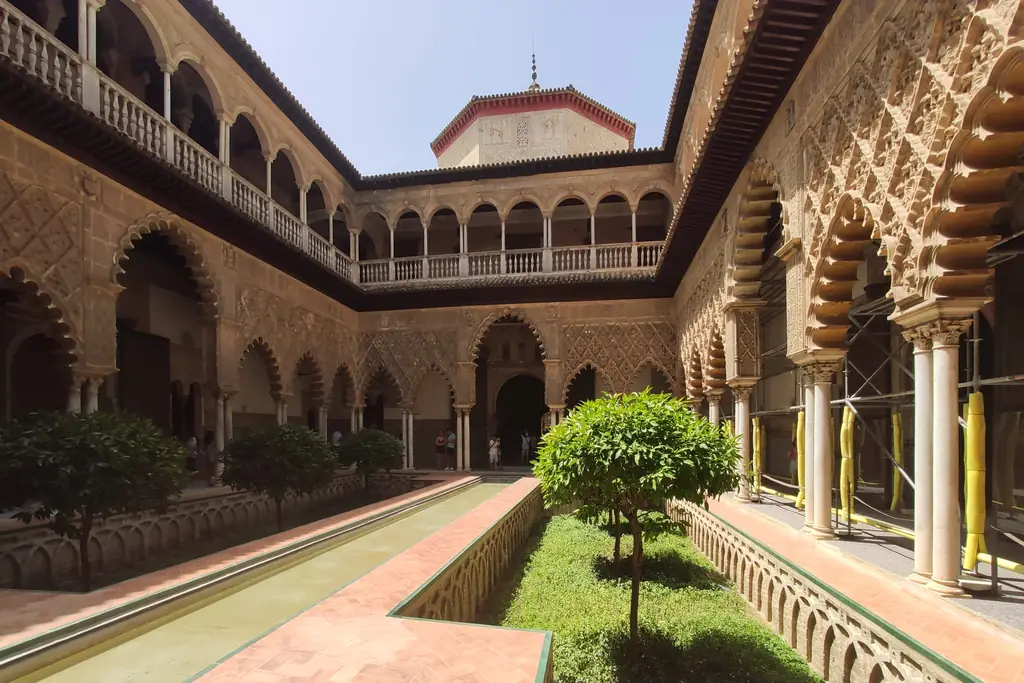
The Patio de las Doncellas (Courtyard of the Maidens) is the main courtyard of King Pedro I's Mudéjar palace, and the image most people have in mind when they think of the Real Alcázar: a long, narrow pool running between two sunken beds of orange trees, framed by carved plaster arches. It is also one of the few places in Spain where you can read two eras of a palace stacked one on top of the other: a 14th-century ground floor in the style of Islamic Spain, and a Renaissance gallery added two centuries later.
It is included in the general ticket (€15.50) and sits at the centre of the visit, so every route through the Alcázar passes through it.
Where it is and how it fits into the palace
The courtyard is the ceremonial core of the Palace of Pedro I, the Mudéjar palace built in the 1360s. A Latin inscription on the palace façade gives the year 1364; an Arabic inscription in the neighbouring Hall of the Ambassadors gives 1366. Around the patio open the palace's formal rooms, with the Hall of the Ambassadors on one side. The smaller, more private Patio de las Muñecas (Courtyard of the Dolls) lies beyond it, in the family quarters.
This layout, with public spaces around a large courtyard and private rooms around a small one, follows the logic of palaces in al-Andalus. Pedro I, a Christian king of Castile, chose it deliberately. See Mudéjar architecture for why.
Two buildings in one courtyard
The ground floor (1360s)
Look at the arcades at eye level. The arches are polylobed, with scalloped edges, and rest on slender marble columns. Above them runs a band of carved plaster (yesería): geometric lattices, plant scrolls and lines of Arabic script. Below, the walls are lined with glazed tile mosaic (alicatado), cut into interlocking star patterns.
The Arabic inscriptions are the detail most visitors miss. Some of them refer to Pedro I as "sultan": in the language and formulas of the Nasrid court of Granada, a Castilian king had his palace praise him as its ruler. It is one of the clearest signs of how deeply the culture of al-Andalus shaped Christian Seville.
The upper gallery (1540–1572)
Now look up. The upper storey has round arches, balustrades and classical columns: an Italian Renaissance design by Luis de Vega, added under Emperor Charles V between 1540 and 1572. The two floors do not pretend to match. Rather than a flaw, that contrast is the best short lesson in Spanish history the building offers: a medieval palace in the Islamic tradition, completed by a Habsburg emperor who ruled half of Europe.
The hidden garden: what the 2002–2005 excavations found
For more than four centuries, visitors saw a very different patio. Between 1581–1584, the original sunken garden was covered over with a flat pavement of white and black marble, and the courtyard stayed that way into the 21st century.
Archaeological excavations in 2002–2005, led by the archaeologist Miguel Ángel Tabales, found that the 14th-century garden beneath was still in a good state of conservation: a long central pool with planting beds set below the level of the walkways on either side. The garden was then restored, which is why the patio today looks older, not newer, than it did in the 20th century. Old photographs and 19th-century paintings of the Alcázar show the marble-paved version.
A sunken garden makes sense in this climate. With the beds lower than the paths, the tops of the trees and flowers sit at the level of the walker, and the water in the pool keeps the air a little cooler.
Why "the Maidens"? Legend and history
The name has a famous story attached to it, and it is best treated as a legend. According to the tradition, the courtyard recalls a tribute of one hundred maidens that the Muslim rulers of al-Andalus were said to demand each year from the Christian kingdoms. No historical record supports the tribute, and the story belongs to a long line of medieval legends rather than to the history of this building. What is documented is the palace's construction under Pedro I and the later additions listed above.
What to look for
- The inscriptions in the plaster above the arches, and in the tile borders.
- The tile patterns at the base of the walls. Each panel is a geometric system built from a few repeating shapes.
- The change of style between the two floors, clearest from the far end of the pool.
- The reflections. On a still morning the pool doubles the arcade. It is the classic photograph of the Alcázar; see the photography guide.
- The doors into the Hall of the Ambassadors, whose Arabic inscription records that the hall's decoration was finished in 1366.
When to visit the patio
The courtyard is the busiest spot in the Alcázar because every route passes through it. For a clear view:
- Take the first entry slot (09:30) and go straight to the patio before the groups arrive. Book it on the official shop.
- Or come back at the end of your visit. Late afternoon light is soft, and the crowd thins as closing time approaches.
A guide makes a real difference here, because most of what is interesting (the inscriptions, the two building phases, the excavation) is invisible unless someone points it out. The guided tour with priority access covers the patio and the surrounding rooms and can be cancelled for free.
Frequently asked questions
Is the Patio de las Doncellas included in the general ticket?
Yes. It is part of the main palace route, covered by the €15.50 ticket.
What does "Patio de las Doncellas" mean?
"Courtyard of the Maidens". The name is tied to a legend of a tribute of maidens, which historians do not treat as fact.
When was the Patio de las Doncellas built?
The ground floor dates from Pedro I's palace in the 1360s. The upper gallery was added between 1540 and 1572.
Why is the garden lower than the walkways?
It is a sunken garden, a design common in al-Andalus. It was paved over in 1581–1584 and uncovered by excavations in 2002–2005.
Was the Patio de las Doncellas in Game of Thrones?
The Alcázar was used as the Water Gardens of Dorne in season 5. See Game of Thrones at the Alcázar for what you can find on your visit.
How much time should I spend in the patio?
Ten to fifteen minutes is enough to see both floors and the inscriptions. With a guide, expect longer.
Is the patio accessible?
It is on the ground floor. See wheelchair access for the palace's steps and routes.
Four ways in with a guide
Entry included in every tour
- Best seller on Viator
Alcazar and Cathedral of Seville Tour with Skip the Line Tickets
★ 4.6 · 5,396 reviews · 3 hours 30 minutes
✓ Free cancellation
See today’s price
Check availability → - Most flexible
Royal Alcázar of Seville Guided Tour with Priority Access
★ 4.9 · 344 reviews · 1 hour
✓ Free cancellation · Reserve now, pay later
from€37.40
Check availability → - Before opening time
Alcazar of Seville: Exclusive Early Access Tour
1 hour 30 minutes
✓ Free cancellation
See today’s price
Check availability → Skip the Line Seville Alcázar, Cathedral & Giralda Guided Tour
★ 4.8 · 1,103 reviews · 2 hours 30 minutes
Non-refundable once booked
from€56.40
Check availability →
Tour prices, ratings and conditions as shown on Viator when last checked; they can change. Affiliate links.