Hall of the Ambassadors, Real Alcázar: Complete Guide
Updated September 19, 2026
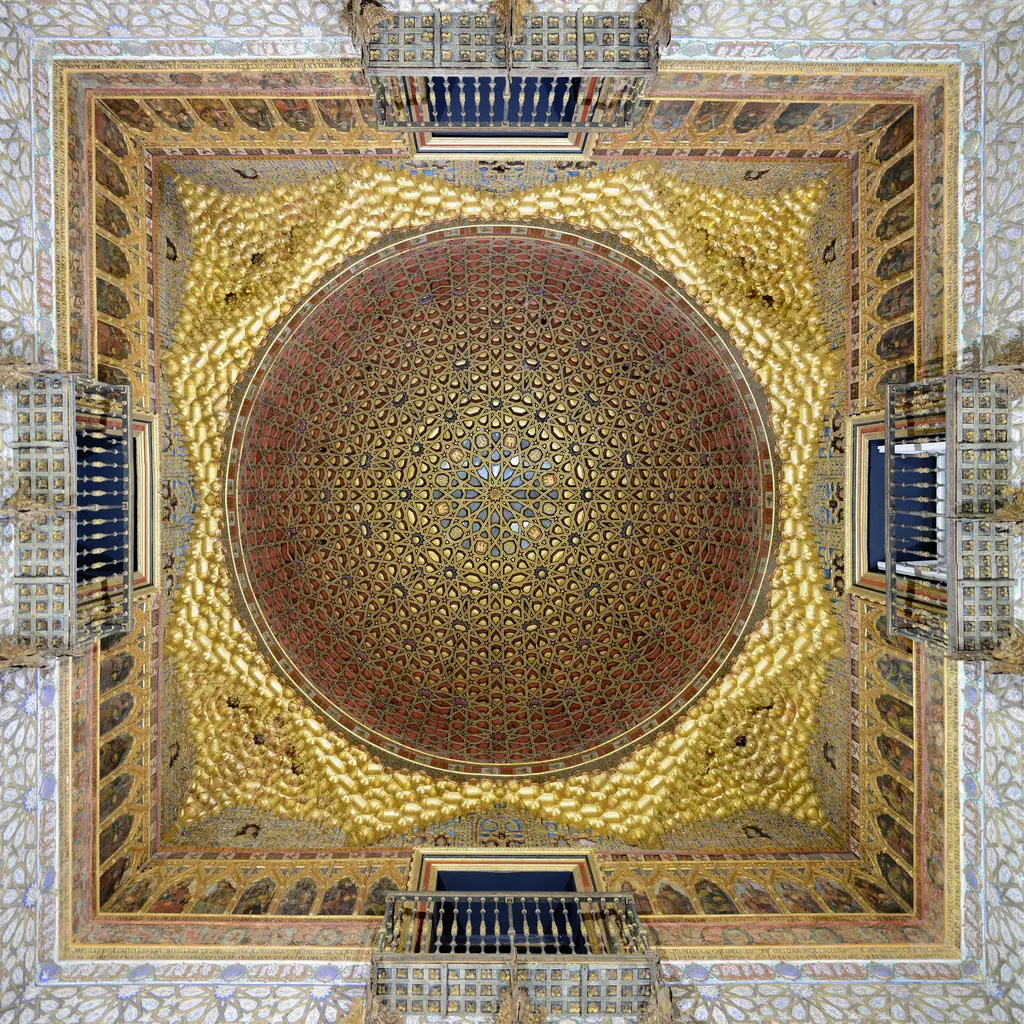
The Hall of the Ambassadors (Salón de Embajadores) is the most splendid room in the Real Alcázar: a square throne room under a golden dome of carved and gilded wood, entered through triple horseshoe arches. It was the ceremonial centre of King Pedro I's palace, the room where he received visitors, and two centuries later it hosted the wedding of Emperor Charles V.
It is part of the main palace route and included in the general ticket (€15.50). You reach it from the Patio de las Doncellas.
A throne room in the tradition of al-Andalus
The hall is a qubba: a square room crowned by a dome, the traditional form of a reception hall in the Islamic world. In al-Andalus the qubba was where a ruler sat in state, and Pedro I, a Christian king of Castile, adopted the form for his own throne room. The choice was not an accident. The architecture of al-Andalus was the most prestigious style he knew, and he built his palace with it. See Mudéjar architecture for the background.
Key dates
| Date | What happened |
|---|---|
| 1366 | The hall's decoration is finished, as recorded by an Arabic inscription on its wooden doors, made by craftsmen from Toledo |
| 1427 | The dome is rebuilt, replacing the original |
| 16th century | Balconies are added on the upper walls |
| 1526 | Emperor Charles V and Isabella of Portugal celebrate their marriage here |
The dome
The dome you see today dates from 1427. It is built of wood, not stone, and its surface is a dense web of interlaced geometric patterns, carved and gilded so that it seems to glitter as you move beneath it. Spanish guides often call such domes media naranja ("half orange") for their shape.
The effect is intended. In the Islamic tradition, a dome over a throne room evoked the heavens turning above the ruler. Stand in the centre of the room, look straight up, and the pattern appears to radiate from the apex outward, which is the view in the photograph at the top of this page.
Below the dome, the transition from a square room to a circular dome is made with muqarnas: small nested niches, like honeycomb, that fill the corners.
The walls, arches and doors
- Triple horseshoe arches on each side open onto the neighbouring rooms, resting on marble columns. Each set is framed by an alfiz, the rectangular moulding that surrounds an arch in Islamic architecture.
- Plasterwork (yesería) covers the upper walls: plant scrolls, geometric lattices and bands of Arabic calligraphy.
- Tile mosaic (alicatado) forms a high dado at the base of the walls, in interlocking star designs.
- The wooden doors carry the Arabic inscription that dates the decoration to 1366 and records their making by craftsmen from Toledo. They are one of the reasons historians can date the hall so precisely.
The 1526 wedding
In 1526, Emperor Charles V married Isabella of Portugal in the Alcázar, and the Hall of the Ambassadors was the setting for the celebration. Charles's time in Seville left marks all over the palace, from the Renaissance upper gallery of the Patio de las Doncellas to rooms and pavilions in the gardens. See the history of the Alcázar for the full timeline.
How to see it well
- Go early. The hall is one of the most crowded rooms after mid-morning. The first entry slot (09:30) gives you the dome with the fewest heads in the way. Book it on the official shop.
- Stand in the middle and look up, then walk to each side arch: the dome changes as the light catches different facets.
- Read the doors. Ask a guide or use the official audio guide to find the dated inscription.
- Photography. A wide lens, or your phone's wide mode, fits the whole dome. See the photography guide.
Most of the hall's meaning lives in details you would never notice alone: the inscriptions, the dating, why a Christian king built a qubba. That is where a guide earns their fee. The guided tour with priority access (from €37.40, free cancellation) spends time in this room.
Nearby in the palace
- Patio de las Doncellas, next door.
- The Patio de las Muñecas, the small courtyard of the family quarters.
- The Upper Royal Quarters, upstairs, visited separately.
Frequently asked questions
Is the Hall of the Ambassadors included in the general ticket?
Yes. It is part of the main palace route.
How old is the dome?
The current dome was built in 1427, replacing the original of the 1360s.
Why is it called the Hall of the Ambassadors?
It was the palace's reception hall, where the king received visitors and embassies.
Is the dome made of gold?
It is carved wood covered with gilding, not solid gold.
Who got married in the Hall of the Ambassadors?
Emperor Charles V and Isabella of Portugal, in 1526.
What is a qubba?
A square hall covered by a dome, the traditional throne or reception room in Islamic palaces.
Four ways in with a guide
Entry included in every tour
- Best seller on Viator
Alcazar and Cathedral of Seville Tour with Skip the Line Tickets
★ 4.6 · 5,396 reviews · 3 hours 30 minutes
✓ Free cancellation
See today’s price
Check availability → - Most flexible
Royal Alcázar of Seville Guided Tour with Priority Access
★ 4.9 · 344 reviews · 1 hour
✓ Free cancellation · Reserve now, pay later
from€37.40
Check availability → - Before opening time
Alcazar of Seville: Exclusive Early Access Tour
1 hour 30 minutes
✓ Free cancellation
See today’s price
Check availability → Skip the Line Seville Alcázar, Cathedral & Giralda Guided Tour
★ 4.8 · 1,103 reviews · 2 hours 30 minutes
Non-refundable once booked
from€56.40
Check availability →
Tour prices, ratings and conditions as shown on Viator when last checked; they can change. Affiliate links.