Fifty facts about the Real Alcázar of Seville, grouped by theme. Every one of them comes from the official Alcázar website, UNESCO, or published reference works; where a story is a legend, we say so.
Origins and the Islamic centuries
It was founded in 913, when the Umayyad ruler Abd al-Rahman III ordered a government house (Dar al-Imara) on the south side of Seville.
The official site calls it one of the oldest palaces in use in the world.
An 11th-century palace lies under your feet. The Abbadid palace al-Mubarak, "the Blessed", survives as remains beneath the Patio de la Montería.
A poet-king lived here. The Abbadid ruler al-Mu'tamid made the Alcázar a centre of literary life.
In 1163 it became a caliph's residence, when the Almohad Abu Ya'qub Yusuf made it his main home in the region.
About twelve palaces were built in the Almohad expansion from 1169, after nearly all earlier buildings were cleared.
Its Almohad architects are known by name: Ahmad Ben Baso and Ali al-Ghumari.
The Patio del Yeso is the best-preserved Almohad space, with arches covered in sebka, a diamond lattice of carved plaster.
The Patio del Crucero began as an Islamic garden, split into four by raised paths, with the beds sunk far below.
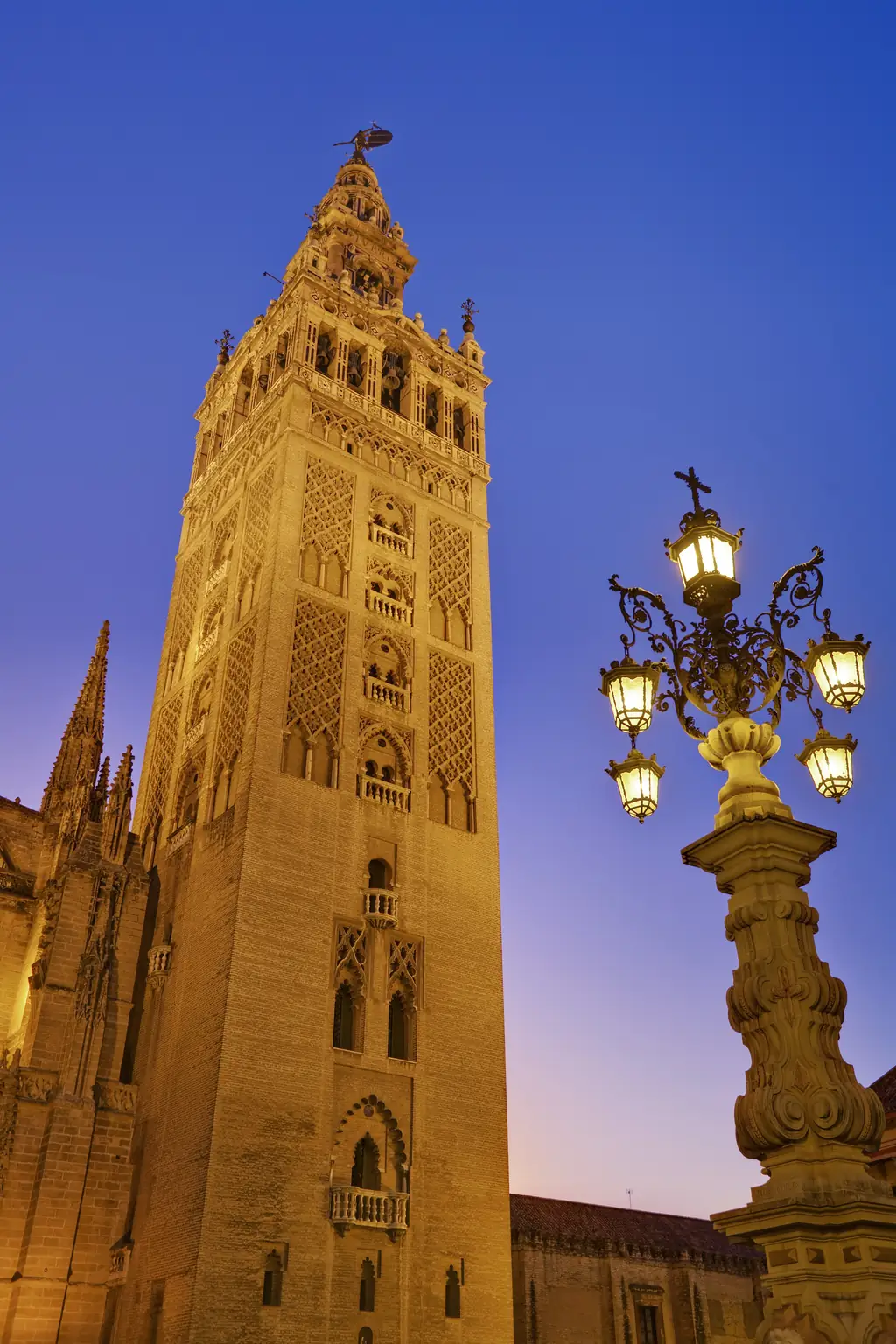
The same Almohads built the Giralda, begun in 1184 as the minaret of their great mosque, now the Cathedral's bell tower.
Christian kings, Islamic style
Ferdinand III took Seville in 1248, and the Alcázar became a Christian royal residence.
Alfonso X added a Gothic palace from the 1250s.
The Hall of Justice commemorates a battle: it was built for Alfonso XI after the Battle of Río Salado in 1340.
Pedro I's palace is dated twice: 1364 in a Latin inscription on the façade, 1366 in Arabic in the Hall of the Ambassadors.
A Christian king is called "sultan" in the Arabic inscriptions of his own palace.
Granada probably lent its craftsmen. Historians consider it likely that the Nasrid sultan Muhammad V sent artisans to his ally Pedro I.
Toledo sent craftsmen too: an inscription on the Hall of the Ambassadors' doors records their work.
"Mudéjar" comes from Arabicmudajjan, "one permitted to remain".
Pedro I had two nicknames: "the Cruel" to his enemies, "the Just" to his supporters.
Rooms and details
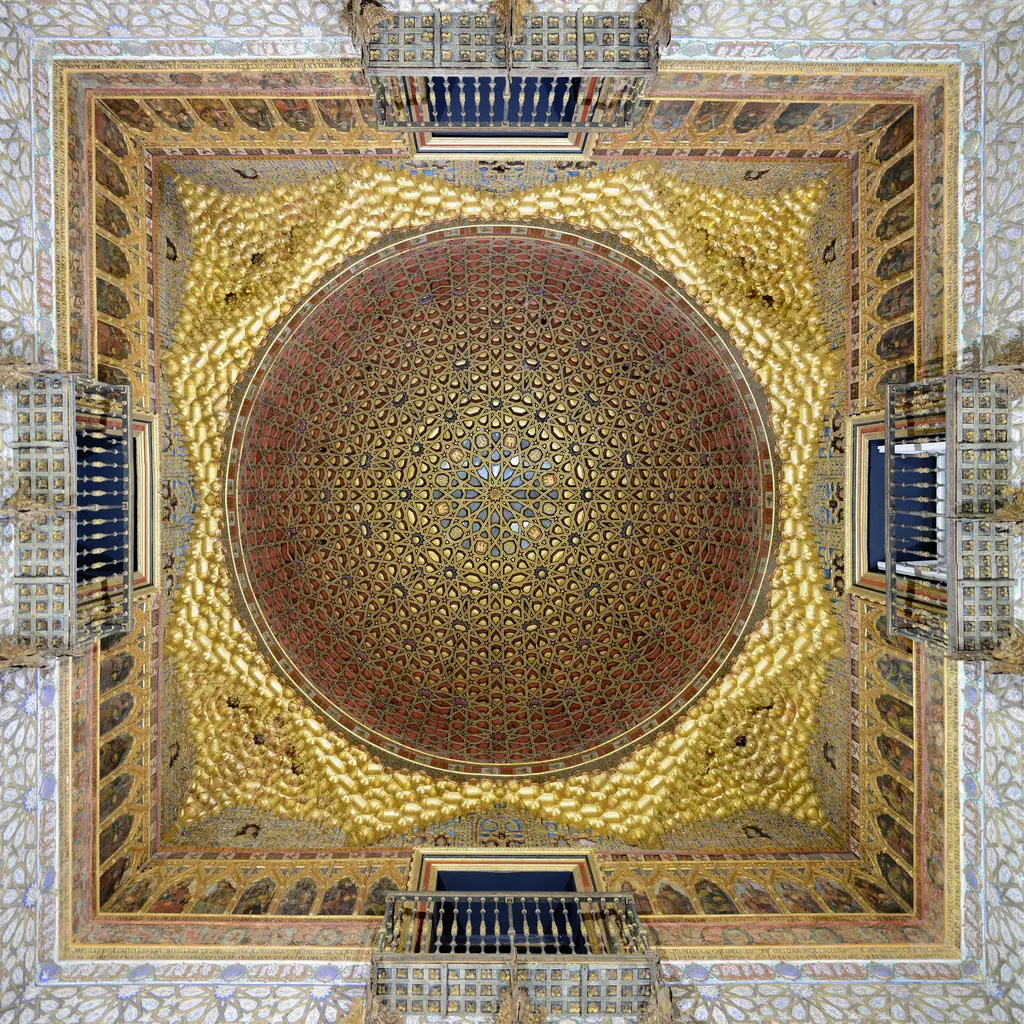
The golden dome of the Hall of the Ambassadors dates from 1427, replacing the original.
It is wood, not gold: carved and gilded.
The hall is a qubba, the domed throne room of Islamic tradition.
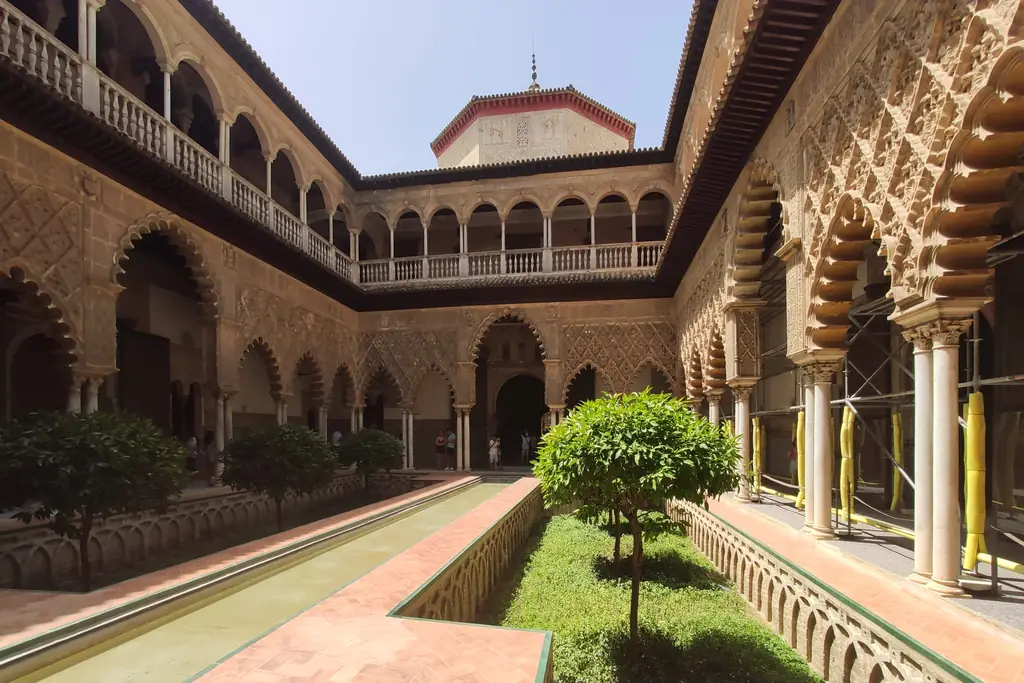
The Patio de las Doncellas has two eras: a 1360s ground floor and a Renaissance upper gallery built 1540–1572 by Luis de Vega.
Its garden was buried for four centuries, paved over in 1581–1584.
Archaeologists found it again in excavations in 2002–2005, led by Miguel Ángel Tabales.
The "hundred maidens" story is a legend, not history.
The Patio de las Muñecas hides tiny carved faces at the base of one arch; finding them is a visitors' game.
The Baths of María de Padilla are not baths but a Gothic cistern from Alfonso X's palace.
The legend that courtiers drank her bathwater has no documentary basis.
The Gothic Palace was rebuilt after the Lisbon earthquake of 1755, by Sebastian van der Borcht.
Its tapestries celebrate Charles V's conquest of Tunis in 1535; those on show are later copies.
Its painted tiles are attributed to Cristóbal de Augusta, made in the late 1570s.
Empire and the Americas
Spain's trade with the Americas was run from here. The Casa de la Contratación was founded in the Alcázar in 1503.
Amerigo Vespucci worked for it, as chief pilot from 1508.
It kept a secret master map, the Padrón Real, updated with every returning voyage.
It moved to Cádiz in 1717.
The Virgin of the Navigators, in the Admiral's Quarter, is often called the first painting of the discovery of the Americas.
Royals
Charles V married Isabella of Portugal here in 1526.
A Spanish infanta was born here in 1729, during the court's stay in Seville.
The royal family still stays here: the Upper Royal Quarters remain in use.
Gardens
The gardens were reshaped in the 17th century by the Italian Vermondo Resta, in a Mannerist style.
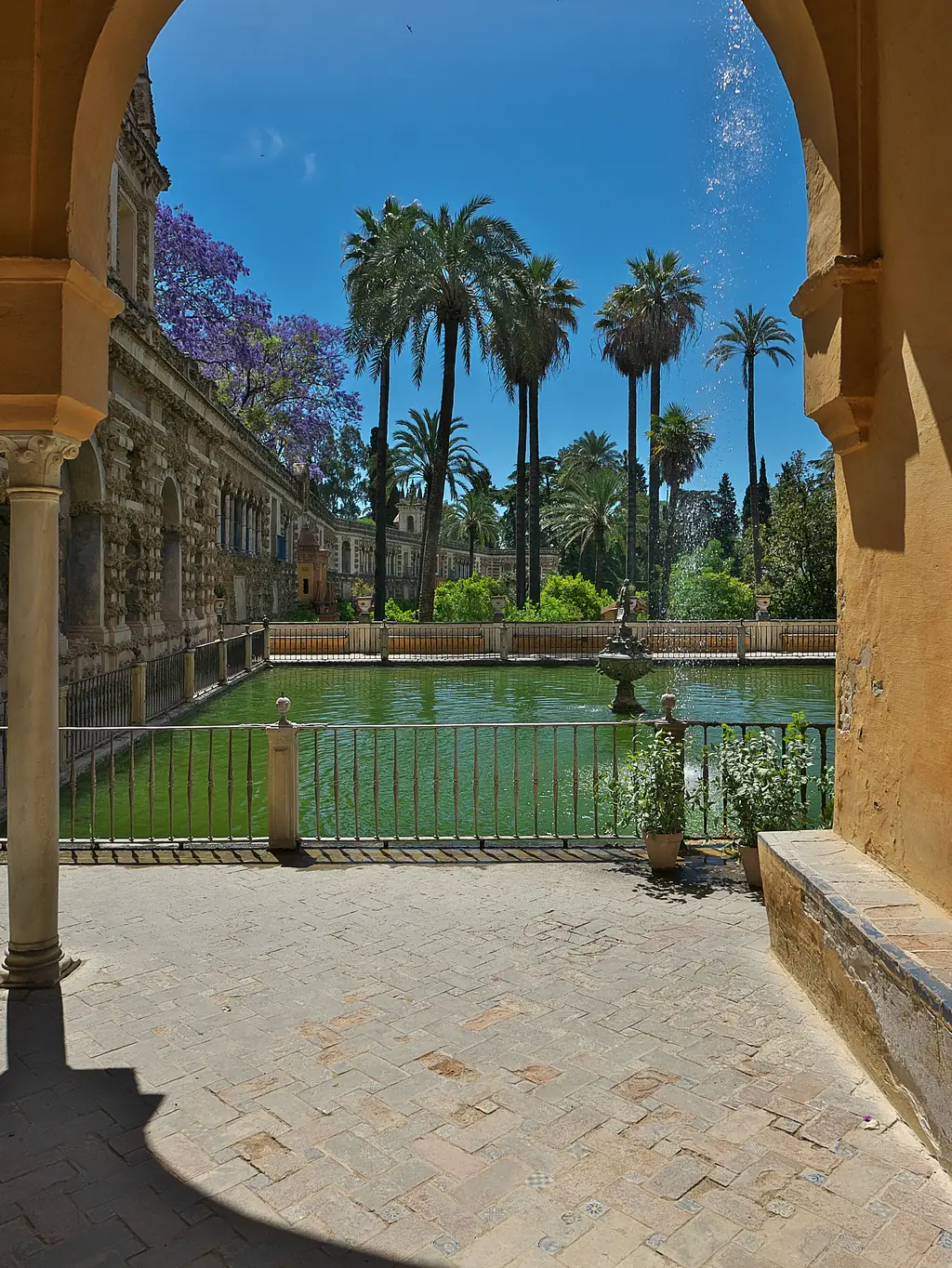
The Galería del Grutesco is built on an old Islamic wall, turned into a gallery with views.
The Mercury Pool has been restored by the Alcázar; see the official site.
Lawrence of Arabia used the Alcázar as a set in 1962.
Kingdom of Heaven (2005) filmed the court of Jerusalem here.
Game of Thrones filmed here for season 5, as the Water Gardens of Dorne.
Visiting today
It is a UNESCO World Heritage Site since 1987, with the Cathedral and the Archive of the Indies.
Children under 13 enter free, and there is a free Monday hour; see free entry.
It opens every day at 09:30, except four days a year: 1 January, 6 January, Good Friday and 25 December.
Want the stories behind the facts?
Most of these facts come alive in the rooms themselves. Start with what to see, or let a guide tell them: the guided tour with priority access (from €56.00, free cancellation).
Frequently asked questions
How old is the Real Alcázar?
Its history begins in 913. The famous Mudéjar palace dates from the 1360s.
Is the Real Alcázar still used by the royal family?
Yes. The upper floor serves as their residence in Seville.
What films were made at the Alcázar?
Among others, Lawrence of Arabia (1962), Kingdom of Heaven (2005) and Game of Thrones (season 5).
Is the Alcázar Moorish?
Its origins are Islamic; its most famous palace was built for a Christian king in Islamic style.
Who was married at the Alcázar?
Emperor Charles V and Isabella of Portugal, in 1526.
Prices per adult, ratings and conditions come from Viator and are refreshed when the site is updated; Viator's page shows today's price. Affiliate links.